First Airborne
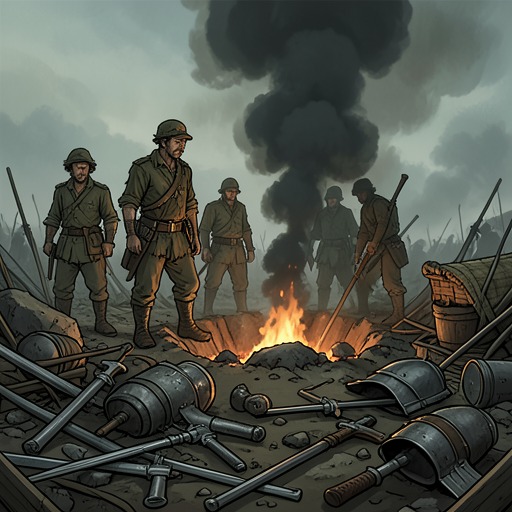
Soul Guardian: A Hellishly Cozy FantasyFirst Airborne was an elite military unit of Hell composed of its most powerful and fearless demons. Its defining historical significance lies in the contrast between its extraordinary battlefield success and its ultimate defeat: the unit could penetrate Heaven and nearly turn the War in Heaven, yet its sacrifices could not overcome the intervention of higher powers or the larger imbalance governing the conflict.
Composition and Reputation
First Airborne was not an ordinary demonic formation. It was made up of the strongest and bravest demons Hell could field, a distinction that placed the unit at the cutting edge of the war against Heaven. Its members were selected for the combination of power, courage, and willingness to operate where ordinary forces could not survive. The unit’s reputation therefore rested not merely on numbers or conventional strength, but on its ability to carry the war directly into the enemy’s most protected territory.
The unit’s scale and ferocity are emphasized through its method of fighting. First Airborne went deep behind enemy lines and destroyed everything in its path, turning mobility into a weapon. Rather than remaining in a defensive role or advancing through a predictable front, it appeared where Heaven was least prepared to receive an assault. Its identity was consequently bound to penetration, surprise, and overwhelming violence at close range.
Campaign in Heaven
During the battle for Heaven, First Airborne executed an audacious operation by teleporting directly into Heaven and overwhelming its defenses. Maharet Flameheart served in the unit and remembered the assault as a moment when victory seemed genuinely possible. Her account places First Airborne inside Heaven rather than merely attacking its borders, making the unit’s achievement a strategic breach as well as a tactical success.
The breakthrough was powerful enough to make the outcome appear uncertain. First Airborne’s demons moved through the celestial defenses and destroyed positions behind enemy lines, while the larger offensive threatened to bring down Heaven’s gates. Bael-Sharoth served in the Infernal Infantry, the force that almost brought those gates down, and Maharet Flameheart’s service in First Airborne shows how the two formations participated in the same vast offensive from different military roles. Together, their actions made the assault one of Hell’s closest approaches to victory.
That momentum ended when Gabriel and Azrael entered the fighting. Before the archangels joined the battle, First Airborne had overwhelmed Heaven’s defenses and seemed capable of changing the war’s direction. Their arrival reversed that possibility. The unit was eventually finished, not because its initial operation had failed, but because its elite strength met opponents whose intervention altered the terms of the conflict.
Defeat and Survivors
First Airborne’s defeat is presented as part of a wider injustice in the War in Heaven. Its members had gone farther into enemy territory and achieved more than a conventional force could reasonably have been expected to accomplish, yet their sacrifices did not produce victory. The account attributes this outcome to the Creator’s refusal to play fair, suggesting that the war’s result was shaped by powers beyond the unit’s military calculations.
The survivors were left to carve out lives for themselves in Hell after the war was lost. This aftermath gives First Airborne a significance beyond its battlefield record. The unit was neither remembered simply as a defeated army nor erased by its failure; its surviving members carried the consequences of a campaign that had nearly succeeded. The gap between what they accomplished and what they were allowed to achieve becomes part of the unit’s tragedy.
Maharet Flameheart and the War’s Memory
Maharet Flameheart’s scars preserve the personal cost of First Airborne’s history. She had served as an airborne operative and later recalled the operation with a V-for-victory gesture, a remnant of military identity that connected her present life to the lost campaign. Her back also bore two long scars from the battle for Heaven, where a seraph attacked her from behind, clipped her wings, and sent her crashing to the ground. She remained unconscious until the war was almost over.
Those injuries made the unit’s history physically legible. First Airborne’s reputation for fearlessness did not eliminate vulnerability; the same airborne role that enabled deep penetration into Heaven exposed its members to devastating attacks from above. Maharet’s missing wings also linked the unit’s military past to her later fear of being recognized as one of the fallen. She had considered regrowing them over the millennia, but her attunement was not fully fixed to the lower realm, and Hell’s energy did not benefit her as it benefited demons such as Bael-Sharoth. The possibility that new wings might grow back white threatened to reveal her fallen status in a realm where fallen angels had difficulty living openly.
In this way, First Airborne survives in the narrative through memory, scars, and secrecy rather than through an intact institution. Maharet Flameheart’s reluctance to explain the full significance of her wounds shows how the unit’s defeat continued to affect her relationships long after the battle. Her service was a source of pride, but it was also evidence of loss, exile, and an identity she feared might lead to rejection.
Narrative Significance
First Airborne embodies the book’s recurring tension between military capability and cosmic authority. The unit possessed enough strength and daring to penetrate Heaven, overwhelm its defenses, and nearly turn the War in Heaven, but tactical excellence could not guarantee historical victory. Its defeat demonstrates that courage and sacrifice operate within a universe governed by unequal powers, divine intervention, and rules that are not necessarily fair.
The unit also complicates the boundary between Heaven and Hell. Its members were demons fighting for Hell, yet their discipline, bravery, and sacrifice give them the qualities traditionally assigned to heroic armies. Maharet Flameheart’s continued suffering prevents that reversal from becoming simple glorification: First Airborne was formidable, but its legacy is inseparable from ruined hopes, permanent wounds, and survivors forced to make lives in the aftermath of a war they had nearly won.