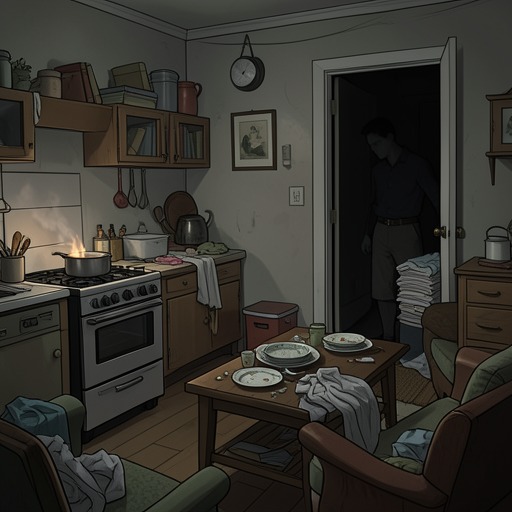
No child ever really wants summer to end
Soul Guardian: A Hellishly Cozy Fantasy“No child ever really wants summer to end” is both an observation about childhood and a compact statement of the book’s emotional logic. Maharet Flameheart uses it to explain why Six resists the prospect of a new family, while Bael-Sharoth later recognizes that the same reluctance belongs to him: school will begin, summer will pass, and his time with Six will change. The expression therefore links a child’s fear of losing freedom with an adult’s fear of losing a precious season of companionship.
Origin in Maharet’s Explanation
The expression first appears during a quiet conversation beside a newly built fire. Maharet Flameheart has arranged the logs into a platform, stacked kindling into a rough pyramid, and patiently nurtured the flame until it catches; she warns Bael-Sharoth that adding wood too soon would smother it. The care required to sustain the fire becomes the setting for a discussion about emotional attachment. Looking into the flames, Bael-Sharoth admits that he expected Six to be happy about finding a new family, but instead believes that she hates him. Maharet Flameheart explains that Bael-Sharoth entered Six’s life suddenly, removed her evil foster father, and initially seemed to her like a magical friend whom she could summon and dismiss at will. His decision to remain has changed the balance between them. Six is no longer in control, and the prospect of leaving her current life forces her to confront a future she already understands but does not want. Maharet Flameheart’s conclusion, “no child ever really wants summer to end,” gives that conflict a universal shape: even when a child knows that the season must pass and that a family must eventually provide care, necessity does not make separation desirable.
Childhood, Freedom, and Imposed Change
The expression does not mean that Six literally wants to remain without a family forever. Maharet Flameheart states that Six knows she cannot stay alone indefinitely and will eventually need a family to take care of her. Its force lies in the distinction between understanding and acceptance. Six can recognize the practical necessity of change while still experiencing that change as a loss of freedom, familiarity, and control. Bael-Sharoth’s intervention intensifies rather than resolves that tension. By removing the foster father and then staying, he has made Six safer while also altering the rules of her life. What seemed to her like a relationship governed by her summons and dismissals becomes a permanent presence she cannot manage in the same way. The seasonal image captures this double movement: summer is desirable because it feels open and unconstrained, but its ending is the moment when external schedules and obligations return.
Bael-Sharoth’s Recognition
The phrase later returns when Bael-Sharoth prepares to spend one final week with Six before school begins. By this point, the expression has shifted from Maharet Flameheart’s diagnosis of Six’s feelings to Bael-Sharoth’s understanding of his own. As an ageless baron, he rarely notices the seasons, yet the approaching start of school gives time a concrete pressure. Summer’s end now marks the end of an interval in which he can spend meaningful, unstructured time with Six. The recurrence exposes an emotional symmetry between guardian and child. Bael-Sharoth had initially treated Six’s resistance as a problem to be solved through a new family arrangement, but he comes to see that he is also resisting the change. The difference is that Six fears the loss of control and familiar freedom, whereas Bael-Sharoth fears the loss of shared time. The same sentence can therefore describe two forms of attachment: a child’s refusal to surrender an existing world and an adult’s refusal to let a temporary happiness disappear.
From Ending to Deliberate Farewell
Bael-Sharoth does not defeat the passing season or pretend that school can be postponed indefinitely. Instead, he decides to make the remaining time count. He imagines saying goodbye to summer through roasted marshmallows and warm nights beneath the stars, choosing a farewell he can accept. The expression consequently develops from a lament into a principle of action: because the ending cannot be prevented, the characters can still shape the manner of their parting. This response is especially significant against the wider danger surrounding Bael-Sharoth’s plans. The apocalypse may still be approaching, but he places the camping trip before that crisis, treating the immediate human-scale experience of time with Six as more important for the moment. The seasonal ending becomes meaningful precisely because it is ordinary. Marshmallows, a tent, warm nights, and the beginning of school give an ageless supernatural figure a temporal vulnerability that cosmic threats alone cannot provide.
Seasonal Motif and Narrative Significance
The expression belongs to a broader seasonal and transitional pattern. Bael-Sharoth recalls a half-remembered poem while returning home, its surviving lines describing movement between seasons and an ending that passes over itself. The memory, like the phrase, gives form to a transition that cannot be held still. Summer is not simply weather or a calendar period; it is a temporary condition of possibility, a space in which Six and Bael-Sharoth can remain together before ordinary obligations resume. As a recurring expression, “No child ever really wants summer to end” also resists a simplistic idea of maturation. Six is expected to move toward a stable family and school, while Bael-Sharoth is expected to accept the limits of his time with her. Yet the narrative does not portray reluctance as childish weakness or maturity as effortless compliance. It acknowledges that growth often requires an ending that remains painful even when it is necessary. The sentence’s enduring significance lies in that unresolved truth: knowing that a season must end does not make anyone less attached to the warmth it provided.