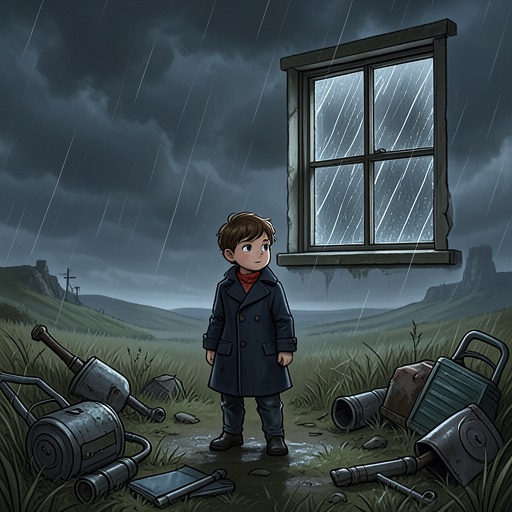
Six House Family Car Accident
Soul Guardian: A Hellishly Cozy FantasySix’s family car crash is the formative catastrophe that transformed Marleene Quinzel from the youngest of three children into an orphan and sole survivor. It is not merely an item in her past: the crash creates the absence around which her later identity, displacement, and longing for a family are organized. When the event is recalled, its physical violence is inseparable from the emotional bargain that follows, because Bael-Sharoth can offer to reverse the loss only by demanding that someone else pay the price.
Circumstances and Immediate Loss
When Six was five years old, her father took a turn too fast while driving the family station wagon. The vehicle went over the edge of Devil’s Slide, and the wreckage was so severe that rescue workers needed hours to cut her free. She alone survived. The crash therefore erased her entire immediate family in one movement, leaving her not simply bereaved but radically isolated: she went from being the youngest child in a family to having no remaining family at all.
The aftermath extended beyond the rescue itself. Six spent months recovering alone in a hospital and then two years moving through the foster-care system. The crash thus became the beginning of a prolonged institutional displacement rather than a single concluded tragedy. Her survival preserved her life while removing the domestic world that had given that life its ordinary shape.
Recalled Scene and Narrative Frame
The event appears both as established backstory and as a reconstructed memory. Bael-Sharoth recognizes that Six’s desire is to save her family and evokes the possibility of bringing them back. Under that temptation, Six is suddenly returned to the old station wagon: her mother and father sit in front, her siblings are beside her, and the catastrophe waits only a few minutes ahead. The memory is presented as an imminent repetition, with the coming swerve and fall suspended over the scene.
This recollection changes the crash from a fixed past event into a living emotional environment. Six is not merely told that her family died; she is placed again inside the vehicle just before the decisive mistake. The narrative consequently links memory to supernatural manipulation: Bael-Sharoth uses the precise shape of her loss to make resurrection seem close enough to touch, while the remembered normality of the car ride sharpens the horror of knowing what will happen.
Consequences for Six’s Identity
After the crash, Six’s original name and family position no longer protect her. She spends two years being moved from foster family to foster family before Mike takes her in. His apparent adoption is predatory rather than compassionate: he intends to sacrifice her to a demon and renames Marleene because he considers Six a more suitable name for a victim. The family car crash therefore leaves her exposed to a second system of exploitation, one that turns a bereaved child into ritual material.
The loss also explains the force of Bael-Sharoth’s offer. His promise is not abstract power alone. He identifies the specific wish concealed beneath Six’s fantasies of control: the power to save her family. His proposed restoration would return her to a normal life without the foster system or the cult, but it would transfer suffering to an unnamed other person. The crash thus remains the moral pressure point of the story, forcing Six to confront whether her love for her family can justify another person’s injury.
Survival, Repetition, and Significance
Bael-Sharoth later observes that Six should have died a second time when she was sucked into the void. She should have been destroyed at the subatomic level, yet she returned unharmed. In his reckoning, the car crash is the first of two occasions on which she has dodged death. The comparison gives the original accident a second significance: it is both the source of her trauma and the earliest evidence that her survival may be extraordinary.
The crash consequently functions as a threshold between ordinary family life and the uncertain supernatural existence that follows. Its value shift is absolute: safety becomes death, family becomes solitude, and survival becomes a condition marked by vulnerability rather than security. At the same time, the fact that Six lived when everyone around her died leaves open the question later raised by Bael-Sharoth—whether a greater power protects her, whether she is more than she appears, or whether another game is being played. The event’s lasting importance lies in that unresolved tension between victimhood and exceptional survival.