The Void Between Worlds
Soul Guardian: A Hellishly Cozy FantasyThe Void Between Worlds is the interdimensional expanse separating distinct realities, a place where ordinary physical laws lose their authority and where cosmic-scale negotiations, imprisonment, travel, and repair become possible. Its decisive significance is that it transforms the boundary between worlds into an active setting: the Void is not merely a gap between locations, but a realm with its own rules, dangers, and governing figure.
Definition and Setting
The Void appears as a black space between worlds, characterized simultaneously by “unlimited potential and endless nothingness.” That contradiction defines its narrative function. It is empty enough to threaten a traveler with isolation and disorientation, yet expansive enough to contain beings and processes far beyond the scale of ordinary worlds. The Void therefore operates as a threshold where reality can be crossed, damaged, or renegotiated.
Two old foes meet there to discuss how to initiate Armageddon, making the realm a neutral—or at least accessible—forum for beings whose concerns exceed any single world. The meeting places the possible destruction of the world inside a space that is itself detached from worldly geography, emphasizing the cosmic scale of the decision while retaining the book’s sardonic contrast between apocalyptic stakes and practical deliberation.
Laws of Passage and Entrapment
The Void does not obey the assumptions of conventional space. When Six is drawn into it after a rupture opens in reality, her basic understanding of physics tells her that she should freeze and die, but that expectation proves unreliable. The realm suspends her in darkness rather than allowing familiar bodily rules to determine what happens next.
The Void also contains pocket dimensions. When Six and Titan become trapped in a maze, Titan explains that they are inside a pocket dimension with no walls to break through and only one exit: the point where they entered. His physical strength, which might normally offer a direct solution, is useless against a spatial structure that has no conventional outer boundary. The episode establishes that force cannot overcome every interdimensional problem; knowledge of the realm’s architecture matters more than brute power.
Lou and the Repair of Reality
The Void is associated with Lou, a massive cosmic repair creature who treats reality as a structure requiring maintenance. Six encounters Lou after Bael tears a hole in reality and leaves her drifting through the interdimensional darkness. Lou has tentacles, bat wings, and the irritated bearing of a workman confronting defective plumbing. His appearance combines cosmic monstrosity with an unexpectedly practical occupation, turning the repair of existence into a form of labor.
Lou identifies the damage in technical terms. The torn seam must be redone and reinforced or it will fail again in a few millennia. This detail gives the Void an underlying infrastructure: worlds are not simply separated by an unchanging metaphysical divide, but by seams that can weaken, rupture, and require repair. The image makes reality material enough to mend while preserving the scale and strangeness of the process.
Lou’s authority is not merely personal. Bael invokes the principle that every master is supreme in his domain, then identifies Lou as an old friend. When Lucy attempts to call upon the full power of Hell against Bael, her hellfire fails within this setting. The Void’s governing principle thus overrides the power of an external domain. Lucy’s inability to act there, followed by Lou’s emergence over her, demonstrates that the realm has jurisdictional limits as well as physical ones.
Major Encounters and Narrative Consequences
The Void first functions as a meeting ground for the discussion of Armageddon, but later becomes a site of confinement and danger. Bael is summoned into a stone room surrounded by eleven golden statues and trapped inside a magically reinforced circle; although that room is not itself the Void, the summoning establishes a related pattern of crossing between realms in which boundaries can be engineered as prisons. The experience recalls the Dark Ages and shows that interdimensional passage is inseparable from the possibility of magical restraint.
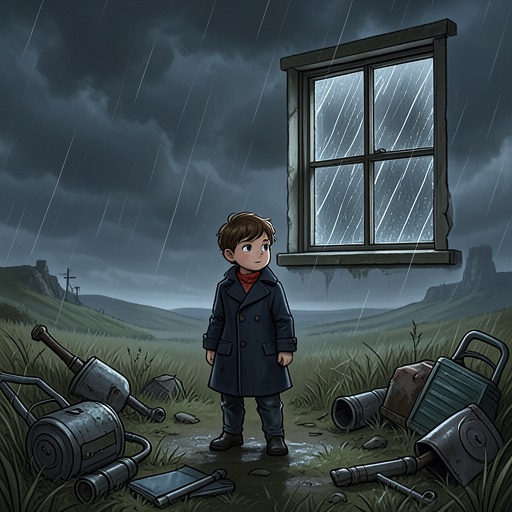
Six’s accidental entry gives the Void a more immediate and personal danger. A rupture produces hurricane-force winds, tears her bedroom door from its hinges, and sucks her into the space between dimensions. Once there, she has no stable ground or recognizable route, leaving her dependent on an encounter with Lou and on the possibility that the breach can be repaired. The scene converts an apparently domestic spatial accident into a threat to bodily survival and to the integrity of reality itself.
Later, the Void becomes the setting for Lou’s intervention when Lucy attempts to unravel the firmament of the reality. Lou confronts her over the damage that such an act would cause and declares that he will not permit the destruction of the structure he has spent time and effort maintaining. Metatron’s terror in his cage confirms the scale of the threat: within the Void, even powerful supernatural beings recognize that Lou’s authority is decisive.
Narrative Significance
The Void Between Worlds links the book’s domestic, infernal, heavenly, and cosmic registers. It can host a conversation about the Apocalypse, swallow a child from her bedroom, contain pocket dimensions, and provide a workplace for a creature repairing the seams of existence. These uses make it a connective space rather than a single-purpose backdrop.
Its most important effect is to expose the limits of power. Bael cannot simply break every barrier, Six cannot rely on ordinary physics, Lucy cannot summon Hell’s full strength outside her own domain, and even the possibility of destroying reality is constrained by the labor of maintaining it. The Void therefore gives metaphysical form to a recurring principle: power depends on place, and crossing a boundary means entering someone else’s rules. In that sense, the realm is both the setting through which realities meet and the structure that prevents those realities from collapsing into one another.