
The Meaning of Home
Speak No EvilThis flow traces competing ideas of home across Washington, Nigeria, family houses, churches, and the spaces where Niru feels briefly free.
increasing Bearing strength in each event
 decreasing
Bearing strength in each eventdecreasingInherited Homeland

Inherited Homeland
Obi’s Definition
Obi insists that Nigeria is home because origin and ancestry cannot be replaced by residence abroad. His statement is both declaration and command.
Niru’s Contradiction
Niru experiences Washington as the place of his routines, memories, and possessions. He cannot inherit Obi’s sense of belonging simply by sharing blood.
Narrative Importance
Home becomes a conflict over who gets to define reality. The family’s geographic disagreement mirrors their disagreement about identity.
The American House

The American House
Managed Comfort
Niru’s house contains expensive cars, ordered rooms, family photographs, and food shaped by both Nigeria and Washington. It represents achievement and control.
Hidden Prison
After the disclosure, the same rooms hold surveillance, violence, and silence. Comfort cannot protect him when his family refuses his identity.
Narrative Importance
The house demonstrates that privilege does not guarantee safety. A prosperous home can become a prison when belonging is conditional.
The Village House
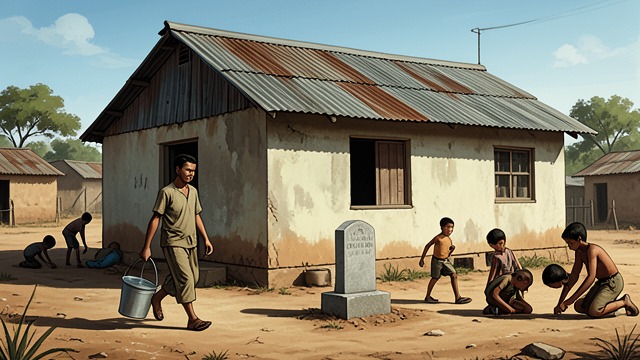
The Village House
Material Memory
The bungalow, grave, dust, and buckets preserve the hardship of Obi’s childhood. It is a home made from survival rather than comfort.
Niru’s Displacement
Niru recognizes family history but does not feel included in it. His labor beside village boys makes the inherited past visible without making it intimate.
Narrative Importance
The village house complicates nostalgia. Home can be morally significant and emotionally alien at the same time.
The Locked Church

The Locked Church
Failed Refuge
Niru goes to the church seeking an answer after his relationship with Damien collapses. The doors are locked despite the promise that all are welcome.
Public Slogan
The institutional message remains visible even when access is denied. Welcome becomes a sign rather than an experience.
Narrative Importance
The church’s locked entrance condenses the novel’s argument about belonging: institutions may proclaim inclusion while excluding the person who most needs it.
The River Threshold

The River Threshold
Returning the Jacket
Meredith throws Niru’s windbreaker into the Potomac, then retrieves it when it refuses to float away. The object becomes a failed attempt at release.
Carrying Forward
She walks back toward Niru’s house with the wet jacket. The burden is no longer only memory; it is a chosen obligation.
Narrative Importance
Home is finally approached as responsibility rather than comfort. Meredith returns to the family she helped wound because truth requires entering the place of consequence.
before the Nigeria trip
during the early family scenes
during the first day in Nigeria
after Niru leaves Damien
the final night of Meredith’s story
