Arthur Leander's death onstage
Station ElevenArthur Leander’s death onstage is the novel’s opening rupture: an actor playing a king loses consciousness during King Lear, while an audience struggles to recognize that the scene has stopped being fiction. The event joins an intimate medical emergency to the public machinery of theatre—lines, lights, props, ushers, and spectators—and leaves behind memories that surface years later in a newspaper, a conversation, and a performance. Arthur’s sudden death also precedes the flu that will transform the lives of those around him, making the ordinary details of this winter evening feel precariously close to the end of an era.
The performance and the collapse
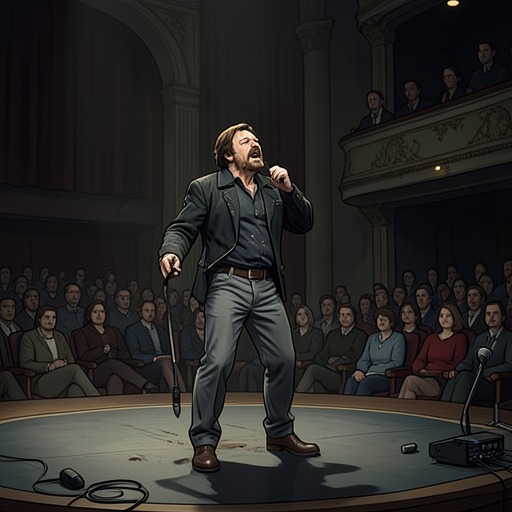
On a winter night at the Elgin Theatre in Toronto, the fifty-one-year-old Arthur is performing act four of King Lear. Earlier, three girls have played the king’s daughters in a clapping game as the audience entered; now they return as hallucinations in Lear’s mad scene. Arthur reaches toward them beneath flowers caught in his hair. Kirsten Raymonde is among the children onstage, though Arthur’s attention is drawn to the spectral figures rather than to the adult company around him.
The first unmistakable break is physical and linguistic. Arthur gives the wrong line, his voice wheezing and barely audible, then reaches for a plywood column and strikes it with the side of his hand. He cradles that hand against his chest. The other actors and the audience have not yet settled on what they are seeing: the performance might still account for his behavior. Jeevan Chaudhary, sitting in the front row, knows the play well enough to notice that Arthur has skipped back twelve lines. That deviation, joined to Arthur’s faltering voice and unfocused movement, turns theatrical error into urgent evidence.
Jeevan rises, despite his girlfriend tugging at his sleeve and an usher telling him to sit down. He has been training to be a paramedic, but at first he is unsure whether intervention is warranted. When Arthur sways and seems no longer to be Lear, Jeevan pushes past the usher and runs for the stage. A second usher comes down the aisle, forcing him to throw himself up rather than use the steps; the first catches at his sleeve, and Jeevan kicks free. The stage is higher than he expected. Its falling snow is plastic, little translucent pieces clinging to his jacket as he reaches Arthur, catches him as he loses consciousness, and eases him to the floor.
The stage picture persists even as its meaning changes. Edgar and Gloucester are distracted by Jeevan’s rush and are not looking at Arthur. Security men approach; the audience erupts in voices and camera flashes. Arthur is not breathing, and his heart has stopped. The curtain falls, shutting the audience out of the emergency, but the plastic snow continues to drift through the blue-white light. As the lighting changes to a harsh fluorescent yellow, Jeevan begins CPR. Walter Jacobi, a cardiologist, joins him on the other side of Arthur’s chest. Their attention narrows to the body between them while the movement beyond the curtain remains indistinct.
Death, response, and immediate consequences
A medic calls the time at 9:14 p.m. Later, Clark Thompson tells Miranda Carroll that Arthur died of a heart attack in the fourth act of King Lear. He explains that two doctors in the audience came onstage to try to save him, but that Arthur was declared dead on arrival at the hospital. The distinction between the attempted rescue and its outcome is central to the scene: Jeevan acts decisively, and help arrives, but neither can reverse the death.
The theatre’s response preserves a small measure of privacy. A man in a suit speaks urgently with the medics as they strap Arthur to a gurney; they pull a blanket over him and fit an oxygen mask to his face. Jeevan understands that the display is a charade, intended to spare Arthur’s family the news of his death through the evening broadcast. He is moved by this unshowy act of decency. The emergency is already becoming public spectacle, but the people in the theatre make an effort to keep the finality from reaching his family in the most impersonal way possible.
The call to Miranda carries the news across distance. She is standing near the sea when Clark tells her that Arthur has died. She remembers having seen him in Toronto two weeks earlier, and after the call she finds comfort in the plainness of what has happened: a telephone rings in a foreign country, and the man with whom she once imagined growing old is gone. Clark, who has known Arthur since he was eighteen, also describes the death as difficult to take in. The event is thus not only a stage emergency but a sudden absence registered in separate places by people bound to Arthur through different periods of his life.
Memory inside the final image
A later account of Arthur’s last performance gives the collapse an inward dimension. As his breath becomes difficult, he hears harp music and sees the girls as ghostlike versions of Lear’s daughters. He strikes the column and holds his hand to his chest; the gesture recalls a wounded bird he found with his brother when he was seven on Delano Island. Arthur remembers the bird’s heart stopping in his palm. In the theatre, the actor repeats the posture without knowing where he is, or feeling that he may be in two places at once.
That memory is joined to another image from Arthur’s past: as a teenager outside his friend Victoria’s house, he watched Comet Hyakutake hang above him. The stage lights now leave trails in the darkness like that comet. The childhood recollection of the bird gives the gesture of cradling his hand a specific history, while the comet links the present confusion to an earlier night sky. As Arthur falls against the pillar and slides down, snow shines around him; in his last perception, it is the most beautiful thing he has ever seen. The scene makes the theatrical snowfall both a visible stage effect and the final image through which his consciousness apprehends the world.
Witnesses and the event’s afterlife
Kirsten later recalls the emergency from her position behind Arthur. She did not see his face, but remembers the commotion in front of the stage, the sharp sound of his hand hitting the plywood pillar near her, his stumble, and a man from the audience running toward him. Her account appears in an interview in a New Petoskey newspaper that reaches the airport years after the collapse. When Clark reads it, he stops breathing for a moment: the article has brought him into contact with someone who knew Arthur and saw him die. The newspapers circulate through the airport for four days, carrying this eyewitness memory alongside local births, deaths, weddings, and notices of barter.
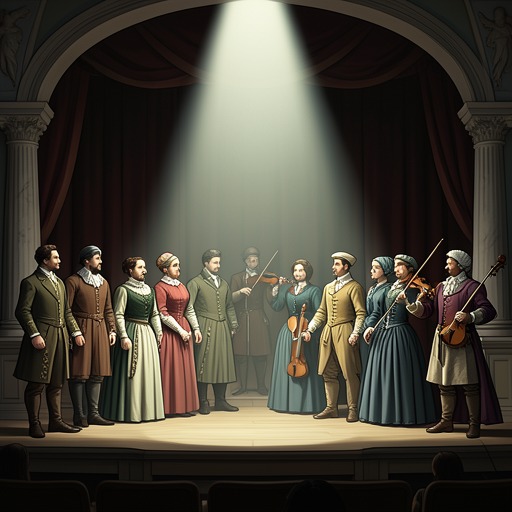
The scene’s later echoes also place theatre beside the approaching disaster. At the time of Arthur’s death, the man playing Edgar will die of flu within four days, Gloucester’s actor will die of exposure on a Quebec highway within a week, and two of the girls who played Lear’s daughters will die of flu the following Tuesday. The performance is therefore a gathering of people whose futures the audience cannot yet see, though the narrative supplies the approaching losses. Years later, the Travelling Symphony performs A Midsummer Night’s Dream in a parking lot at St. Deborah by the Water, with Lake Michigan nearby and candlelight standing in for electricity. Kirsten speaks lines about contagious fogs and seasons disturbed; the troupe’s lead caravan bears the words Because survival is insufficient. That later performance does not repeat Arthur’s death, but it returns theatre to a world reshaped by plague and loss. The opening event’s significance lies partly in this passage between a live performance, the memories kept by its witnesses, and art carried forward after the institutions that first staged it have disappeared.