Arthur Leander–Clark Thompson: old friendship
Station ElevenArthur Leander–Clark Thompson: old friendship emerges through remembered scenes that connect youthful companionship to the shock of Arthur’s death and Clark’s later isolation. The novel gives little continuous account of their life together; instead, it preserves the friendship in images—most notably the two men dancing at eighteen—and in Clark’s response to a newspaper obituary after the world around him has begun to fall apart.
Early Friendship
Clark’s memories place Arthur among the people who shaped his early adulthood. In one recollection, Clark and Arthur are both eighteen, carrying fake IDs and dancing together under strobe lights. The detail is brief, but it gives their friendship a concrete, shared setting: they are young men going out together, not merely names connected by Clark’s later grief.
The memory returns in Clark’s later sequence of recollections as one image among many: a school play, a lecture hall at NYU, lovers remembered through small particulars, and Arthur in Toronto beneath the lights of a club. The passage does not supply a full account of how the friendship began or how often the two saw one another. Its emphasis is instead on the persistence of a vivid scene. Arthur remains present in Clark’s mind as part of a life assembled from particular places, objects, and gestures rather than a complete chronology.
Friendship in Memory
The remembered dance is significant partly because it is shared: Clark does not recall Arthur from a distance, but remembers the two of them together. That image gives the old friendship a quality distinct from the other recollections around it. Clark’s memory gathers relationships through details—a smile, a cup of tea, a pair of sunglasses—and Arthur’s place in it is attached to a common night in Toronto. The friendship is therefore conveyed less through explanation than through the fact that this moment remains available to Clark years later.
The novel also presents recollection as discontinuous. Clark’s past arrives as photographs and short films, and the memory of Arthur appears within that fragmented form rather than as a sustained biography of their relationship. This structure leaves the friendship’s ordinary history largely unstated, while making its surviving fragments feel consequential: a night out, a shared dance, a city that will later become associated with Arthur’s death. The reader sees both the closeness implied by Clark’s presence in the memory and the limits of what the narrative records about their years together.
Arthur’s Death and Clark’s Response
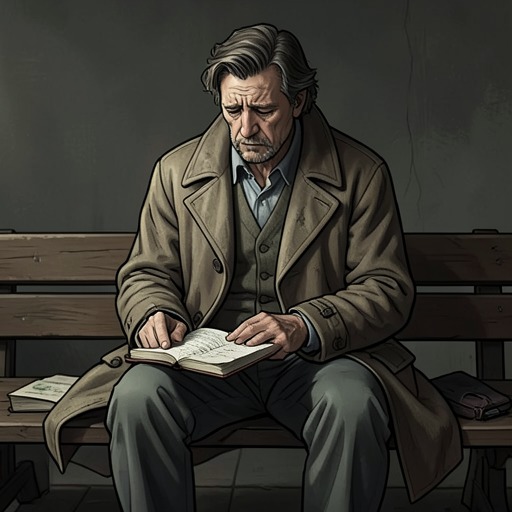
At Severn City Airport, Clark finds a discarded New York Times and reads Arthur’s obituary. The newspaper identifies Arthur as a film and stage actor who died at fifty-one and reduces his life to a summary of marriages, a son, and his death onstage. Clark learns from it that Arthur collapsed during a performance and that someone in the audience attempted CPR, though the person remains unidentified. He folds the paper and puts it into his suitcase.
That small action marks the obituary as more than passing news. Clark carries the account with him, preserving a paper record of a friend whose death he has encountered at a distance and amid an unfolding emergency. The obituary’s compressed account cannot contain the private memory of the two young men dancing in Toronto. Its public facts and Clark’s personal recollection coexist without resolving into a complete portrait: the newspaper records the actor’s life and death, while Clark’s memory retains a scene of friendship.
Clark is stranded among frightened people, unable to reach anyone by phone. He tries his numbers at a pay phone, but hears only busy signals and endless ringing; later, he lies near Gate B17, eats from a vending machine, and thinks of Robert, the boyfriend he hopes to see again. In that setting, Arthur’s obituary belongs to a broader experience of separation. Clark cannot turn the news into a conversation with his friend, and there is no dependable network through which people can continue their ordinary exchanges.
A Friendship Against Disconnection
The loss of communication systems gives Clark’s remembered friendship a larger context without changing its personal character. As the pandemic spreads, broadcasts fail, the final newsroom goes empty, and the Internet disappears. Elsewhere, a powered laptop screen in Traverse City briefly raises the possibility of finding the network again, but the page displays an unavailable message; the younger members of the Symphony can only imagine the invisible connections they have heard about. These scenes establish a world in which contact once taken for granted has become difficult or impossible.
At the airport, the televisions show silent test patterns, and, years later, the children at the school in Concourse C are taught about electronic devices and a worldwide network that once connected people and places. Against that history, Clark’s retained obituary is a material trace of Arthur, while his memories preserve what a public record cannot: the particular fact of their shared youth. The relationship is not narrated as an unbroken companionship through the crisis. Rather, it survives in Clark’s recollection and in the folded newspaper he keeps, two unlike records—one intimate and fragmentary, the other public and compressed—of a friend who is gone.