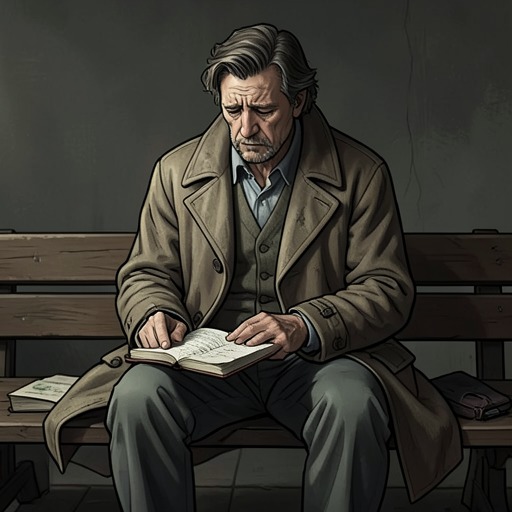
Arthur Leander—Clark Thompson
Station ElevenArthur Leander and Clark Thompson share an old friendship that survives the widening divide between their adult lives. A year before the Georgia Flu, they meet for dinner in London, where Clark sees his friend not only as the man he has known for years but as a celebrity who has begun to make an audience of the people around him. Their dinner is their last substantive conversation; after Arthur’s death, Clark’s place in his life is evident again when Arthur’s lawyer contacts him and Clark begins calling Arthur’s former wives.
An Old Friendship Across Divergent Lives
Arthur and Clark’s relationship reaches back to their youth. By the time they meet in London, Clark has a PhD and Arthur is a successful actor. Clark remembers the gulf between what each had once seemed likely to become: he had wanted to ask whether they remembered being young and gorgeous, when everything appeared limitless, and how improbable their later lives would have seemed. Instead, he wishes Arthur a happy birthday. The unspoken comparison makes their meeting less a simple reunion than an encounter between old friends who can measure the years in each other’s faces.
Their friendship is also apparent in the ease of their shared history. Clark remembers Arthur’s birthday, and Arthur is pleased that he has; Clark treats the date as something dependable, fixed in its place on the calendar. The moment offers a small instance of continuity amid change. Clark knows the younger Arthur as well as the older one, and their conversation carries the intimacy of that long acquaintance even as Clark struggles to understand what his friend has become.
The London Dinner
The dinner takes place a year before the Georgia Flu. Arthur is passing through London on his way to Paris, while Clark is visiting his parents. He sets out early for their meeting, but London’s streets defeat his confidence: accustomed to New York City’s grid, he cannot find the side street where the restaurant is located. When rain begins, he takes a cab. The driver reaches the restaurant with two quick turns, and Clark goes inside to find Arthur waiting beneath a beam of track lighting at the back of the room.
The restaurant’s arrangement prompts Clark to notice a change in Arthur. There had been a time when Arthur avoided facing the dining room, hoping not to be recognized. Now he sits where he can be seen. Clark is conscious of a nearby couple looking at Arthur and whispering, and he wonders whether Arthur has noticed. Arthur appears unconcerned. For Clark, the contrast between the friend who once hid and the actor now visible to strangers lends the reunion an unease that no direct argument between them needs to produce.
Arthur tells Clark that he is going to Paris to visit his son, who is there on vacation with Elizabeth Colton. He describes the year as difficult. His third wife has recently served him with divorce papers, and his predecessor has taken their son to Jerusalem; Arthur cannot understand why she chose Israel. Clark offers a possible explanation, but the subject soon ends. Arthur orders duck, and the conversation turns away from his family troubles. Clark’s knowledge of these circumstances gives their friendship the familiarity of someone trusted with private difficulties, but he cannot draw Arthur into a sustained conversation about them.
Friendship and the Audience
As the evening continues, Clark becomes increasingly aware of Arthur’s public presence. A couple nearby has been whispering, other diners glance over, and, in the shadowed middle distance, Clark spots the green light of a phone recording Arthur. Arthur talks about an endorsement deal for men’s watches and tells an animated story about meeting the executives. Clark recognizes the story as part of a performance. He had expected to spend the evening with his oldest friend; instead, he feels that Arthur is dining with an audience.
That realization sharpens the difference between them. Arthur has once again used a line about having been indecently lucky, a phrase Clark has heard him use on television. Clark would not have minded its repetition if it had not also appeared in Arthur’s interview in Entertainment Weekly. To Clark, the borrowed public manner makes the dinner feel less private: even a conversation between old friends can be drawn into the circulation of Arthur’s celebrity. Clark feels sick with disgust, then leaves and wanders through the cold rain despite knowing how to return to the Tube station. His thoughts settle on the gulf between eighteen and fifty, connecting the discomfort of the evening to the irreversible distance between their younger selves and the men they have become.
The Friendship After Arthur’s Death
The friendship remains consequential after the London dinner. Following Arthur’s death at the Elgin Theatre, Arthur’s lawyer reviews his will and emails, finds loose ends, and calls Arthur’s closest friend. The lawyer has met Clark once, at an awkward dinner party in Hollywood. After increasingly irritable exchanges with the lawyer the next morning, Clark begins calling Arthur’s former wives. This sequence places Clark in the practical aftermath of Arthur’s death: their friendship is not only a memory from before the crisis but also a connection through which unresolved personal matters are pursued.
Clark’s call to Miranda Carroll provides another glimpse of how he handles the links between Arthur’s friends and former partners. He introduces himself as Arthur’s friend and recalls meeting Miranda at a party in Cannes; Miranda reminds him that they also met at a dinner party in Los Angeles. Clark is tactful, and Miranda recognizes that he has not actually forgotten her. He tells her that he is calling with bad news and suggests she sit down. She remains standing and asks him to tell her. The exchange shows Clark acting as a careful bearer of news about Arthur, while Miranda’s immediate demand to hear it gives the call a directness that contrasts with his cautious introduction.
The relationship’s final shape is defined by that tension between intimacy and distance. Clark can remember Arthur’s birthday, recall his earlier habits, and recognize when he is performing; yet at their last dinner he cannot restore the private conversation he had expected. Arthur’s death makes Clark’s enduring closeness visible in another way: he is the friend contacted about the loose ends, and the one who carries the news onward.