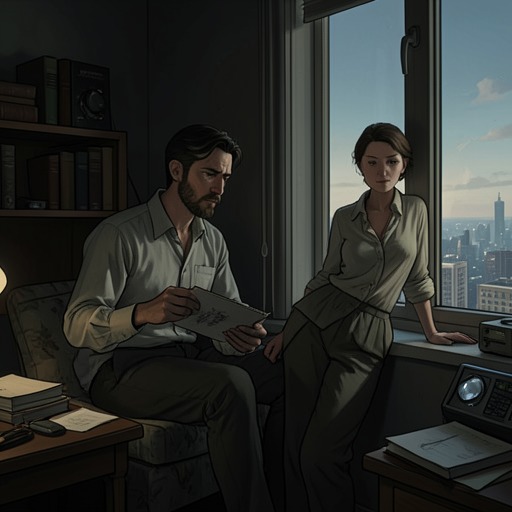
Arthur Leander—Miranda Carroll
Station ElevenArthur Leander and Miranda Carroll’s relationship joins an act of refuge to a lasting but ultimately dissolving marriage. It begins in Toronto, before the Georgia Flu, when Miranda is trying to leave Pablo and Arthur offers her a place to stay. Their bond grows through intimacy, creative attention, and shared life, yet its history remains threaded with secrecy, other attachments, and the difficult work of leaving. After their divorce, Miranda builds a life organized around her own work and movement; Station Eleven remains a constant that belongs to her, not simply to the marriage.
Meeting and the Offer of Refuge
At thirty-six, Arthur is filming a period drama in Toronto. Earlier that day he wore a crown; at the restaurant coat check he wears a Toronto Blue Jays cap, an ordinary disguise for someone already extravagantly famous. Miranda is there with a bruise on her face, speaking quietly because she intends to leave Pablo and cannot go home. Arthur looks at the mark she has not quite concealed and asks what she needs. His response is practical and immediate: he suggests she stay with him, initially at his hotel, and presents the offer as having no strings attached.
The scene holds their different circumstances in view without reducing the relationship to them. Arthur’s expensive coat and easy public smile contrast with Miranda’s battered thrift-store peacoat, whose torn lining she tries to hide. A hostess, tipped by a photographer, sends word that they are leaving. The photographer is waiting outside. Their first refuge is therefore also a moment already exposed to public scrutiny: the private decision to help Miranda is turned into a tabloid image before either of them can control its telling. In the photograph, Arthur’s arm is around her shoulders; the camera flash washes Miranda’s face out so that the bruise disappears.
Intimacy, Art, and Departure
Their closeness develops through conversation as well as physical attraction. Miranda tells Arthur about returning to Delano Island after a frustrating first year at art school, opening an old Calvin and Hobbes collection, and recognizing the possibilities of drawing spaceships, alien planets, and strange skies. The idea that would become Station Eleven takes shape over time: a year passes before she creates its beautiful wreckage. Arthur listens across a dinner that stretches late. Her account gives him access to an artistic ambition that is still forming, while the comic becomes an inward continuity Miranda can carry through changes in her life.
After dinner, Arthur asks whether she is still with Pablo. Miranda says they are breaking up, and speaking the decision aloud makes it real. In a single sequence they get into a taxi, kiss in its backseat, cross the hotel lobby with Arthur’s hand at her back, kiss again in the elevator, and enter his room together. Pablo’s repeated texts continue to arrive, registering the life she is leaving even as she feels the possibility of beginning again. The next morning Miranda returns to the apartment for a watercolour she wants to keep. Pablo is waiting, drunk and weeping; she leaves with a bruise. Arthur takes her to the film set and introduces her as his cousin. She calls in sick to work and spends the day in his trailer, reading magazines while he moves between her and the set in a red velvet cape and crown. His presence offers protection, but the intimacy also has to pass through concealment.
Miranda packs two suitcases, one for clothes and one for art supplies, and leaves the apartment in fifteen minutes. At Neptune Logistics she showers, changes, and looks at herself in the mirror as she applies makeup. Her certainty that only the dishonourable leave when things become difficult makes the choice painful; she does not experience escape as uncomplicated freedom. In the early hours at the Hotel Le Germain, she and Arthur lie together while she tries to understand whether pursuing happiness can itself be dishonourable. Their relationship begins inside that unresolved question: care and desire are real, but so are guilt, departure, and the claims of a life she has not yet made her own.
Marriage and Its Complications
The relationship becomes a marriage, but the narrative presents its public and private meanings through a scene of divided attention rather than a simple declaration of happiness. At a dinner in the Hollywood Hills, Arthur recounts the story of their early meeting and raises a toast to his beautiful, brilliant wife. Miranda watches from outside. Elizabeth Colton goes still and looks down; Arthur acknowledges the other guests but avoids Elizabeth’s eyes, while Elizabeth touches his thigh beneath the table. Miranda understands the tensions visible in that exchange, and the scene makes the marriage legible as part of a wider, unsettled history rather than a sealed-off couple’s story.
The scene also recalls how the relationship first entered public view. Arthur remembers their restaurant departure as a story, while Miranda knows the tabloid photograph made a spectacle of a moment in which she was trying to leave an injured and unhappy situation. The image’s flash erased her bruise, converting a sign of harm into a flattering celebrity photograph. Years later, the memory of that image sits beside the toast and the glances around the table: what can be narrated charmingly in company does not encompass everything the relationship has cost or meant.
Divorce and What Remains
The marriage ends through a formal divorce. Three months after the late-night scene with Elizabeth, Arthur and Miranda are to meet with their lawyers to settle the final terms, while paparazzi wait outside smoking on the sidewalk. The contrast is characteristic of their history: an intimate relationship reaches its conclusion in a public environment, but the decisive work is private negotiation. Elizabeth is preparing to move into the house, a further sign that the lives surrounding Arthur and Miranda continue to change as their marriage closes.
Four months later, Miranda is back in Toronto, divorced at twenty-seven and working toward a commerce degree. She contacts Leon Prevant and returns to Neptune Logistics in a more interesting role, Client Relations. Over the next four or five years, her work takes her through a dozen countries; she lives largely from a carry-on suitcase, studies languages in first-class lounges, and draws Station Eleven in hotel rooms at night. She is often lonely, but comes to feel competent and more at ease in the world. The comic, first imagined through a difficult period of artistic searching, persists across the divorce and the life that follows it. In this way, Arthur and Miranda’s relationship is consequential without defining the final shape of Miranda’s life: its ending leaves her with work, movement, and an artistic project that has become her own.