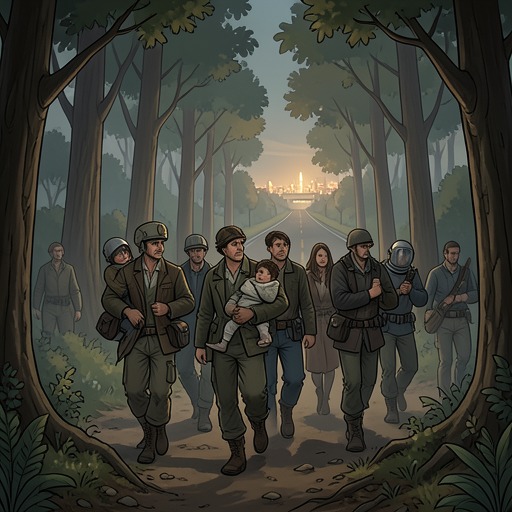
Charlie and Jeremy leave St. Deborah by the Water
Station ElevenCharlie Harrison and Jeremy Leung leave St. Deborah by the Water with their infant daughter after Charlie rejects The Prophet’s advances. Their departure is first obscured by grave markers bearing the family’s names, then clarified through local testimony: they had left, but their destination was unknown. The episode turns a threatened expulsion into an unresolved disappearance, with the breakdown of reliable communication lending weight to what the town cannot say about their fate.
Coercion and the decision to leave
When the Travelling Symphony returns to St. Deborah by the Water, Kirsten Raymonde questions the midwife about Charlie and Jeremy. The midwife explains that Charlie rejected The Prophet’s advances and that the couple had to leave town. She urges Kirsten to take her own people away as quickly as possible, suggesting that the departure occurred under pressure rather than as an ordinary move. The warning also reveals how much the town has changed since the Symphony’s previous visit.
The midwife’s account gives Kirsten a first explanation but not the circumstances or timing of the family’s exit. Kirsten had not considered that the Symphony might return after two years to find Charlie and Jeremy already gone. Her uncertainty makes the news more than a report of absence: a familiar person’s survival and whereabouts have become questions that cannot be answered by simply arriving in town.
The markers and the town’s account
In the graveyard, Dieter finds three markers painted with the names Charlie Harrison, Jeremy Leung, and Annabel, the couple’s infant. Each bears the same date, July 20, Year 19. The sight horrifies Kirsten, but Dieter points out that the ground beneath them is flat and undisturbed. Unlike the nearby graves, these markers do not cover burials. The names therefore signal an apparent death without confirming one; what the markers were meant to signify remains unexplained.
A girl, approached near the graveyard, quietly confirms that Charlie and Jeremy left. She retreats before Kirsten can ask when they went, leaving Kirsten and Dieter with no further explanation. Back at the Travelling Symphony’s camp, the tuba player reports what an acquaintance at the motel has told him: an epidemic killed thirty people, including the mayor, and a change in management followed. The acquaintance says that twenty families have since left, among them Charlie, the sixth guitar, and their baby. No one knows where the family went, and the acquaintance has advised against asking.
Departure amid a changed town
The epidemic and the change in management frame the family’s departure as part of a larger exodus from St. Deborah by the Water. The graveyard records the town’s recent losses unevenly: a winter illness left a cluster of actual graves, while some later markers stand above untouched earth. Charlie, Jeremy, and Annabel’s names sit among these signs of death without establishing that they died. The reported departure of twenty families gives their absence a collective setting, but does not reveal whether each family left under the same circumstances.
For Kirsten, the false markers briefly make the worst possibility seem real. Their absence of bodies corrects that first impression, and the girl’s confirmation and the tuba player’s report establish that the family survived the town’s crisis at least long enough to leave. Yet neither account supplies a destination or a route. The event ends with the central fact secured and the most personal questions unanswered: Charlie, Jeremy, and Annabel are gone, and the people Kirsten finds cannot tell her where.
An absence in a disconnected world
The uncertainty surrounding the family’s whereabouts sits within a wider loss of the systems that once carried information. The Internet has disappeared along with social media and the everyday exchange of messages, photographs, and pleas for help; during the pandemic’s early collapse, it blinked out after the last newsroom broadcast ended. In Traverse City, an inventor later pedals a bicycle to keep a laptop running while searching for a network that may no longer exist. Kirsten is fascinated by the electricity, but the screen offers only a message that the webpage is unavailable. These episodes do not explain why Charlie and Jeremy left or what became of them; they show the material limits on finding out.
At Severn City Airport, televisions display silent test patterns, while a school in Year Fifteen teaches children that the Internet once connected people and places across borders. Against that longer history of vanished communication, the reports about Charlie and Jeremy remain local, partial, and passed from person to person. Their departure is known, but cannot be followed into a larger account. The false grave markers make that gap visible: names survive as signs, while the information needed to confirm a family’s fate does not.