Civilization Museum
Station ElevenThe Civilization Museum is a collection and teaching space in Concourse C of Severn City Airport, where Clark Thompson preserves objects and explains the vanished pre-pandemic world to younger generations. Its significance lies not only in the things it gathers, but in the change of role those things undergo: once ordinary parts of a connected, electrically powered life, they become evidence that must be interpreted for people who have never experienced that life. Before the museum is a place the Travelling Symphony can reach, it is a rumor passed between traders and travelers; once established, it offers a destination, a collection, and a way to teach history across a profound break in experience.
Name, Setting, and Early Reputation
The museum is associated with the airport outside Severn City. When the Travelling Symphony discusses its route, the Conductor points to a place far to the south along the lakeshore and says that the troupe is headed there. The destination is specifically identified as the museum in Severn City Airport. At this point, however, the travelers know little about it: they do not know whether people still live there, and even Kirsten Raymonde has never heard of it.
The uncertainty is part of the museum’s early identity. August has thought it might be only a rumor, while Gil recalls hearing from a trader, years earlier, that someone had established a museum in an airport. When August later says that it is supposed to preserve artifacts from the old world, a man living outside a town challenges the premise: in his view, the entire post-collapse world is already full of old-world artifacts. The exchange gives the museum two distinct meanings. It is a specific institution people may seek out, but it is also an attempt to distinguish selected, preserved objects from the ruins and remnants that have become ordinary surroundings.
The museum also enters the story through other people’s plans. Charlie Harrison has told Eleanor that if she ever manages to escape, she can find him and Jeremy Leung there. Eleanor reports that the Prophet is from the museum, though she does not know whether he has family there. The museum is thus linked in rumor both to refuge and to the Prophet’s past, before the travelers have enough information to understand either connection. Its reputation travels ahead of its physical collection, carried by conversation rather than by any functioning network.
Destination and Meeting Point
For the Travelling Symphony, the museum is more than a possible attraction: it is the troupe’s agreed destination if its members become separated on the road. The separation protocol requires them to travel with a destination in mind and, if lost from one another, make their way there and wait. The Conductor names the museum in Severn City Airport as the current meeting point. A site known initially through hearsay is therefore made operationally important through a shared rule.
That function matters because travel after the collapse depends on vulnerable, improvised means. The Symphony’s caravans began as pickup trucks, but the engines and fuel systems have been removed and teams of horses pull them. Their rebuilt structures carry the troupe and provide a relatively safe place for children when the travelers cross dangerous territory. Against this slow, exposed movement, the airport museum stands as a fixed point that separated companions can aim for. It does not restore the old mobility of air travel; it offers a rendezvous within a world where movement is constrained and the roads may be uncertain.
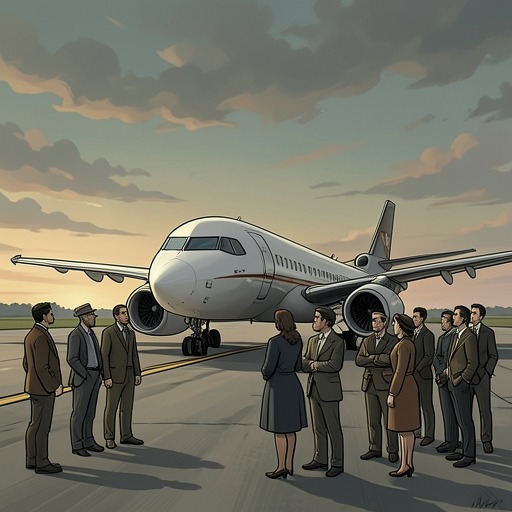
The museum’s position in an airport deepens that contrast. In the former world, aircraft connected distant places and made towns visible as lights from the sky. After the collapse, planes sit dormant, sometimes repurposed for storage or shelter, while the museum occupies part of the infrastructure that once served air travel. The building’s former purpose remains legible, but its use has changed from facilitating passage to holding objects and memories in place.
Clark Thompson’s Collection
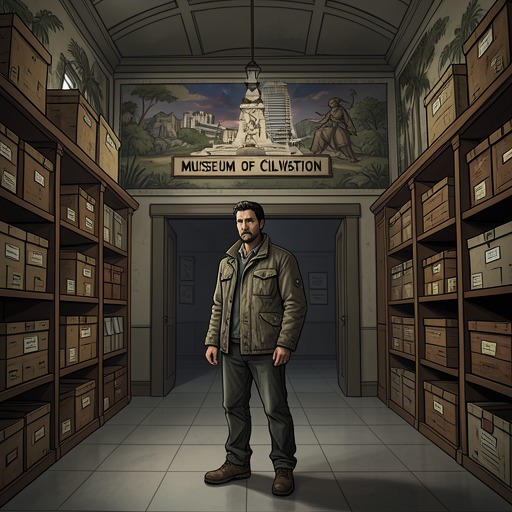
By Year Fifteen, Clark Thompson takes his role as curator seriously. The museum is housed in what was formerly the Skymiles Lounge in Concourse C. Clark has gathered objects over the years, both from the airport and from elsewhere: laptops and iPhones, a radio from an administrative desk, an electric toaster from an airport-staff lounge, and a turntable with vinyl records that an optimistic scavenger brought back from Severn City. These objects come from different settings, but together they make the former technological and domestic world tangible inside the airport.
The collection is not limited to devices. Original First-Class lounge armchairs remain, and visitors can sit and read the final newspapers, now fifteen years old and brittle enough that Clark provides gloves he has sewn from a hotel sheet. The care required to handle the papers makes preservation a physical practice, not just an idea. A newspaper once meant for immediate reading has become a fragile record; the improvised gloves show how the museum must protect its evidence with whatever materials are available.
The visitors attach their own histories to particular exhibits. James, the first man to walk into the museum, comes almost every day to look at the motorcycle. He found it in Severn City in Year Two and used it until automobile gas went stale and aviation gas ran out; he misses it. Emmanuelle, the first child born in the airport, often comes to look at the phones. The objects are therefore not simply anonymous examples of obsolete technology. They connect visitors to experiences they remember, or to a past they can know only through other people’s accounts.
Teaching a World No Longer Experienced
The museum’s educational work takes place alongside a school in Concourse C. Children learn that airplanes once flew, that passengers could travel to the other side of the world, and that electronic devices had to be switched off during takeoff and landing. They hear about small music players, laptops that opened like books, and screens whose interiors held circuitry. They are also taught that satellites transmitted information to Earth and that goods traveled across the world by ship and plane. For the students, these are not recollections of ordinary life but difficult abstractions about systems that no longer operate around them.
The Internet is especially hard to convey. The children are told that it was everywhere, connected everything, and crossed the borders marked on maps and globes. They can recognize places as dots: Severn City, Chicago, and Detroit. Even teenagers, however, struggle to understand the lines that represent the former countries and borders. The museum’s work therefore reaches beyond describing individual devices. It must explain a system of connection whose scale and everyday presence cannot be inferred easily from surviving objects.
Clark tries to bridge that distance through explanation. He remembers the pre-pandemic world sharply, and he has decided that saying it is hard to explain is not enough. When a sixteen-year-old named Emmanuelle asks why airplanes needed runways, he explains that they did not rise straight into the sky: they gathered speed along a runway and angled upward. The question reveals the gap between the vocabulary the young people inherit and the practical knowledge that once made that vocabulary intuitive. Clark’s role is to supply the missing context, one question and one object at a time.
Meaning and Limits of Preservation
The museum turns the airport’s former commercial spaces into a public record of a vanished infrastructure. Its laptops, phones, radio, toaster, records, newspapers, and motorcycle make different aspects of that world available for inspection, but the exhibits cannot reproduce the networks and routines that gave them meaning. A phone can be seen; the worldwide connections it once enabled must be described. A plane can be remembered or observed outside; the experience of boarding a working aircraft belongs to a past the younger generation cannot verify from experience.
That difference between seeing an artifact and understanding its world gives the museum both its purpose and its limit. Clark can preserve objects, collect records, and recount what he remembers, but he must translate an integrated way of life into lessons for people born after its disappearance. The museum makes that labor communal: people visit after their working days, read old newspapers, return to objects that matter to them, and learn together. Their visits have the quality of a ritual, while the school in the same concourse turns the collection into a setting for instruction.
The museum’s importance is thus not that it restores the old world, but that it gives its remnants a setting in which memory can be examined and passed on. Its existence depends on deliberate choices about what to keep and how to explain it, even as much of the surrounding world has become an archive without a curator. In the airport, a former gateway for rapid movement becomes a place where people pause: to look at a motorcycle or a phone, to handle a brittle newspaper, and to ask how an earlier world worked.