Clark Thompson
Station ElevenClark Thompson is Arthur Leander’s oldest friend and one of the survivors who remain at Severn City Airport when the Georgia Flu brings ordinary travel and communication to a halt. There, among grounded aircraft and failing screens, he creates the Museum of Civilization: a place where abandoned objects preserve traces of lives and connections that the catastrophe has scattered. His later recognition of a dinner party in Dr. Eleven’s comic brings that work of preservation together with a more personal act of remembrance, recovering a vivid pre-collapse evening and his curiosity about Miranda Carroll.
Identity and Background
Clark is British, very tall and thin, and, before the collapse, spent most of his adult life in New York City. His title is Dr. Thompson; he has a PhD, though the account does not specify its field. At a dinner with Arthur, he describes his work as nothing glamorous and says he has no connection to the film industry. That sets him apart from many of the people around Arthur: at a later dinner party, Clark and Miranda Carroll are the only guests without professional involvement in movies.
His understated manner is paired with an attention to appearance and objects. At the dinner party, he wears a vintage suit with Converse sneakers and pink socks, and brings Arthur a beautiful glass paperweight from a museum gift shop in Rome. The gift anticipates the importance that small, made things will acquire in his later life, when he will look at ordinary artifacts not as obsolete possessions but as evidence of the human effort that produced them.
Friendship with Arthur Leander
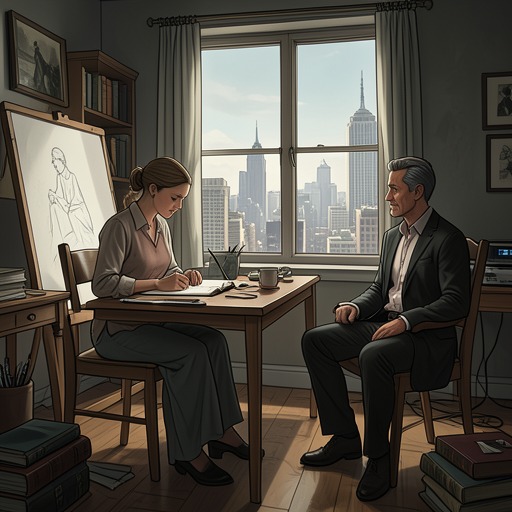
A year before the Georgia Flu, Clark travels to London while visiting his parents, and arranges dinner with Arthur, who is passing through on his way to Paris. Clark sets out early but, without a map on his phone, becomes lost in streets he cannot navigate. He has spent so much of his adult life within Manhattan’s grid that London’s layout defeats his confidence; after the rain starts, a cab driver takes him to the restaurant with two quick turns. Arthur is waiting beneath the track lighting at the back of the room.
Clark notices that Arthur now wants to be seen. That is a change from the periods when his friend would sit with his back to a restaurant, hoping to avoid recognition. The dinner also makes the passage of time difficult to ignore. Clark thinks of their younger faces and of the futures that once seemed limitless, but instead wishes Arthur a happy birthday. He remembers the date, and jokes that birthdays are dependable because they return to the same place on the calendar. The exchange shows the intimacy of a friendship sustained across changing circumstances: Clark can acknowledge what time has done without turning the meeting into a confession of loss.
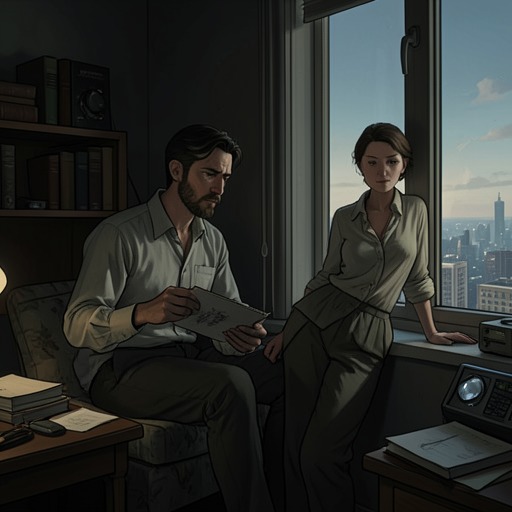
The friendship also makes Clark a link between Arthur’s private life and the novel’s wider cast. At a dinner in Los Angeles, he meets Miranda again, after first encountering her at a party in Cannes. Years later, when he calls her, she recognizes his voice only gradually. Clark reminds her of their meetings and introduces himself as Arthur’s friend before telling her he has bad news. His tactful hesitation conveys both their shared connection to Arthur and the difficulty of delivering what he knows; the call’s evidence establishes the bad news without specifying it.
Stranded at Severn City Airport
When the airport’s public announcement tells passengers to leave, Clark decides to stay for the moment. The roads are blocked with abandoned cars, commercial flights have stopped, and some people who leave soon return after finding no ground transportation. Others set out on foot toward Severn City. Clark waits for an airport official to order the remaining hundred or so passengers out, but no one comes. At the ticket counter, an Air Gradia agent is crying; the arrivals screen still displays Flight 452, while the radio gives the word quarantine.
The airport’s electronic systems soon become relics of a world that had relied on constant connection. Television screens show silent test patterns, and the Internet, after the last news broadcasts and emergency messages fail, disappears from everyday life. In the wider landscape of the collapse, the loss is more than the end of a convenient service: along with social media and its pictures, pleas, plans, and small updates, it removes a way people had used to feel less alone. Clark’s later work at the museum gives material form to that vanished network and to the difficulty of explaining it to people who have never experienced it.
Founding the Museum of Civilization
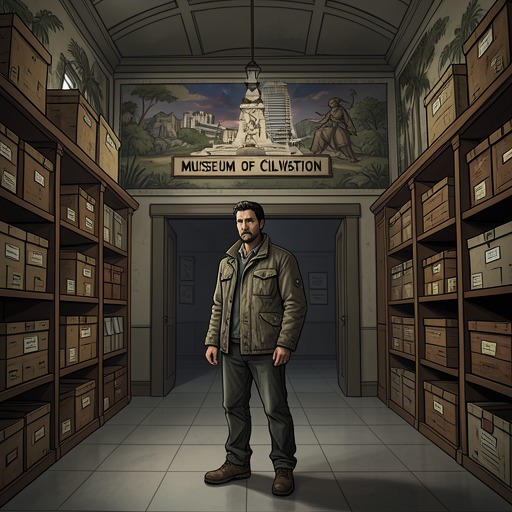
On Day One Hundred, while waiting for a scouting party to return, Clark enters the Skymiles Lounge and looks into a glass case that once held sandwiches. Thinking of Robert, his boyfriend, he imagines that Robert, a curator, would fill the shelves with artifacts and start an impromptu museum. Clark begins the collection himself. He places his useless iPhone in the case, then adds Max’s American Express card, left behind at the airport’s Mexican restaurant, and Lily Patterson’s driver’s licence. He adds his laptop when the first objects look too slight on their own.
When he returns a few hours later, the display has grown without his asking: someone has added another iPhone, red stiletto heels, and a snow globe. The museum begins not as a formal institution but as a shared response to abandoned things. Clark is moved by the human enterprise contained in them. The snow globe, especially, leads his attention outward from the finished object to the workers, makers, shippers, and hopes that carried it through production and across an ocean to the airport. The planes seen through the globe’s glass bend into a miniature storm; the object holds both the reach of the old world’s supply chains and the disorientation of the world left behind.
By Year Fifteen, people come to the museum after work to spend time with its remnants. Visitors read brittle newspapers in gloves Clark has sewn from a hotel sheet. James returns to look at a motorcycle he found in Severn City in Year Two and used until the automobile and aviation fuel ran out; Emmanuelle, the first child born at the airport, often comes to look at the phones. The collection’s importance lies not only in the objects themselves but in the memories and losses visitors bring to them. The museum becomes a place for attention to the past, something close to a shared ritual.
The airport school makes the distance between preserved object and living knowledge especially clear. Children learn that airplanes once flew across the world and that small electronic devices connected to a worldwide network through satellites. They are told that the Internet was everywhere and connected everything, but borders and faraway places are harder to explain than dots on a map. The devices in Clark’s museum thus preserve more than a vanished technology: they stand for a scale of connection that the children can hear described but cannot fully imagine.
Age, Memory, and Recognition
At seventy, in Year Nineteen, Clark moves slowly, with aching joints and hands, especially in cold weather. He shaves his whole head and wears four rings through his left ear. Annette, his dear friend, died of an unknown illness two years earlier; he keeps her Lufthansa neck scarf as a memorial and has left wildflowers on her grave. He is no longer specifically sad, but death is constantly in his awareness. From an armchair in the museum, he can see the graveyard between Runways Six and Seven, where airplane tray tables mark the graves, and the airport’s gardens, hunters’ work area, rusting jets, and Air Gradia Flight 452 in the distance. The view makes the museum part of a living settlement shaped by labor, death, and survival, not simply a room of old things.
When the Travelling Symphony performs at the airport, Clark recognizes Kirsten Raymonde and introduces himself. His British accent remains, and four loops in his left earlobe make him recognizable as the same older man whose body bears the passage of years. Kirsten does not remember their earlier introduction. The moment places Clark beside someone whose life, like his, has been shaped by separation from the pre-collapse world, though their memories and histories differ.
In the early evening, after dusting the museum’s objects, Clark settles into his favorite chair and reads Dr. Eleven by candlelight. A dinner-party scene catches his attention. The woman with square-framed glasses recalls travel before the war; Clark recognizes her as a guest from a Los Angeles dinner years earlier. He also identifies Elizabeth Colton and Arthur in the comic’s other figures. In the drawing, Dr. Eleven occupies the place where Miranda had sat at the real table. Clark remembers the caterers, the guests, the dog looking in through the glass, and Miranda rising to leave. Curious about her, he had followed her outside after saying he needed a cigarette. The comic does not simply reproduce the past: it rearranges it, leaving Miranda’s place to a fictional figure, and prompts Clark to recover an evening—and a question about what became of her—that he had not thought about for years. His museum preserves the material past; this recognition shows how art can reopen its human associations.