Clouded-glass paperweight
Station ElevenThe Clouded-glass paperweight is a keepsake whose history crosses the lives of Miranda Carroll, Arthur Leander, and Kirsten Raymonde. Its importance lies not in practical use but in its passage: Miranda takes it from Arthur’s study, later arranges to send it to the Elgin Theatre, and Kirsten remembers receiving a glass paperweight there after Arthur collapses. Kirsten carries it in her backpack when she leaves Toronto, preserving a physical remnant of a night whose other details have partly faded.
Provenance and return
Eleven years before the events in Malaysia, Clark Thompson brought the Clouded-glass paperweight to a dinner party in Los Angeles. Miranda took it from Arthur’s study that night, intending to return it to him. The object therefore begins as a borrowed possession caught up in the social and intimate history around Arthur, rather than as something Miranda describes as hers to keep.
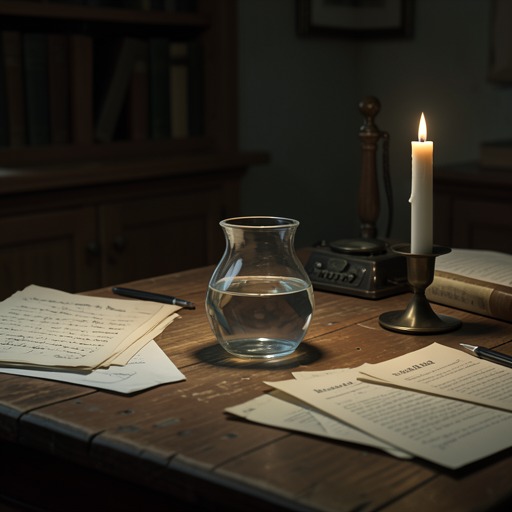
Much later, back in her hotel, Miranda remembers the paperweight when it clinks against her keys inside her handbag. She takes it out and admires it in the lamplight. Instead of keeping it or handing it over in person, she writes a note on hotel stationery, puts her shoes back on, goes to the concierge desk, and arranges for a courier to take it to the Elgin Theatre. Her decision is a concrete attempt to complete the return she had intended years earlier. The account establishes that she arranges the dispatch, not what happens to the package after it leaves the hotel.
The gift after Arthur’s collapse
In Kirsten Raymonde’s recollection to François Diallo, the paperweight belongs to the aftermath of Arthur’s collapse onstage. A man from the audience runs onto the stage and attempts CPR. When the medics arrive, he remains with Kirsten as they work; after the curtain falls, the two sit in the wings. Kirsten remembers his calm, while the shock of the scene is reflected in the distress of the minder who eventually finds them.
Kirsten cannot remember the minder’s name. She does remember that the woman is sobbing, that Kirsten begins to cry too, and that the woman cleans off her stage makeup before giving her the glass paperweight. The gift follows a moment of fright and care: it is offered after the child has watched adults try to save Arthur and has been comforted by the minder’s presence. Kirsten says that she thought it beautiful then and still thinks so when speaking to Diallo years later.
The recollection of the gift sits alongside Miranda’s earlier decision to send the Clouded-glass paperweight to the theatre. The narrative thus places the object’s dispatch and Kirsten’s receipt in relation to the same venue and the same night, without showing the courier’s delivery or explicitly narrating a handoff. Its route is suggested through the juxtaposition of the accounts rather than fully documented.
What Kirsten remembers—and carries
Kirsten’s account distinguishes sharply between what she remembers herself and what she knows from her older brother, Peter Raymonde. She recalls the stage, the man attempting CPR, the minder’s tears, and the paperweight; she does not remember the subsequent arrangements for taking her home. After the adults in the theatre cannot reach her parents, the minder calls Peter. He is at home, says he does not know where their parents are, but agrees that the minder can bring Kirsten to him. At fifteen or sixteen, Peter has often looked after his much younger sister, and the minder drives Kirsten home and leaves her with him.
The paperweight outlasts this incomplete childhood memory as a tangible possession. Diallo observes that Kirsten is the only person he knows who carries a paperweight in her backpack. Kirsten answers that it is not very heavy. When he asks whether this is why she took it with her when she left Toronto, she confirms that it is. The object’s modest weight makes its continued presence all the more striking: it is not useful equipment for the journey, but something she chooses to bring.
Memory and significance
The Clouded-glass paperweight joins two acts of remembrance. Miranda’s recognition of it comes belatedly, when the sound of it against her keys brings the forgotten object back to mind; Kirsten’s account preserves it among the few sharply recalled details of a traumatic night. The object itself is unchanged in the accounts, but its meaning shifts with its keepers: first an item taken from Arthur’s study and meant to be returned, then a gift from a crying minder, and finally a possession Kirsten deliberately carries away from Toronto.
Its small, portable form makes private history materially present across a break in ordinary life. Kirsten’s memories of the night are partial, and she relies on Peter’s account for the journey home; nevertheless, the paperweight remains with her and its beauty remains vivid. Rather than resolving the uncertainty around its passage from Miranda to Kirsten, the novel lets the object connect their separate recollections. The keepsake becomes a quiet link between Miranda’s unfinished return and Kirsten’s enduring memory of the theatre.