Daria
Station ElevenDaria is a founder of McKinley and, by Year Ten after the Georgia Flu, the wife of Jeevan Chaudhary. Her role is defined less by a narrated personal history than by the life she helps sustain: a settlement built out of the remnants of the old world, a careful argument about what should be remembered, and a household shaped by practical care. Through her, survival appears not only as reaching safety but as making a place where knowledge, children, and neighbors can matter again.
Identity and Place
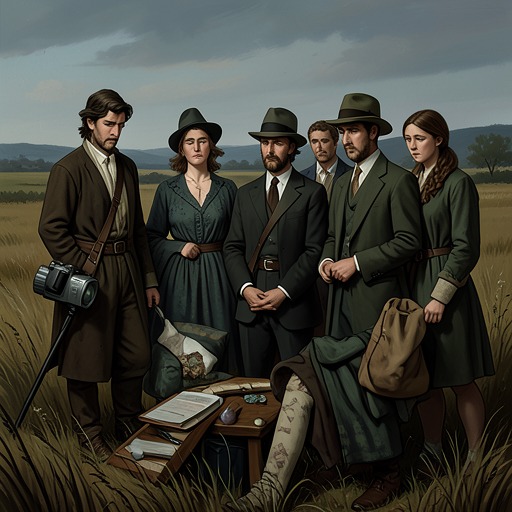
Before her marriage, Daria had worked as a sales assistant. She became one of the founders of McKinley, a community that began when eight members of a sales team were stranded at a remote corporate retreat during the Georgia Flu. After leaving the retreat, they settled in rooms at an abandoned motel on a little-used road, far from the major highways. In the first frightening years, living close to other people mattered; in time, staying became habit. By Year Fifteen the settlement had grown to twenty-seven families and was described as peaceful.
That account places Daria within a community whose origins are both improvised and durable. McKinley was not founded through a return of the institutions that had vanished. Its first home was a motel, and its later form rested on people continuing to live together there. Daria’s place in its founding group therefore links her to the work of making an abandoned structure serve as a shared home. The narrative gives no fuller account of her earlier life, but her former occupation and role in McKinley’s beginnings locate her on both sides of the change: she came from the old working world and helped build a settled one after it collapsed.
Marriage and a Life of Settlement
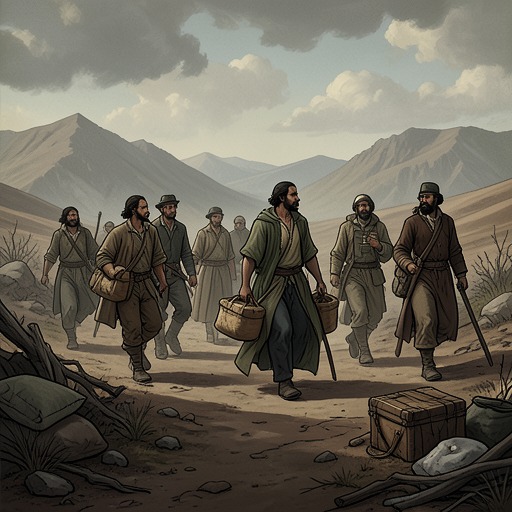
Jeevan had walked a thousand miles before arriving at McKinley in Year Three. He married Daria in the summer of Year Ten, several years after he reached the settlement. The chronology sets his long passage through a disrupted landscape against the later steadiness of their shared life. By Year Fifteen, the two are together beside a river with their friend Michael, discussing what children should be taught about the world before the pandemic.
Daria’s life with Jeevan is also shown through ordinary household care rather than a declaration about what their marriage means. In the later family scene, Jeevan bakes bread in an outdoor oven made from an oil drum while Daria is inside with their baby and children. He watches her lift the baby from the crib and then move to put out a candle; their silhouettes disappear from view, and their young son runs ahead of her onto the grass. The scene gives the family a small, specific rhythm: a shared home, children moving between its rooms and the outdoors, and food being prepared for the household and neighbors.
What the Past Is Worth Teaching
At the riverbank, the immediate question comes from Michael, a former truck driver. His eleven-year-old daughter has been upset after learning that people once lived much longer; she wants the lifespan of the old world and finds its loss unfair. Daria answers that she would want her own child to know about the past, including the remarkable things people had possessed. Her response treats history as more than a list of inventions: knowledge of what existed is worth passing on, even when it unsettles the young.
Michael objects that children’s eyes glaze over when adults speak about antibiotics or engines, and worries that such knowledge may only distress them. Daria does not turn her first answer into a fixed position. She allows that he may be right and asks whether knowing makes children more or less happy. The exchange leaves the problem open. Daria values the past, but she also recognizes the cost of giving children facts that make their present limitations newly visible. The debate is especially pointed because the conversation happens in a settlement with a school: its children inherit both the material consequences of the collapse and adults’ uncertain responsibility to explain them.
Care in the Settlement
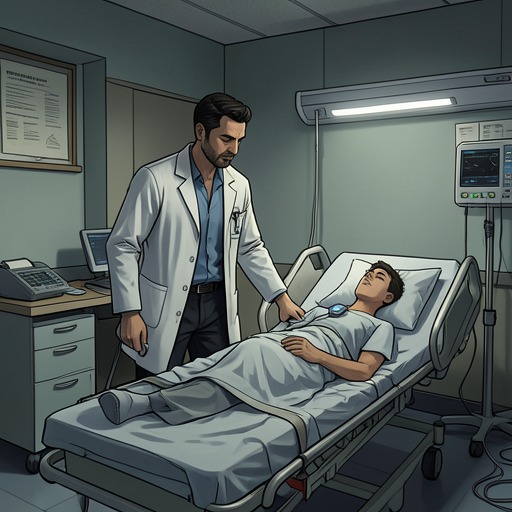
Daria’s care is not confined to her own family. When a wounded woman is brought to Jeevan, the explanation is that the Prophet had shot her after she refused to remain with his group and become a wife to one of his men. While Jeevan finishes treating her and calls for a bandage, Daria is already at his side with strips torn from an old sheet. She helps turn a scarce household material into what the injured woman needs, and Jeevan wraps the patient carefully before advising her and her companion to remain in the settlement for several days.
The scene is brief, but it gives Daria a definite place in McKinley’s response to danger. She is neither presented as the medical authority nor left outside the work of treatment: she supplies what is needed and acts without delay. Set beside her later family scenes, this moment shows care extending from the household to people arriving from beyond it. McKinley’s peacefulness does not mean that violence has disappeared from the wider world; Daria’s practical assistance helps make the settlement a refuge for those who have encountered it.
Family and Narrative Significance
In the later glimpse of Jeevan’s family, their son Frank had a fever the night before. Daria sang to him while Jeevan pressed cold compresses to his forehead; by the time of the scene, she says that the boy seems better. The detail makes caregiving reciprocal and shared: Daria soothed the child through the night, while Jeevan now prepares food. Their baby and children belong to a household formed after the pandemic, and the name Frank carries a reminder of Jeevan’s brother into that new family without making the past the center of the scene.
Daria’s appearances thus move between three scales of life: McKinley’s beginnings, a community’s argument over historical memory, and the repeated acts that keep a family and its neighbors going. The book does not provide a complete biography or spell out her private response to the losses of the old world. Instead, it places her in scenes where the consequences of those losses become practical questions: where people can live, what children should know, and how someone in need can be helped. Her significance lies in that grounded continuity. The world has changed beyond recognition, but Daria’s work of building a settlement, weighing what to pass on, and caring for others gives survival a social shape.