Dear V.: An Unauthorized Portrait of Arthur Leander
Station ElevenDear V.: An Unauthorized Portrait of Arthur Leander is a bestselling, unauthorized portrait of Arthur Leander assembled from letters he sent to his childhood friend Victoria. The book matters both as a breach of privacy, exposing the people Arthur wrote about before they could prepare for publication, and as a material link to the past: Kirsten Raymonde carries a copy out of Toronto, loses it on the road, and keeps hoping to find another.
Description and Epistolary Form
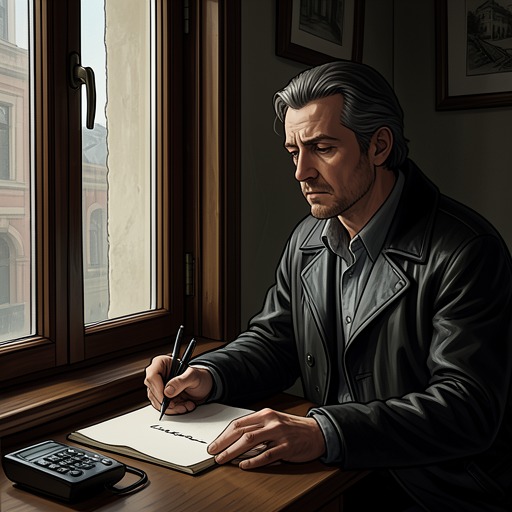
The book is made entirely of letters addressed to an initially anonymous friend, V. Its title presents itself as a portrait of Arthur, but the portrait is composed through the private act of writing to someone he once knew. The form therefore places a question of intimacy at the center of the object: these are letters directed to a particular recipient, yet they become a public account of the writer and the people in his life. The revelation that V. is Victoria identifies the friend behind the initial without making the letters any less one-sided.
The copy Kirsten remembers has white lettering across the top announcing that it was a number-one bestseller. Its black-and-white cover photograph shows Arthur looking over his shoulder as he gets into a car. His expression remains hard to read: it might look haunted, but it could just as easily be the moment of turning because someone has called to him. The cover offers an image that seems to promise access to Arthur while withholding certainty about what the image means, an apt visual counterpart to a portrait built from letters rather than a settled account of their subject.
One of the passages Kirsten encounters begins with Arthur writing about living in Toronto. He describes the orange appearance of the sky when clouds gather before snow, recognizing it as reflected city light while finding the effect eerie. The letter makes the book more than a retrospective account of a public figure: it preserves an ordinary perception from a specific place and moment, in Arthur's own correspondence. That small detail also connects the volume to Kirsten's life before the collapse, when she left Toronto with her brother.
Kirsten's Copy and Its Loss
When Kirsten and August leave a house, they take suitcases, towels, clothing, magazines, an unopened box of salt, and other items they think may prove useful. Before they go, Kirsten pauses in the living room to scan the bookshelves. August looks for a TV Guide or poetry; she is searching for Dr. Eleven, but would accept a replacement copy of Dear V. The book is thus sought among practical remnants and other reading matter, but it holds a particular claim on Kirsten that those objects do not.
The copy she remembers belonged to her mother, who bought it shortly before everything ended. Kirsten had misplaced it on the road two or three years before the search with August, and had been trying to replace it ever since. The lost book's value is established not by a grand explanation but by the persistence of that search. It is a surviving possession tied at once to her mother, to the world before the pandemic, and to the uncertain journey on which Kirsten lost it.
The book had been forbidden reading. When Kirsten left Toronto with her brother, he allowed her to bring only one book in her backpack. She chose Dear V., despite her mother's having told her she was not allowed to read it. Her brother raised an eyebrow but said nothing. The single-book limit gives the choice a clear weight: among all the reading she might have carried, Kirsten took the book whose contents her mother had withheld. Its later disappearance turns that constrained choice into a recurring absence, one she tries to repair by looking for another copy.
Publication and Its First Reactions
Three weeks before the pandemic, Elizabeth Colton calls Clark Thompson with news that the book is coming out. She has not yet seen it; it will not be released for another week, but a reliable source has told her that both she and Clark appear in it. Elizabeth is furious and considers litigation, though she is uncertain whether the publisher or V. would be the proper target. She rules out suing Arthur because, as far as she knows, he did not know about the book either.
The report is especially alarming because the letters apparently discuss Arthur's marriages and friendships in detail, in an account described to Elizabeth as unsparing. Clark wants to know what Arthur says about them, but neither he nor Elizabeth has read the book at this point. Clark writes down the title while talking to her and briefly gets it wrong, calling it Dear B. The mishearing is small, but it underscores how little either of them knows beyond the fact that their private histories have been made part of a forthcoming book. Their concern belongs to the brief pre-pandemic interval when a book's publication and its possible damage to reputations can still occupy the foreground.
Arthur tells Miranda about the book in person. A friend in publishing has sent him an advance copy, and the volume will be available for purchase in a week and a half. He warns Miranda that she appears in it and apologizes. His disclosure confirms the book's reach beyond the author and recipient: it includes people who were part of Arthur's life, including a former wife who has not chosen to have her story told through his letters.
Arthur, Victoria, and the Meaning of the Letters
Arthur admits to Miranda that he was angry at first but believes he deserved what happened. He explains that he treated Victoria like a diary. Early in his correspondence from Toronto, she sent him a couple of letters and three postcards; later, she sent brief notes about changes of address, sometimes with a cursory apology for not writing more. Arthur continued writing, but the exchange had become markedly unequal: he used her as a place to deposit his thoughts rather than attending to her as a person who might read them.
Miranda understands from his account that Victoria did not answer most of the letters she saw him writing. This makes her unexpectedly sad. Arthur goes further: he says that he stopped thinking of Victoria as a human reader and believes he actually forgot she was real. The book's publication exposes more than intimate information about Arthur's marriages and friendships; it makes visible the imbalance built into the correspondence itself. The letters were private in destination, but Arthur's own description shows how little he was imagining the person on the other end.
The conversation takes place over green tea. Arthur carries two mugs to the coffee table, where they leave rings of steam on the glass, then lifts his mug, blows across its surface, and sets it down with deliberate care. Miranda wonders whether he is performing a scene, as if the aging actor were playing Arthur even in the act of explaining himself; she cannot decide. That uncertainty leaves his confession suspended between self-knowledge and performance. What remains clear is his recognition that he had treated a friend as a receptacle for his thoughts, and that publication has returned those thoughts to the world in a form neither he nor the people he wrote about can control.