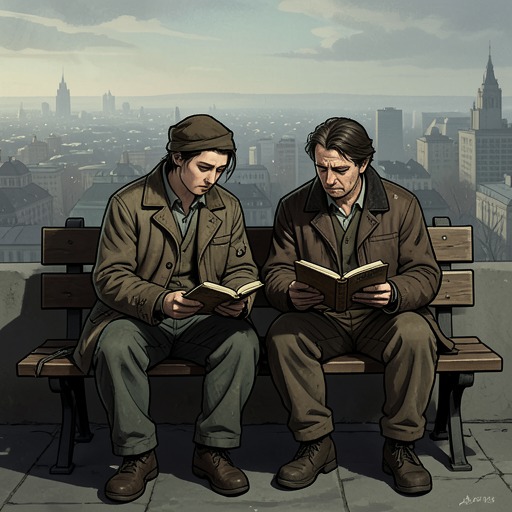
Dieter
Station ElevenDieter is an actor and musician in the Travelling Symphony, a company whose performances and life on the road bind together people who have survived the Georgia Flu in very different ways. At twenty when the pandemic ended the old world, he retains memories that younger companions such as Kirsten Raymonde cannot share. To Kirsten, he becomes family: a trusted friend whose humor, artistic commitments, and recollections give daily life on the road continuity. His disappearance and death reveal how fragile that continuity is.
Identity and Life in the Symphony
Dieter belongs to the older generation within the troupe, not because he is elderly but because he remembers the world before the pandemic. Kirsten first met him in central Ohio when she was fourteen and he was in his late twenties. After her brother’s death, she had been alone; when the Symphony let her join, Dieter served her dinner beside the fire on her first night. He talked with her about Shakespeare, including the playwright’s family and the plague-haunted circumstances of his life. The recollection places Dieter among the people who made the company a home for Kirsten, as well as among those who passed on its artistic traditions.
His work is not confined to one role. At one point he is learning Lear, a part for which he is not really old enough; at another, he has played Theseus. Rehearsal and performance occur amid ordinary discomforts rather than in a protected theatre. During a heat wave, the actors run through King Lear repeatedly in a parking lot, while a musician complains about having heard it three times. Dieter walks ahead of the others, murmuring to Bernstein, his favorite horse. Bernstein is missing half his tail, a detail linked to the first cello’s recent restringing of a bow. The troupe’s theatrical world makes use of whatever is at hand, and Dieter moves naturally between the roles of actor, companion, and caretaker of the horse.
Friendship, Performance, and Conflict
Dieter’s friendship with Kirsten is marked by familiarity rather than formality. She considers him one of her dearest friends and later recognizes that she has thought of him as an older brother, or perhaps a cousin: a fixture in her life and in the life of the company. That closeness is visible in their shared work. During a performance of A Midsummer Night’s Dream, Kirsten and Sayid play characters in a scene that echoes their former relationship. They had been a couple for two years and had separated four months earlier, after Kirsten slept with a travelling peddler. As Kirsten struggles to meet Sayid’s eyes, Dieter mutters from behind her that the scene may not be necessary. His response registers the strain around the performance, even as the actors continue it.
The troupe’s traveling life also gives friendship a daily, teasing rhythm. Twelve hours after leaving St. Deborah by the Water, Dieter objects that the motto painted on the lead caravan would sound more profound if it had not been borrowed from Star Trek. The motto matters deeply to Kirsten, who had tattooed it on her left forearm at fifteen. Dieter dislikes tattoos, partly because he once saw a man die from an infected one; Kirsten’s smaller tattoos of black knives are less troubling to him because they mark particular events. Their disagreement has been repeated for years, but its sting has faded. It has become, in Kirsten’s image, a familiar room in which the friends meet. The exchange shows how the company’s serious beliefs coexist with jokes and habitual argument.
Memory and the Meaning of Survival
Dieter’s recollections of the world before the Georgia Flu are especially clear beside Kirsten’s partial childhood memories. In a tent during a stormy stretch of travel, he tells her that he once dreamed of an airplane. For a decade after the pandemic, he had watched the sky and wondered whether countries across the ocean had escaped. An airplane would have meant that planes still took off somewhere. Kirsten, who was eight when the old world ended, says she has not thought about airplanes in a long time; Dieter replies that this is because she is young and does not remember. The exchange is not simply a disagreement about memory. For Dieter, the airplane had represented the possibility of a surviving connection to places beyond the devastated continent.
His memories also appear in contrast to the recurring stories of people in the Symphony. Years later, when François interviews the troupe in New Petoskey, he recognizes a pattern in their accounts: some remember a world that vanished and walked until they found other people; others were too young to remember it, or were born afterward, and have walked all their lives. Dieter’s age places him on the first side of that divide. The evidence does not provide a full account of his own journey after the pandemic, but his night-watchful hope for an airplane makes the loss of the old world concrete through one particular habit of looking upward.
Disappearance and Death
Dieter vanishes during the Symphony’s cautious passage through a forest with Sayid. The two had gone ahead as scouts, and Kirsten and August walk miles down the road searching for them before returning at first light. The search finds no footprints, blood, broken branches, or other signs of what happened. The absence of evidence makes the loss feel almost unreal to the company, which searches in teams and imagines that the missing men might still reappear. Kirsten’s grief is sharpened by the thought that the Symphony has continued into a world in which one of its fixtures is suddenly absent.
The circumstances become clear only when Sayid returns and explains what happened. The Prophet’s men had captured him and Dieter, intending to take hostages and trade them for a girl. They believed the Symphony was headed for the Museum of Civilization, partly because of rumors that Charlie and Jeremy had gone there. Sayid was tied up beside Dieter and could not wake him. He describes Dieter becoming increasingly unresponsive; whether Dieter had an allergic reaction to chloroform or had been given another, more toxic substance remains uncertain. The captors waited through the following day, but Dieter died in the late afternoon. Attempts to revive him failed. Sayid’s account turns the unexplained disappearance into a death in captivity, while leaving its precise medical cause unresolved.
Aftermath and Narrative Significance
Kirsten’s response is inseparable from the ordinary details that made Dieter her friend. Later, music performed at the airport cannot hold her attention: she thinks of him as Theseus, of their arguments about tattoos, of his fake coffee in the mornings, and of the first night he fed her by the fire and talked about Shakespeare. The memories do not make his death easier to explain; they restore the particular life concealed by the bare fact of his disappearance. The list moves between performance and routine, showing how a person survives in the recollections of those who shared both.
Dieter’s death also changes the emotional weight of survival for the people who remain. After hearing Sayid’s account, Kirsten recalls an earlier killing on the road and recognizes that surviving does not leave a person untouched. August, who has just killed for the first time, faces the knowledge that the act will remain with him. Dieter’s loss therefore belongs not only to Kirsten’s grief but also to the troupe’s encounter with the costs of its exposed, mobile life. His artistic work, his memories, and his familiar arguments had helped make the Symphony a community; his absence reveals that even its most enduring bonds cannot protect its members from the violence beyond the stage.