Discovery of the electrically lit settlement
Station ElevenThe discovery of the electrically lit settlement is a late turning point at Severn City Airport: from the control tower, Kirsten Raymonde sees a distant town or village whose streets glow with electricity. In a world where power has largely disappeared, the grid of lights is both concrete evidence of a functioning settlement and an unanswered question about what may still be possible beyond the airport.
A world without dependable power
The sight carries its force because the novel has shown how thoroughly ordinary life depended on systems whose human maintenance went largely unnoticed. As the Georgia Flu pandemic spread, television channels fell to static, emergency broadcasts repeated, and then the Internet went dark. In Toronto, the city's daily hum faded as fuel deliveries stopped, cars became stranded, food ceased reaching stores, and workers no longer maintained power plants or cleared fallen trees from electrical lines. When the lights finally went out in Jeevan Chaudhary's apartment, the failure was not an isolated technical accident; it followed the breakdown of the work and transport networks that had kept the grid operating.
The same collapse transformed electricity from an assumed service into a vanished possibility. Airplanes remained, but they stood dormant on runways and in hangars; roads filled with abandoned cars, and national borders were left unmanned. Kirsten and Peter Raymonde escaped Toronto by driving a hotwired car until blocked roads forced them to continue on foot. Against that remembered world of stopped movement and failing infrastructure, a distant pattern of electric streetlights is startling precisely because it suggests organized activity, not merely a surviving machine.
Clark's invitation
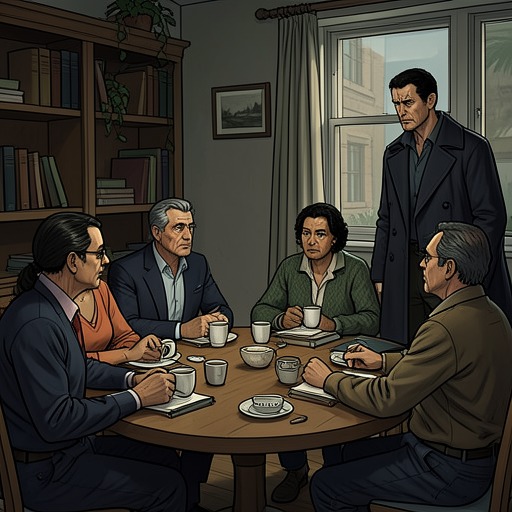
Clark Thompson does not present the lights as a rumor. He has spent time with Charlie Harrison, who told him of Kirsten's interest in electricity, and invites Kirsten to see something he thinks will matter to her. The invitation comes after difficult days and after the arrival of a newspaper from New Petoskey has given them reason to talk. Kirsten is wary of following a stranger, but Clark is elderly, moves slowly, and she is armed with three knives; she decides to go with him.
They climb to the ninth landing of the airport's air traffic control tower. Clark knocks a particular pattern on the door, and four people admit them to an octagonal room lined with glass. Its screens are dark. People there watch the tarmac, terminal, gardens, and barrier fence with binoculars, while airplanes lie pale beneath the stars. The tower remains a place of observation even though its electronic equipment is no longer active: people still keep watch over the airport and its approaches.
Clark points south, toward a patch of sky that seems dimmer than the rest, and explains that the phenomenon appeared about a week earlier. He cannot say how anyone achieved it on such a large scale. Rather than rely on the naked eye, he borrows James's telescope and adjusts its focus, asking Kirsten to look without moving it. The careful arrangement of the scene delays recognition: she first cannot make sense of what she sees, steps back, and then looks again.
The lights in the distance
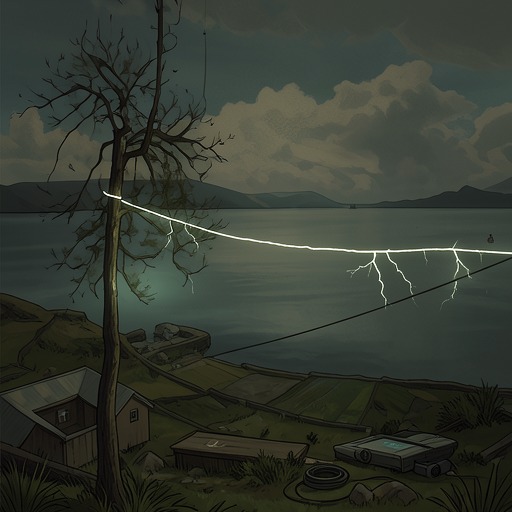
Through the telescope, the scattered points resolve into a grid. On the side of a hill several miles away, the lights outline streets in a town or village. Kirsten's first response is disbelief; Clark's answer is to insist on the evidence before them. The discovery is visually simple, but its scale changes its meaning. A single surviving lamp might be an unexplained remnant. A town-shaped pattern implies a place where electric light is present across streets, although the scene does not reveal who lives there, how many people it holds, or how its power is produced.
Clark's uncertainty matters as much as the sight itself. He can describe the lights and their recent appearance, but he cannot explain the means behind them. The tower's watchers have registered an event at a distance; they have not yet made contact with the people or systems responsible for it. The settlement is therefore both a place and a limit to present knowledge, visible from the airport but not yet understood.
The meaning of a lit town
The discovery resonates with the airport's developing Museum of Civilization. Clark began the museum by placing abandoned personal objects in a glass display case: a phone, a credit card, a driver's licence, and, soon after, objects left by others. Looking at a snow globe, he considered the labor and movement embodied in an ordinary manufactured thing, from its making and packing to the workers and ships that carried it across the world. His attention to objects makes infrastructure legible as human effort rather than as an invisible convenience.
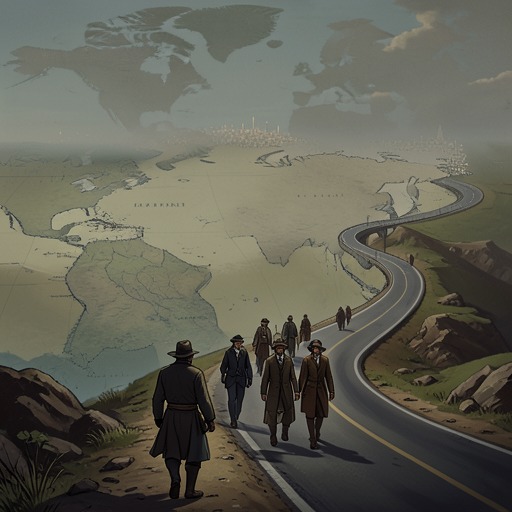
By Year Fifteen, the airport's school teaches children about airplanes, electronic devices, satellites, and the worldwide network that once connected distant places. The children can understand locations as dots on maps more readily than the borders that once divided them. Their lessons describe a global system that no longer operates as it did. The lights on the hill do not restore that former world or explain how much of it survives; they offer a sharply local counter-image, proof that electricity has not vanished everywhere.
The event ends not with a journey to the settlement but with Kirsten looking through the telescope. Its significance lies in that shift from inherited knowledge of a dead infrastructure to direct observation of a possible exception. The dark screens in the tower, the powerless world behind the airport, and the illuminated streets far away remain in tension. The lights make the future imaginable again, while leaving their cause, durability, and connection to the airport unresolved.