Dolores
Station ElevenDolores is a business traveller stranded at Severn City Airport after the collapse, where she becomes a trusted companion to Clark Thompson and a member of the airport’s scouting party. Her role is defined less by a long personal history than by a handful of practical, sharply observed moments: she agrees to monitor Clark’s state of mind, refuses to indulge his hope that rescue is still on its way, and discovers that returning to the airport can feel like coming home. Together, these details make her a measure of the community’s changing expectations.
Identity and Place in the Airport
Before the collapse, Dolores was a single business traveller with no family. Clark regards her as one of the more clear-headed people among those stranded at the airport. That judgment is his, not an independent diagnosis, but it helps explain why he trusts her with a frank arrangement: each has promised to tell the other if the other begins to seem to be losing their mind.
Their compact gives Dolores a particular place in the airport community. It is neither a formal authority nor a claim that either can remain untouched by grief and isolation. Instead, it sets up a mutual obligation to notice changes in one another and to speak honestly about them. In a place where people have lost their former lives and have little reliable information about the world beyond the runways, being willing to make that promise is a meaningful form of companionship.
A Watchful Friendship with Clark
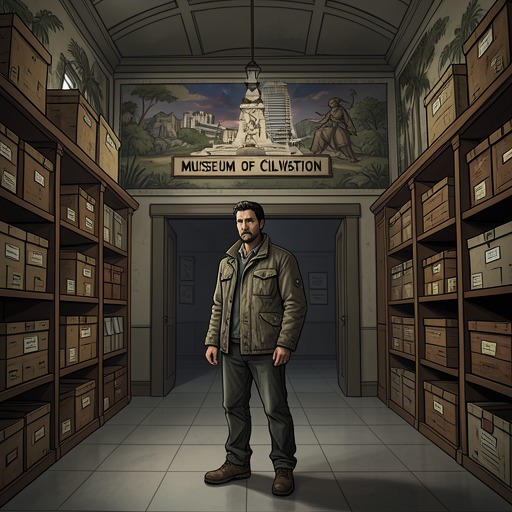
The terms of the agreement emerge in an ordinary exchange. When Clark parts his hair and shaves one side of his head, Dolores raises an eyebrow. He explains that the style is one he wore between the ages of seventeen and nineteen; although he does not tell her, it makes him feel like himself again after years of corporate respectability. The episode shows both the familiarity between them and its limits: Dolores notices a striking change and gives him the opening to account for it, while Clark keeps part of its personal meaning to himself.
Her role is not to prevent every sign of strain, but to be someone before whom strain can be recognized. Clark’s concerns extend beyond his appearance. He trains himself not to think about people he knew outside the airport or about the sealed Air Gradia 452, whose presence brings back the decision to keep the aircraft closed rather than risk contagion among the airport’s occupants. Against that background, the pact with Dolores offers a modest safeguard: not certainty or cure, but a witness who has agreed to say when the effort to cope appears to be failing.
Doubt About Rescue
When Elizabeth Colton insists that the people at the airport will be rescued and that they need to keep a runway clear, Clark tries to answer kindly, allowing that rescue is possible. Dolores gives a more direct assessment: if anyone were coming for them, she thinks they would already have arrived. Her judgment punctures the comfort of Elizabeth’s certainty without claiming knowledge of what will happen. It is a conclusion drawn from waiting, not proof that no one could ever reach the airport.
The difference matters because the stranded group has few signs to interpret. On Day Sixty-five, a single helicopter passes in the far distance, moving from north to south. Afterward, people keep watch in pairs, wear brightly coloured shirts to attract pilots’ attention, and burn a signal fire at night, but no aircraft appears. In this setting, Dolores’s skepticism is not simply pessimism: it gives voice to the gap between the hope of being found and the repeated evidence that no rescue has come.
The Scouting Expedition and Return
On Day One Hundred, Dolores leaves with Tyrone and Allen, a schoolteacher from Chicago, to scout for supplies. The expedition is debated because the airport’s residents can still hunt enough deer to survive and have the necessities, though soap and batteries have run out. The group nevertheless sets out with a handgun and road maps, accepting the risks of going beyond the airport in search of what the community lacks.
The scouts encounter a roadblock marked with a quarantine warning. Abandoned cars extend beyond it, some containing bodies; a nearby hotel is left unexplored because its dark lobby and smell suggest what might be inside. They find supplies at fast-food restaurants and see no other people. The landscape offers resources, but not evidence that ordinary society or a safe route elsewhere remains. These discoveries give Dolores’s earlier assessment of rescue a grim context: beyond the airport, the group finds silence and the consequences of the pandemic, not a functioning outside world.
On the return, the scouts struggle past the roadblock with carts of supplies, including napkins and bottles of Tabasco sauce. As the airport comes into view between the trees, Dolores is overtaken by emotion and thinks of it as home. The reaction marks a change in what the place means. The airport remains isolated and precarious, but it is also where the survivors have made a community to return to. Her response gives the expedition an outcome beyond its provisions: going out confirms the danger of the world around them, while coming back reveals an attachment to the refuge they have built.
Relationships and Narrative Significance
Dolores also appears in Clark’s recollection of Elizabeth and Tyler. A few months before they leave, Clark finds Tyler reading aloud by the forbidden Air Gradia 452. Later, as Clark looks again at Elizabeth and Tyler’s passports, still unsettling to him years after Elizabeth entrusted them to him, Dolores calls them unsettling people. Her brief comment accompanies Clark’s enduring unease about the pair; it does not explain or resolve it.
Across these moments, Dolores is presented through attention, judgment, and response rather than an extended account of her past. She notices Clark’s changed appearance, participates in a reciprocal agreement to watch over his sanity, challenges an unsupported expectation of rescue, and recognizes the airport as home after seeing the desolation beyond it. The contrast between mobility before the collapse and danger outside the airport sharpens the meaning of that recognition: for Dolores, as for the other stranded survivors, the place is no longer merely a transit point. It has become the fragile center of the life still available to them.