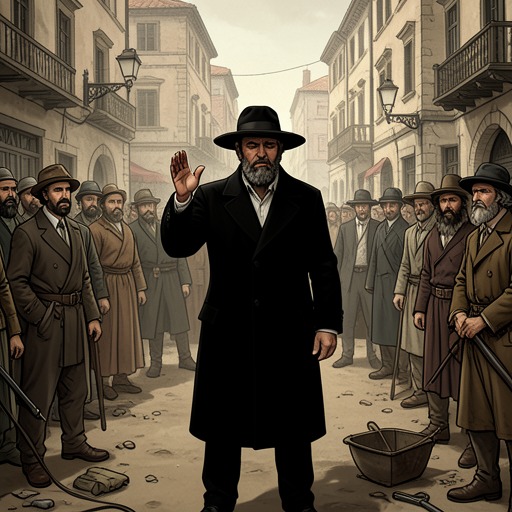
Eleanor
Station ElevenEleanor is a twelve-year-old stowaway whose escape from the Prophet’s control brings a child’s account of his household into the Travelling Symphony’s camp. Found hidden beneath costumes after following Kirsten Raymonde at St. Deborah by the Water, she explains that she had been promised to the Prophet as his next wife. Her brief appearance also supplies a lead about Charlie Harrison and Jeremy Leung: she says they went to the Museum of Civilization and that the Prophet came from there.
Discovery in the Caravan
Eleanor’s entrance is abrupt and physical. Someone in the third caravan calls out in alarm, and the first cello hauls her out by the arm. She has been concealed under the costumes, where the first cello finds her while looking for a tent. The girl is crying and sweaty, and her skirt is soaked with urine. The details register the fear and bodily distress of the journey without explaining how long she has been hiding or what happened before she reached the caravan.
August recognizes the situation as a stowaway’s arrival and notes that the Travelling Symphony has not had one in years. His own past experience of stowing away gives his reaction a note of recognition, but Eleanor’s circumstances are distinct: she is not simply an unauthorized traveler. She has followed Kirsten Raymonde from St. Deborah by the Water and is fleeing a promise made on her behalf. After she is lifted down, Gil tells the others to get her water. The Conductor offers her a clean handkerchief and asks her name, then her age. Eleanor answers plainly: she is twelve.
Escape from the Prophet
Asked why she had to leave, Eleanor apologizes and pleads that she will do anything, then says that she is promised to the Prophet. The response around her is disbelief; Eleanor is crying as she explains that she had no choice and was going to be his next wife. Her account defines the immediate stakes of her flight. She is a child being placed into a marriage she did not choose, and she has left because remaining would mean becoming the Prophet’s next wife.
Eleanor adds that the Prophet already has four wives and that they live in a gas station. This specific detail gives the planned marriage a domestic setting: the Prophet’s authority is accompanied by an existing household, and Eleanor understands that she would be added to it. The evidence does not describe the other wives’ lives or establish what Eleanor witnessed there. Her words instead make the arrangement legible through the facts she can state: the number of wives, where they live, and the future assigned to her.
Knowledge of Charlie and Jeremy
The exchange with the Travelling Symphony also connects Eleanor to its search for Charlie Harrison and Jeremy Leung. When asked whether she knows where they went, she identifies the Museum of Civilization. She says the name carefully, as though uncertain of its pronunciation, an audible hesitation that marks the phrase as something she has heard rather than a place she knows firsthand. August asks whether Charlie and Jeremy told her that was their destination, but Eleanor’s account offers no indication that she accompanied them.
She has heard people talk about the Museum of Civilization, though she says she does not know very much about it. She also says the Prophet is from there. When asked whether he has family there, she cannot say. Her information is therefore useful but sharply bounded: she can connect Charlie and Jeremy’s destination with the Prophet’s origin, but she cannot explain the connection, confirm that he has relatives there, or provide further details about the museum. The careful way she names it reinforces that her knowledge is secondhand and incomplete.
Narrative Significance
Eleanor’s arrival changes what the Travelling Symphony can learn about the Prophet. Until she speaks, the group has found a frightened girl hidden beneath its costumes; through her account, it learns that the Prophet had designated her as his next wife and that he already has four wives living at a gas station. Her escape makes the Prophet’s power concrete not through a general account of his rule but through the future imposed on one twelve-year-old.
At the same time, Eleanor contributes information beyond her own circumstances. Her mention of the Museum of Civilization gives the group a possible link between the Prophet and the destination reported by Charlie Harrison and Jeremy Leung, while her uncertainty prevents that link from becoming a complete explanation. The scene preserves both sides of her position: she is a frightened child in need of immediate care, and a witness with knowledge the travelers do not have. Her answers remain limited, but they are precise enough to connect her flight to the Travelling Symphony’s unanswered questions.