Elizabeth Colton
Station ElevenElizabeth Colton, an actress and Arthur Leander’s second wife, moves between the polished image the public sees and a quieter, less certain private life. At the airport after the pandemic, she tries to sustain hope that catastrophe will pass; eventually, she and her son Tyler leave with religious wanderers. Years later, her passport helps Clark Thompson connect the woman he knew to the Prophet’s family history, making Elizabeth an unexpected bridge between the stranded airport community and the later world beyond it.
Identity and Public Image
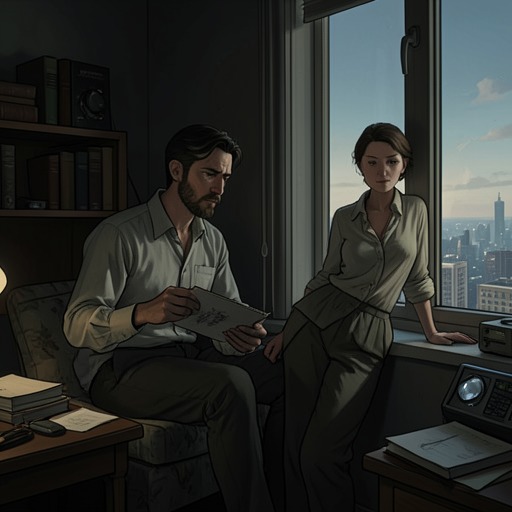
Elizabeth is known in Arthur’s world as a beautiful blond actress. Her face appears beside his on billboards, where she smiles with vivid red lips; away from the camera, she wears no lipstick and seems shy and nervous. She speaks so softly that people often lean closer to hear her. Her appearance attracts attention, but the contrast between her public image and her subdued manner suggests how little that image conveys about her private experience.
The available accounts place her within the orbit of celebrity and its watchful audience. A makeup artist discussing Arthur’s family says his son Tyler lives with his mother in Israel, probably in Jerusalem or Tel Aviv, and knows the answer is Jerusalem. In another account, a journalist asks Arthur about a woman he has been seen with. He deflects the question by insisting that she has a right to privacy. The exchange shows the pressure of publicity around Arthur’s relationships, though it does not itself identify the woman as Elizabeth.
Marriage and Private Unease
At a dinner party marking a wedding anniversary and the opening-weekend figures for a film, Elizabeth is among ten guests. The celebration is also a social occasion, and that combination leaves Miranda Carroll feeling out of place. Elizabeth’s public image is bright and assured, but the party presents a more vulnerable figure: she is quiet, and her small gestures register against the elaborate gathering around her.
Arthur’s toast to his beautiful, brilliant wife does not settle the tension in the room. Watching from outside, Miranda notices Elizabeth go still and look down; she also sees that Arthur meets the eyes of the other guests but not Elizabeth’s, even as Elizabeth lightly touches his thigh beneath the table. The scene gives Elizabeth little room to speak, yet her reaction and gesture make the strain in the marriage legible. The glamour of the party does not conceal the distance between the spouses; it frames it.
In a later encounter with Miranda, Elizabeth appears in disarray, half-drunk, with smudged mascara and tousled hair. She enters Miranda’s room carrying a glass of water in both hands, then sinks unexpectedly to the floor without spilling it. Her apology for being unsteady is met with Miranda’s dry reassurance, and Miranda asks her not to cry. Elizabeth’s entrance recalls the beginning of Miranda’s relationship with Arthur at Hotel Le Germain, while her presence in the doorway feels like its ending. The encounter turns the image of the composed actress into a scene of physical vulnerability without erasing her beauty.
Hope at the Airport
At the airport, Elizabeth and Tyler are among the people cut off from the world as the crisis deepens. Clark Thompson walks through the unmanned security checkpoints several times, expecting freedom but feeling fear instead; he watches other passengers for signs of illness and eventually withdraws to a distant corner. When he returns to Elizabeth, she tells him they only have to wait and expects the National Guard by morning. Clark remembers Arthur liking her optimism. Her confidence is practical and immediate: help, she assumes, will arrive soon.
That expectation falters as the airport remains isolated. After a reconnaissance pilot leaves in a small plane and does not return, Elizabeth asks whether they are supposed to believe civilization has ended. Clark replies that civilization was always fragile. Elizabeth draws on her years of art-history classes, recalling that the history of art runs close beside political and social catastrophe. People in earlier crises must also have thought the world was ending, she reasons, but those moments had been temporary. Her historical perspective gives her a way to resist the idea that the present disaster is final, even as events around her undermine that reassurance.
Later, Elizabeth and Tyler live in the first-class cabin of an Air France jet. Clark finds her knitting on the rolling staircase leading to the aircraft entrance. Their conversation turns to Tyler: Clark is worried about him, and Elizabeth pauses her knitting to ask why. The scene shows a quieter interval after her earlier, more intense hopefulness. The cabin and staircase, once parts of an ordinary travel system, have become domestic spaces within the stranded community.
Departure and Later Recognition
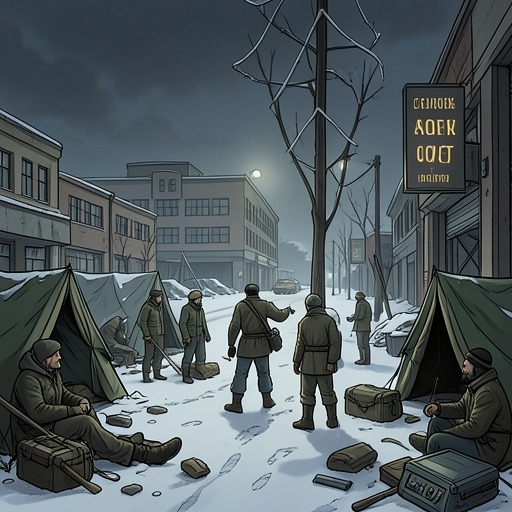
That summer, a band of religious wanderers arrives at the airport, traveling south. Their beliefs remain unclear to the people there. They speak of visions, signals, and dreams, eat the airport community’s food, and offer blessings in return. They chant at night in Concourse C, in a language no one recognizes. The residents host them for several uneasy nights because allowing them to stay seems less dangerous than driving them away.
When the wanderers leave, Elizabeth and Tyler go with them. Elizabeth explains that she and her son want a more spiritual life and apologizes as though her departure were a personal abandonment of the people at the airport. Tyler trails at the back of the group, looking small. Clark thinks he should have done more to pull Elizabeth back, but recognizes that he himself had been struggling to stay steady. Dolores calls the group’s apparent madness contagious, expressing the apprehension that hangs over their departure. The episode marks a decisive change: Elizabeth’s earlier confidence that catastrophe would pass gives way to a choice to seek meaning with the travelers, though the account does not specify where that choice leads.
Much later, when Jeremy describes the Prophet who ruled St. Deborah by the Water through charisma, violence, and selected verses from the Book of Revelation, Clark turns to the Museum of Civilization’s display case. He is looking at Elizabeth’s passport, its photograph from the remote past, and asks whether her son’s mother is still alive. The question reveals the connection Clark has begun to make: Elizabeth is the Prophet’s mother, and Tyler is the man described to him. Her preserved passport, an ordinary remnant of her former identity, becomes evidence that joins the airport’s history to the Prophet’s emergence. Elizabeth herself is not present in this later recognition, but her earlier departure with Tyler gives the revelation its personal and historical weight.