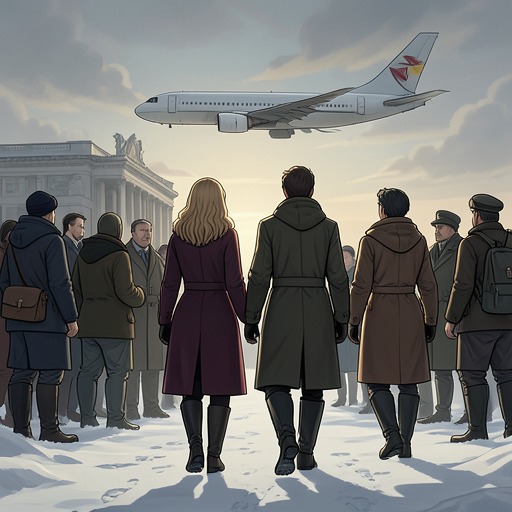
Elizabeth and Tyler leave with the religious wanderers
Station ElevenElizabeth Colton and Tyler Leander leave the Severn City Airport with a southbound band of religious wanderers during the summer after the Georgia Flu. Their departure is both a personal choice, framed by Elizabeth as a search for a more spiritual life, and a consequential break from the airport community that had become a place of refuge. In retrospect, the scene also points toward Tyler’s later connection to the Prophet, whose rule over St. Deborah by the Water Clark Thompson recognizes through a question about Elizabeth.
Background and Setting
The airport was a place of refuge created by interrupted travel. Clark Thompson had arrived there after a flight from New York was diverted to Michigan; Elizabeth and Tyler were aboard the same plane. They had intended to travel to Toronto before a predicted snowstorm, and their meeting with Clark was a coincidence only in a limited sense: he had told Elizabeth his plans, and she had said she would try to join the flight. At the airport they occupied different cabins, Elizabeth and Tyler in First Class and Clark in Economy, before the diversion brought them together in the same stranded community.
That arrival belonged to the last brief interval in which commercial flight still connected distant places. Clark’s plane was the twenty-seventh-to-last to depart from John F. Kennedy International Airport. After the collapse, airplanes remained on runways and in hangars, but no longer carried passengers between cities; their uses became local and practical, from storing food to sheltering teenagers. Against this history, the wanderers’ departure is not a simple continuation of ordinary travel. The airport’s road, rather than an international route, becomes the threshold between a settled refuge and an uncertain journey south.
The Wanderers’ Visit
The group arrived later that summer, headed south, and spent several uneasy nights at the airport. The precise nature of their religion was unclear. They described a new world that required new gods, said they were guided by visions, and spoke vaguely about signals and dreams. The airport residents judged hosting them less dangerous than driving them away, an uneasy accommodation rather than an embrace of their beliefs.
The visitors ate the airport’s food and offered blessings in return, usually laying palms on foreheads and murmuring prayers. At night they sat in a circle in Concourse C and chanted in a language unfamiliar to the residents. These acts gave their brief stay a visible and audible presence within the airport, but the group remained difficult for its hosts to understand. Their practices were presented as signs of a religious life, not as evidence that the community knew what the wanderers believed or where their visions would lead.
Elizabeth and Tyler Leave
When the group moved on, Elizabeth chose to go with them, and Tyler went too. She explained the decision as a wish for herself and her son to live a more spiritual life, and apologized to those remaining as though leaving amounted to a personal abandonment. Her apology makes the departure more than a change of location: she understands that the airport residents have shared the conditions of survival, and that her choice breaks a bond formed in that shared isolation.
Tyler appeared small as he followed at the back of the group. Clark watched them leave and thought he should have done more for Elizabeth, while also recognizing that he had barely managed to keep himself from being drawn toward an edge of his own. He could not see how he might have pulled her back. As the group disappeared around the curve of the airport road, Clark felt relief, and he was certain he was not alone in it. Dolores gave that shared response a blunt formulation, calling the wanderers’ insanity contagious. The scene leaves two reactions in view at once: concern for Elizabeth and Tyler, and relief that the group’s unsettling presence has gone.
Aftermath and Retrospective Significance
The departure takes on a different weight when the Travelling Symphony later reaches the airport. Charlie Harrison tells Clark that the troupe had encountered a prophet who claimed to be from there. Jeremy Leung describes a blond-haired man who ruled St. Deborah by the Water through charisma, violence, and selected verses from the Book of Revelation. Clark rises and goes to the museum’s first display case, where he looks at Elizabeth’s passport; he asks whether her mother is still alive. The question links the boy who left behind the airport with the man whose authority now governs a distant town, while the passport supplies the remembered image of Elizabeth from before the collapse. The connection emerges through Clark’s recognition rather than through a narrated account of what happened after the departure.
The airport’s later life sharpens the contrast. By Year Fifteen it has a museum, a school, and people who come to look at objects from the vanished world. The community that Elizabeth and Tyler left became a continuing settlement, while their choice carried them into a religious group whose later story is associated with the Prophet. Their departure therefore marks both an intimate separation and a turn in the larger history: a mother and son move away from the airport’s uneasy refuge, and the journey foreshadows the rise of a figure whose past Clark can finally connect to the people he once knew.