Frank Chaudhary
Station ElevenFrank Chaudhary is Jeevan Chaudhary’s brother, a wheelchair user and working ghostwriter whose life in their shared apartment becomes a close study of what collapse means in practical terms. As the Georgia Flu empties the city and its infrastructure fails, Frank’s reflections on civilization meet the immediate problem of moving through a world built around roads, services, and routines that no longer function. His final offer to leave first gives their crisis an intimate, unresolved edge: Jeevan understands what Frank means, but the passage does not narrate what follows.
Identity and Background
Before the crisis, Frank works as a ghostwriter. During the weeks in the apartment, he is absorbed in a memoir for a philanthropist whose identity he is contractually forbidden to disclose. He takes notes in the manuscript’s margins, continuing the project in the grey light filtering through the blinds. The work supplies a task in a life otherwise narrowed by uncertainty; Jeevan recognizes that Frank is hiding in it, and accepts that refuge rather than condemning it. He thinks that he too would hide in a project if he had one.
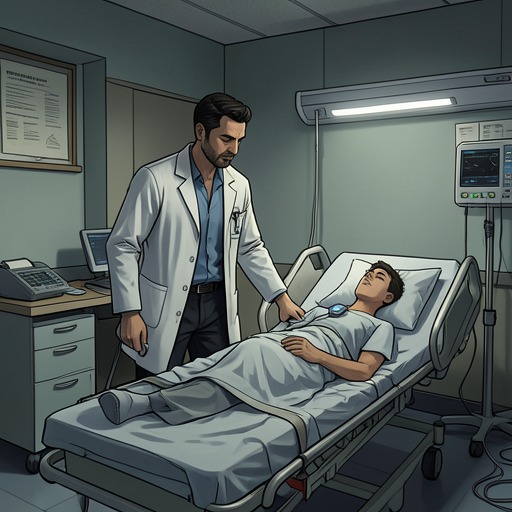
Frank’s physical circumstances are specified through his own account of being shot. In hospital, he was told he would not walk again. The text does not provide further detail about the shooting or his medical history, but it makes the wheelchair central to the decisions the brothers face. Frank is not presented only through a diagnosis: he works, reflects, speaks plainly about fear, and weighs the risks of leaving against the danger of remaining. At the same time, the crisis exposes how strongly the practical possibilities available to him depend on an environment that has stopped accommodating ordinary movement.
Life in the Apartment
The brothers share an apartment during the breakdown of city life. Frank works on his manuscript while Jeevan lies on the sofa, caught between thoughts of ordinary comforts and worry about whether he will see his girlfriend or his Cabbagetown house again. Outside, snow continues to fall, and communication has failed: cell phones no longer work, and Frank has no landline. The contrast between Frank’s ongoing work and the vanishing world around them is not a return to normality; it is a fragile routine maintained inside a crisis.
When the apartment lights go out, Frank tells Jeevan to stop repeatedly flipping the switches. Jeevan wonders whether the failure might be local, perhaps a blown fuse, but Frank sees the larger pattern: the lights had stayed on remarkably long. The power loss gives physical form to the collapse Frank and Jeevan have been trying to comprehend. Jeevan reflects that modern life had never been impersonal; it depended on countless unnoticed workers delivering fuel and food, keeping aircraft and power plants operating, and clearing trees from electrical lines. When those people stop going to work, the systems fail. Frank’s observation punctures Jeevan’s hope that the darkness might be confined to their building.
Disability, War, and the Meaning of Civilization
Frank’s understanding of civilization comes in part from his own experience after being shot. He recalls lying in hospital after being told he would not walk again and thinking about what civilization meant and what he valued in it. He says, “I never wanted to see a war zone again, as long as I live. I still don’t.” The recollection gives the present crisis a sharp resonance: the city outside has become dangerous, and the prospect of going out into it recalls precisely the kind of environment he had hoped never to face again.
That danger is not abstract. Looking at the expressway, Jeevan realizes that pushing Frank’s wheelchair through the jam of stopped cars would be impossible. They might take alternate roads, but he cannot know whether those roads are blocked as well. The obstacle is therefore not simply Frank’s body; it is a landscape of immobilized vehicles and failed infrastructure that leaves no clear route. The scene makes the material consequences of disability visible without treating Frank as a problem to be solved: the brothers must reckon with a world whose roads and systems offer him no reliable passage.
The Decision to Leave
After more than a week without hearing anyone in the corridor, Jeevan risks going out. He moves a dresser from the door, climbs to the roof, and finds a silent city with no other lights. Snow is in the air, and he decides that the brothers will leave under cover of the storm. Frank asks what could be waiting outside and points to the gunshots and news reports he has already heard. His fear is not ignorance of the danger but a clear-eyed response to it; he knows that survival beyond the apartment may mean entering a world shaped by violence.
The pressure is also concrete: the brothers have enough food for only about two more weeks, and Jeevan is troubled by the thought of maneuvering Frank’s wheelchair through the expressway traffic. Frank says he does not know where he would go or how he would manage it. When Jeevan insists that there is still a world outside, Frank counters that there may be nothing there but survival, and urges Jeevan to go and try. Jeevan says he cannot simply leave him. Frank answers, “I’ll leave first.” Jeevan asks what he means, while already understanding. The exchange leaves Frank’s intention implicit, but its force is unmistakable: he is prepared to make himself the one who goes first so that Jeevan will not have to abandon him. The passage ends on that unspoken meaning, holding Frank’s care for his brother together with the danger and constraints of the world beyond their door.