Georgia Flu pandemic and societal collapse
Station ElevenThe Georgia Flu pandemic and societal collapse mark the division between the interconnected world before the outbreak and a life organized around survival afterward. The crisis begins as a medical emergency, but its consequences spread through the systems people had relied on without seeing their dependence on them: hospitals, roads, air travel, electricity, news, and communications. As those systems fail, movement becomes dangerous or impossible, while small groups devise practical ways to remain fed, sheltered, and connected.
Outbreak and the first warnings
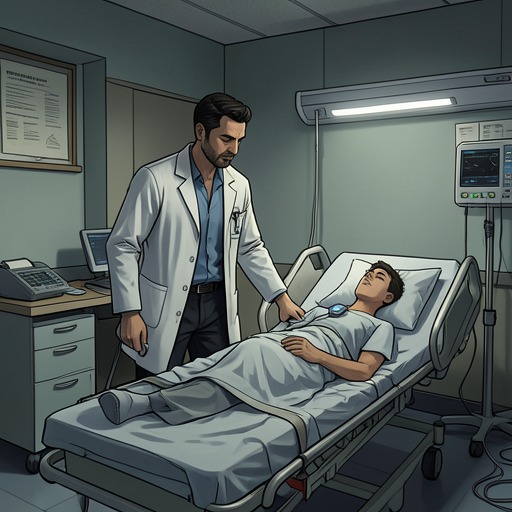
The outbreak becomes undeniable to Jeevan Chaudhary when Hua, a doctor who had once asked him to call if there were ever a real epidemic, reports that hospitals have admitted more than two hundred flu patients since morning. One hundred and sixty arrived in three hours, fifteen had died, and the emergency department was full, with beds placed in the hallways. Hua is afraid, and his warning carries particular weight for Jeevan because he knows Hua is not prone to exaggeration.
Hua tells Jeevan to leave or, if leaving is impossible, to obtain food and stay in his apartment. The warning changes Jeevan’s understanding of the illness: it is not a contained hospital emergency but an event that will divide his life into a before and an after. In a grocery store, he sees a television report that Toronto General Hospital and two other local hospitals have been placed under isolation. Health Canada confirms an outbreak of the Georgia Flu but releases no numbers; the report also says Georgian and Russian officials may have concealed the severity of the crisis. The official request for calm sits uneasily beside the accumulating evidence of deaths and overwhelmed care.
The breakdown of ordinary systems
In the first days, Jeevan and Frank shelter in Frank’s apartment and follow the news. Jeevan tapes plastic over the air ducts, covers the windows with Frank’s bath towels to conceal light, and moves a dresser in front of the door. When someone knocks, they fall silent. Twice, someone tries to force the lock, but the deadbolt holds. Their precautions show how quickly a home changes from a private refuge into a boundary against an outside world that can no longer be trusted.
The news becomes both indispensable and increasingly unreliable as a source of shared understanding. By the fifth day, broadcasters are replaced by network employees unused to appearing on camera. Reports from Moscow, Beijing, Sydney, London, and Paris disappear, while local stations fall away one by one. The final newsroom broadcast gives way to static, test patterns, and repeated emergency instructions; then the Internet goes out. The loss is not a single dramatic switch-off but a sequence of absences, each making it harder to know what is happening beyond immediate reach.
Toronto grows quieter as the city’s familiar hum fades. Abandoned cars block roads, and even those with fuel cannot make progress through traffic. The pandemic also ends ordinary air travel. Airplanes remain on runways and in hangars, collecting snow; later, people adapt some of them for food storage, including fruit left to dry in the summer heat. The contrast is stark: aircraft built to connect distant places become stationary containers, while borders go unmanned and public services such as policing, firefighting, road maintenance, and garbage collection disappear. The failure of the old world is therefore not only the loss of machines, but the loss of the people and coordination that kept them useful.
Flight, entrapment, and makeshift survival
The collapse forces radically different responses to movement. Kirsten Raymonde remembers remaining in a basement while her neighbourhood emptied. Peter Raymonde steals food at night, then announces that they must leave. He hotwires an abandoned car, but the expressway ramps and side roads are clogged with vehicles, so they join others on foot. They travel east and south, around a lake and into the United States, where the border guards have left. Their escape is not a planned journey so much as a passage through the openings left by a disintegrating transport system.
Before the outbreak closes air routes, Clark Thompson boards one of the last planes to leave John F. Kennedy International Airport. He is travelling to Toronto and does not realize at first that Elizabeth Colton and her son, Tyler Leander, are on the same flight. The aircraft is diverted to Severn City Airport, where passengers disembark without understanding why. When Clark decides to stay, other passengers who have tried to leave return with news that ground transport is unavailable. An Air Gradia agent is crying at the ticket counter; the display still lists Flight 452 as arriving, while an announcement over the agent’s radio identifies a quarantine. A place designed for transit becomes a place of involuntary waiting.
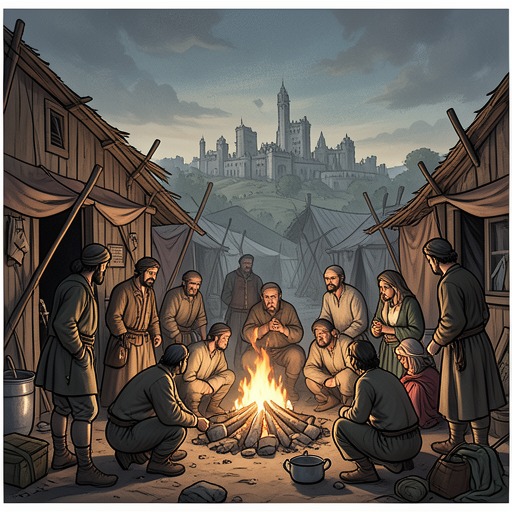
The airport’s remaining population gradually makes survival collective. Some passengers cover their mouths and noses, but the uncertainty persists: those who are still there do not know whether they have been exposed or whether help will come. People break into airport businesses for food and clothing. On the eighth day, the remaining TSA agent, Tyrone, goes into the trees with a former park ranger and two service handguns; they return with a deer, which the group cooks over a fire. The practical effort does not restore the institutions that have disappeared, but it provides a meal and a shared task. Meanwhile, the networks stop broadcasting, the lights briefly fail, and the airport switches to generator power after the grid goes down. The workers who knew how the generators operated have already left.
Aftermath and a new social scale
Beyond the airport, signs of quarantine turn the surrounding landscape into both warning and barrier. A scouting party finds a roadblock bearing a warning that the flu is present and sick passengers should be kept out. Past it are abandoned cars, some containing bodies; near the airport, the party avoids a hotel after recognizing what its darkened lobby signifies. They find no other people. Returning with carts of supplies, Dolores feels relief when the airport comes into view between the trees. The settlement has become home not because it is safe from every danger, but because its inhabitants can recognize one another and organize their needs there.
By the end of Year Fifteen, three hundred people live at the airport, and the Museum of Civilization fills the Skymiles Lounge. Clark once spent his days gathering firewood, carrying water to keep the toilets operational, salvaging supplies, planting crops along the runways, and preparing deer. As the population grows and others take on more of that work, he devotes his time to the museum, keeping records and preserving objects that have no practical use in the new economy: phones, computers, impractical shoes, polished engines, passports, and credit cards. Those objects make the former world tangible without making it recoverable.
Jeevan Chaudhary’s later life offers another measure of the transformation. After walking a thousand miles, he reaches McKinley in Year Three, a settlement founded by eight people stranded at a corporate retreat when the flu swept across the continent. What began as a place to stop during the frightening early years becomes a community of twenty-seven families. By Year Ten, Jeevan has married Daria, one of its founders; in Year Fifteen, he sits with her by a river in what was once Virginia. The pandemic’s lasting consequence is not a return to the old network of cities and institutions, but the formation of smaller settlements whose survival depends on local cooperation. The catastrophe changes the scale of human life, while the surviving communities make clear that the collapse of a system need not mean the end of social life.