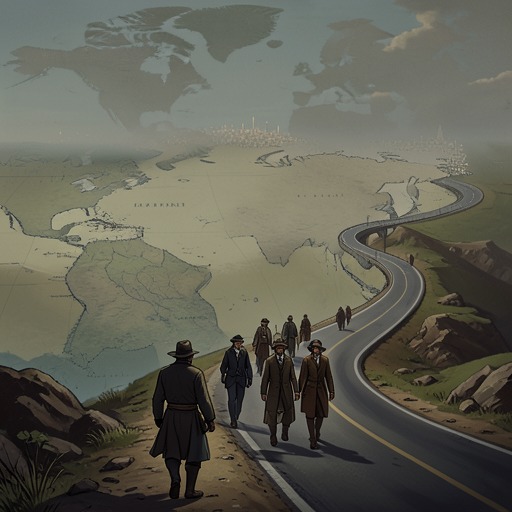
Georgia Flu pandemic and the Collapse
Station ElevenThe Georgia Flu pandemic and the Collapse mark the passage from an interconnected modern world to a society in which the systems that once made daily life possible have largely ceased to function. The outbreak moves with terrifying speed, but the disaster is not only the disease: it is also the failure of communication, transport, utilities, and the human labor hidden beneath them. Through the experiences of Jeevan Chaudhary, Clark Thompson, and Miranda Carroll, the novel renders collapse as both a public emergency and the sudden loss of familiar connections.
Economic Fragility Before the Outbreak
Before the pandemic is understood as a global emergency, economic collapse has already immobilized a vast commercial network. Off the coast of Malaysia, twelve percent of the world’s shipping fleet lies at anchor. The largest shipping fleet ever assembled is positioned fifty miles east of Singapore Harbour, including twelve ships belonging to Neptune Logistics. Two new Panamax-class vessels have never carried a single container: they were ordered when demand seemed certain to keep growing, built over three years as the economy contracted, and left without a purpose when spending dried up.
Miranda Carroll visits the ships by company helicopter and finds skeleton crews aboard vessels where the empty rooms and corridors amplify the men’s isolation. A man tells her he has not been ashore in three months. Her superior, Leon Prevant, worries that the crews cannot simply be left alone and imagines the ships as floating parties, but the men are serious and afraid of pirates. At night, their lights are intended to prevent collisions; from the beach, Miranda sees them as a distant, almost otherworldly settlement. The image makes the old world’s dependence on global circulation visible before that circulation is extinguished: enormous ships remain, but the commerce and movement that gave them purpose have faltered.
The Outbreak Reaches Toronto
The crisis becomes immediate for Jeevan when Hua calls with news from the hospital. More than two hundred flu patients have been admitted since morning, 160 in the preceding three hours, and fifteen have died. The emergency room is full and beds have been placed in hallways. Hua is not merely tired; Jeevan recognizes that his friend is afraid. Hua tells him to leave at once or, if leaving is impossible, to stock up on food and stay inside his apartment. Because Hua is known for understatement, Jeevan takes the warning as proof that the situation is worse than the word epidemic can convey. He experiences it as a dividing line between a before and an after.
The warning is already late in one crucial sense: the disease is not confined to a distant outbreak. News reports say that Toronto General Hospital and two other local hospitals have been placed under isolation, while Health Canada confirms the Georgia Flu and acknowledges fatalities. The illness is described as developing rapidly: exposure can bring sickness within three or four hours, followed by death in a day or two. Clark Thompson, who has paid little attention to the news and has only recently heard of an outbreak in Paris, encounters the North American emergency while in the air. On arriving at Severn City Airport, he sees reports of delayed evacuations, hospital riots on three continents, and roads clogged by people trying to flee. The scale is no longer local, and the roads reveal the futility of escape by ordinary means.
At the airport, travelers receive no reliable guidance. Some leave because an intercom instructs them to do so; others return after discovering there is no ground transport. About a hundred passengers remain, while an Air Gradia agent weeps beside a flight display that still announces Air Gradia Flight 452 as arriving. Clark hears the word quarantine over her radio. The airport becomes a refuge not by design but because movement beyond it has failed. People cover their mouths and noses, watch planes parked end to end, and wait without knowing whether they have reached safety or merely another place where the crisis has caught up with them.
The Failure of Communication and Infrastructure
Jeevan and Frank retreat into an improvised domestic defense. Jeevan tapes plastic over the apartment’s air ducts, hangs towels over the windows to keep light from escaping, and pushes Frank’s dresser in front of the door. When people knock, they fall silent. Twice someone tries to force the lock with a metal tool, but the deadbolt holds. The repeated broadcasts offer little relief: the numbers seem impossible, and the newsreaders’ delivery grows numb and strained as the emergency overwhelms the forms meant to contain it.
The collapse of information unfolds in stages. By Day Five, Frank turns from the news to his ghostwriting project. Broadcasts from Moscow, Beijing, Sydney, London, and Paris disappear; local stations become more local as other channels fall away. At last, a newsroom camera shows no one. Other channels offer static, test patterns, or repetitive government advice to stay indoors and avoid crowds. Then the camera is switched off or fails, and the Internet goes dark. With it goes not just a communication tool but the everyday traffic of social life: messages, photographs, plans, pleas, and the small habit of following other people’s lives to feel less alone.
The city’s silence deepens as the networks that support movement and supply fail together. Cars have first inched along the expressway, carrying trailers and luggage, but the gridlock becomes absolute; by the third morning people are walking between abandoned vehicles with children, suitcases, and dogs. Fuel is not reaching stations, food is not reaching stores, and the roads cannot be cleared. Jeevan understands that the apparent impersonality of modern life concealed a delicate infrastructure made of people. When workers stop going to power plants and substations, fallen trees remain on electrical lines. No fuel delivery means stranded cars and grounded airplanes; no trucking means goods never reach cities. Standing by the window, Jeevan sees the lights go out. His instinct to flip the switches cannot restore the system behind them.
Aftermath, Objects, and a New Social Record
At Severn City Airport, the first scouting party returns with steel kitchen carts loaded with supplies from an unlooted restaurant: rice, tomatoes, soap, napkins, and bottles of Tabasco sauce. Beyond a roadblock warning that the flu is present, they have seen abandoned cars, some containing bodies, and no other people. Dolores describes the return to the airport as a moment of relief: after the silent road, the terminal has come to feel like home. The change is small but consequential. A stranded group begins to understand itself not only as a collection of passengers but as a community with a place to defend and supplies to share.
Clark’s Museum of Civilization gives the abandoned objects a different kind of afterlife. It begins with his iPhone, a credit card, a driver’s licence, and his laptop arranged in a display case that once held sandwiches. Others add a second phone, red high heels, and a snow globe. To Clark, the objects carry the human work behind their manufacture and movement: the snow globe recalls its makers, the ship that carried it, the shipping manifest, and the delivery driver who brought it to the airport. The museum preserves more than useful technology. It makes visible the chain of labor and coordination that the pandemic has broken, and turns ordinary possessions into evidence of people who are absent.
By the end of Year Fifteen, three hundred people live at the airport and the museum fills the Skymiles Lounge. Clark once gathered firewood, hauled water to keep the restrooms operating, salvaged supplies, planted crops beside the runways, and skinned deer; as the population grows and he ages, caring for the collection becomes his work. He records objects traded to him and keeps the passports of Elizabeth Colton and Tyler Leander open to their photographs, reminders of the people who left. The pandemic’s lasting consequence is therefore not simply a world emptied of services. It is a world forced to make new forms of shelter, cooperation, memory, and meaning from what remains.