James
Station ElevenJames is the first stranger to walk into Severn City Airport after the collapse, arriving as a figure the residents cannot yet place in their new community. His story later becomes bound to the airport’s Museum of Civilization: he returns almost every day to look at the motorcycle he found and used before fuel ran out, an object that preserves a vanished form of movement and a personal attachment to the past.
Arrival at the Airport
The airport residents had begun posting guards with whistles to warn them when strangers approached. When James appeared on the road beneath low grey skies, he was carrying a gun, but he stopped and let it fall when Tyrone shouted for him to drop it. He raised his hands and faced the people gathering around him.
James struggled to speak. His lips moved without sound, and he had to clear his throat several times before he could explain that he had been in the hotel and had followed the residents’ footprints in the snow. Clark realized that James had not spoken in some time. Tears on his face made the encounter difficult for the residents to read: this first outsider seemed stunned rather than threatening, and his arrival marked a change from guarding against an imagined danger to confronting a person in need of contact.
The Motorcycle
James’s earlier life in Severn City is represented by a motorcycle he found in the city in Year Two. He used it until the automobile gas went stale and the aviation gas ran out. The sequence ties his personal history to the practical limits of post-collapse mobility: the vehicle could carry him while fuel lasted, but no longer functioned once the systems that supplied it had failed.
The abandoned airplanes around the airport likewise remain after ordinary air travel has ended. Across the wider landscape, aircraft stand dormant and are put to other uses, while their fuel becomes a finite resource. Against that altered world, James’s motorcycle is more than a surviving machine: it recalls a period when movement depended on engines and fuel, and when a vehicle could be used rather than only remembered.
The Museum and Its Afterlife
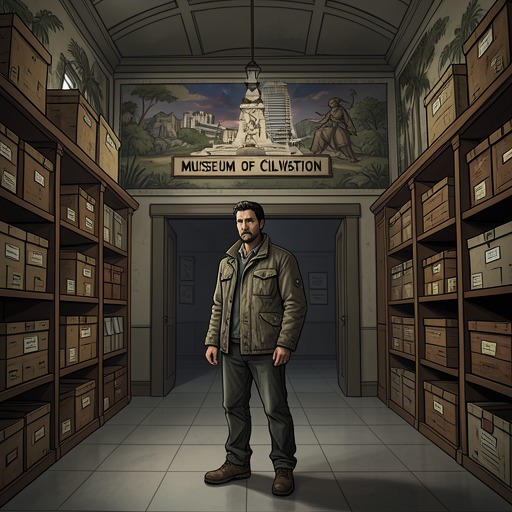
In Year Fifteen, James comes to the Museum of Civilization almost every day to look at the motorcycle. He misses it very much. His repeated visits give the museum a personal dimension alongside its preservation of old newspapers and other remnants: the exhibits are not merely evidence of a lost world but objects to which living people remain attached.
The motorcycle’s place in the museum also completes a quiet reversal. Once found and used by James, it is now looked at as part of the past; the person who knew it as transport returns to encounter it as a remnant. His routine makes that change legible without erasing the affection that survives it.