Jeevan Chaudhary—Frank
Station ElevenJeevan and Frank are brothers whose bond is shown less through frequent contact than through the obligations and memories that surface when disaster arrives. On the night Arthur Leander dies, Jeevan decides to seek Frank out, wanting to share both the shock of the death and his discovery that working as a paramedic feels like the right profession. Hours later, as the Georgia Flu spreads through Toronto, the question of what Jeevan can do for his brother becomes urgent and concrete: leaving the city is not a simple option when Frank uses a wheelchair and no suitable van can be rented at that hour.
Brothers Before the Crisis
Frank lives in a glass tower on the south edge of Toronto, overlooking the lake. Jeevan, wandering through Allan Gardens after Arthur’s death, thinks of visiting him. He wants to tell Frank about the evening at the theatre: the awfulness of Arthur’s death and the sense of purpose Jeevan has found in paramedic work. That impulse gives the visit an intimate purpose. Frank is not simply the next person in Jeevan’s path; he is someone with whom Jeevan wants to make sense of a night that has changed his understanding of himself.
Their shared history appears in brief, specific recollections. Jeevan remembers bird-watching with Frank, who had binoculars, and the small number of occasions on which they had gone together. The detail suggests a relationship made up of intermittent companionship rather than constant presence. Frank also occupies Jeevan’s thoughts as he rides a streetcar through the snow: memories of the theatre and of Arthur lead him to birds, then to those outings with his brother. In the same wandering chain of thought, Jeevan recalls Laura and wonders what will become of them. His concern for Frank exists alongside other unsettled personal ties, but it becomes the one he acts on that night.
The Visit and Its Practical Stakes
The outbreak changes the meaning of Jeevan’s visit. After speaking with Hua, a doctor at Toronto General Hospital, Jeevan hears that local hospitals are under isolation and that the Georgia Flu has caused fatalities. Hua urges him to leave the city that night or, if that is impossible, to stock up and remain inside. Jeevan enters a grocery store near the harbour and begins buying water and food while still intending to reach Frank and check the news there.
Hua then tells him to take both Frank and Laura and leave the city immediately. Jeevan answers that he cannot leave with Frank because he cannot rent a wheelchair van at that hour. The exchange makes the limits of the advice plain: the danger is pressing, but a command to escape does not account for the transport Frank would need. The text presents Frank’s wheelchair as part of the actual circumstances shaping the brothers’ choices, not as an abstract obstacle that Jeevan can simply will away. Jeevan continues gathering supplies rather than resolving the problem by abandoning the plan to see his brother.
Arrival at Frank’s Door
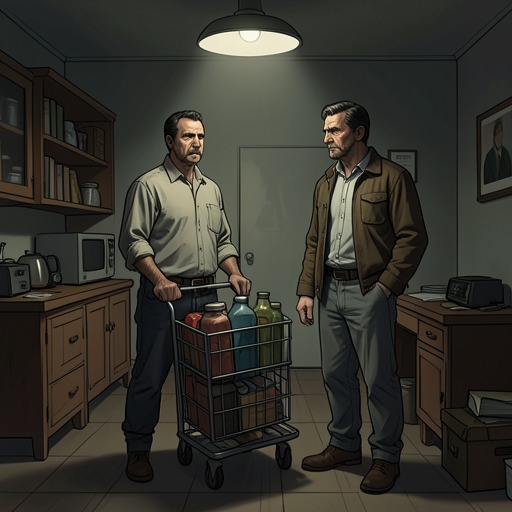
Jeevan reaches Frank’s apartment at one in the morning with grocery carts lined up in the corridor. The visit is unannounced, and Jeevan has to face the difficulty of explaining why he has arrived with so much food and water. Frank opens the door and greets him warmly; Jeevan, unable to explain himself, steps back and gestures toward the carts. Frank looks down the hall and recognizes that Jeevan has been shopping. In that small exchange, their connection is conveyed through action and response: Jeevan brings what he can, while Frank receives the unexpected arrival without turning it into a confrontation.
The brothers’ relationship is defined in this episode by an affection that is not elaborated into a long history of shared life. Their occasional bird-watching, Jeevan’s wish to tell Frank about his newly chosen work, and the late-night delivery of supplies establish the available terms of their closeness. The approaching epidemic tests that bond through a practical question—how to protect Frank when ordinary transportation is unavailable—and the scene ends with Jeevan at his brother’s door, the carts making his concern visible before he can put it into words.