Jeevan leaves Toronto and survives on foot
Station ElevenJeevan Chaudhary leaves Toronto and survives on foot after the Georgia Flu turns the city into a place of isolation, danger, and dwindling human presence. His departure is not a planned journey toward a known refuge: he chooses the lakeshore because roads and towns seem more hazardous, and keeps moving through a landscape whose emptiness gradually reveals the scale of the catastrophe. The trek carries him from the guarded stillness of his brother Frank’s apartment into a new life organized around vigilance, memory, and the need to continue.
Warning and Departure
Jeevan’s decision to leave begins with a warning from Hua, his close friend and a hospital doctor. Hua reports that more than two hundred flu patients have been admitted since morning, including fifteen who have died, and that the emergency department is overwhelmed. He tells Jeevan that the illness is already spreading beyond the hospital and advises him to leave immediately or, if that is impossible, stock food and stay inside. Jeevan trusts Hua’s characteristic understatement: if Hua calls it an epidemic, Jeevan understands that the danger is greater than the word suggests. He recognizes the outbreak as a dividing line between the world before and the world after.
At Frank’s apartment, the brothers spend days following television reports as the death toll rises. Jeevan seals the air ducts with plastic, hangs Frank’s bath towels over the windows to hide light, and pushes a dresser against the door. Twice, someone tries to force the lock; the brothers remain silent until the attempts stop. These precautions offer temporary protection, but not a future. As the news becomes an almost abstract litany of disaster, the apartment’s barriers also mark how fear has narrowed their world to the people inside it.
Frank dies before Jeevan leaves. On the final evening, Jeevan watches the expressway through a telescope and sees only two people, both moving away from downtown. He checks Frank’s breathing, even though he knows the second check is irrational, because he fears Frank waking alone. At Frank’s desk, he finds a page from the manuscript Frank had been working on, with a handwritten reflection about immortality in the margin. Unsure whether the words belong to Frank or to the manuscript’s subject, Jeevan folds the page and puts it in his pocket. It becomes one of the few personal objects he carries out of the apartment.
Just after sunset, Jeevan takes a dusty backpack that Frank had used for hiking before a spinal-cord injury. The backpack’s presence in the apartment is unexplained, and Jeevan does not know what Frank had intended for it. He moves the dresser aside, listens before opening the lobby door, and finds the glass doors smashed. Outside, there is no electric light. Smoke suggests fires in offices and homes, but the more decisive change is the city’s darkness: the infrastructure that once made Toronto legible has gone quiet, and Jeevan wants only to escape.
The Lakeshore Route
Jeevan resolves to follow the lake. The beach is difficult to cross in snow, and he worries about losing his footing and leaving tracks, but he prefers the exposed shore to the roads. He walks with the lake to his left, returns to the water after climbing embankments or following streets, and stops often to listen. His attention is fixed on immediate risks: a sound might signal danger, and another person might want the supplies in his pack. The journey makes caution less a strategy than a continuous way of perceiving the world.
The city falls away behind him, but the first hours do not bring a sense of safety. Jeevan hears two distant gunshots. Cold, fatigue, and the lack of shelter complicate the effort to keep moving; he uses snow to stay hydrated and, at sunrise, builds a rough windbreak from driftwood and garbage bags. He curls around the backpack and sleeps fitfully. The familiar rhythms of home are gone, replaced by improvised decisions about where to walk, when to stop, and how to protect what little he has.
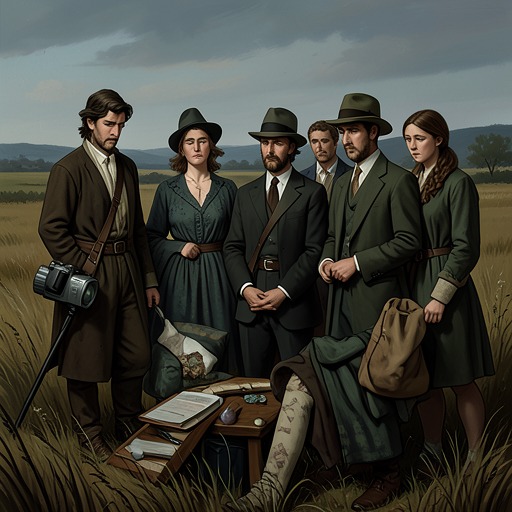
For five days, Jeevan sees no one. The solitude initially seems safer than the lawless world he had imagined, where someone might rob him and leave him without supplies. Then its meaning changes: the Georgia Flu has killed so efficiently that almost no one remains. When he finally spots three people ahead on the shore, relief overcomes his suspicion. He follows them at a distance through the day, then approaches their beach fire at night with both hands raised to show he is unarmed. Ben and Abdul, two young men, and Jenny, an older woman, let him join them. They have been walking for a day longer than he has, after coming from the northern suburbs.
Company, Separation, and Continued Survival
Jeevan travels with Ben, Abdul, and Jenny for nearly a week. Their routes diverge when he wants to keep following the lake and they want to turn west toward a town where Jenny’s sister had lived. They debate the choice for an hour or two: Jeevan considers entering a town a mistake, while Jenny is afraid she may never see her sister again. No shared plan resolves the disagreement. They wish one another luck and part, making the journey’s temporary alliances as consequential as its hazards. Alone again, Jeevan feels small against the landscape, but also more intensely alive and sad than he has ever felt.
His route keeps him away from roads and towns. He sees snowbound cars and abandoned places, steps around the dead, and hears gunfire in towns he chooses not to enter. On the roads, travellers move with stunned expressions; some children are wrapped in blankets, and people risk being killed for the contents of their backpacks. Jeevan instead slips into country houses to look for canned food while the occupants lie dead upstairs. The distinction between routes is practical rather than absolute: avoiding crowds and gunfire lowers some risks, but means searching alone and relying on chance provisions.
The effort also threatens Jeevan’s sense of self. As he walks, he recites biographical facts to anchor himself to his former life: his name, his work as a photographer and intended career as a paramedic, his parents’ names and origins, and the Toronto suburb where he was born. The facts break apart and give way to fragments of thought. Eventually he repeats an instruction to keep walking. The phrase reduces the future to its smallest possible demand, while the owl watching from a snow-laden branch briefly places him within a world that continues beyond human plans.
Meaning and Aftermath
Jeevan’s trek belongs to a larger reversal in the novel’s account of mobility. Before the Collapse, people crossed distance in airplanes; afterward, the abandoned aircraft remain on runways and in hangars, collecting snow or serving as places to store food. The old network of rapid travel gives way to walking, stalled cars, and journeys shaped by food, weather, and danger. Jeevan’s decision to stay off the roads embodies this changed world at ground level: movement remains possible, but it is slow, vulnerable, and dependent on judgment rather than functioning infrastructure.
His survival does not restore the life he left. Frank is gone, the city’s lights are out, and even the encounter with other people offers only a temporary companionship before the travellers separate. What carries forward is a page taken from Frank’s desk, the discipline of attending to immediate needs, and the repeated insistence on continuing. The departure therefore marks both an escape from Toronto and a break with the assumptions that had made his former life recognizable. In the empty landscape, staying alive requires not a destination but the next step.