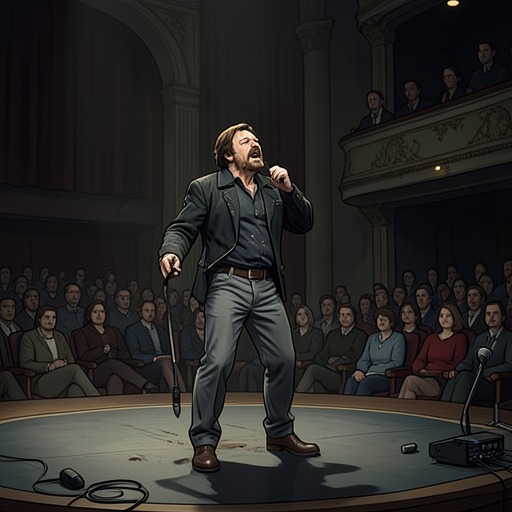
Jeevan’s attempt to resuscitate Arthur
Station ElevenJeevan Chaudhary’s attempt to resuscitate Arthur Leander begins when a theatrical collapse becomes a real medical emergency during King Lear at Toronto’s Elgin Theatre. Trained as a paramedic, Jeevan recognizes the danger in time to reach Arthur and begin CPR, but the effort cannot save him. The scene turns the stage’s artifice—its snow, scenery, and roles—into the setting for an urgent encounter with death.
The performance breaks down
The emergency unfolds during act four, in the mad scene. Arthur, playing Lear, is surrounded by child performers who have returned as hallucinations of Lear’s daughters. He falters, reaches for a column, and strikes it with the side of his hand. His next line is wrong, his voice is barely audible, and he clutches his hand to his chest. At first, the actors and audience cannot be certain that the apparent distress is not part of the performance.
Jeevan is in the first row of the orchestra section. His girlfriend, Laura, tugs at his sleeve as he rises; people behind him murmur for him to sit, and an usher moves to intercept him. The hesitation is brief but consequential: Jeevan himself is not initially sure what he is seeing. Then Arthur sways, his eyes unfocused, and Jeevan understands that the actor is no longer playing Lear. He pushes past the usher and rushes toward the stage.
Reaching Arthur
The route onto the stage is not straightforward. A second usher is coming down the aisle, so Jeevan throws himself up rather than reaching the stage by the stairs. The first usher grabs his sleeve; Jeevan kicks free and gets to Arthur, who has been leaning against a plywood column. He catches him as he loses consciousness and lowers him gently to the floor. The care of that movement contrasts with the force of Jeevan’s scramble through the obstructed space.
Plastic snow continues to fall around them, catching in Jeevan’s clothing and brushing his skin. The scenic column is painted wood, not stone; the snow is translucent plastic, not weather. Yet the emergency is not theatrical. Arthur is not breathing, and his heart is not beating. Jeevan begins CPR as the audience’s clamour, phone-camera flashes, and shouted reactions fill the theatre. The performers who had been sustaining the fiction of the play are now distracted by a crisis beyond it.
CPR on a transformed stage
The curtain drops, cutting off the audience and diminishing the stage’s brilliance. The change does not stop the snow. Under fluorescent light that seems yellow beside the earlier blue and white, Jeevan works on Arthur’s chest. The fallen curtain makes the stage feel like a separate room, but its open spaces and catwalks also suggest a transit point, somewhere people pass through. The setting’s theatrical boundaries offer temporary privacy without making the situation private: stagehands, actors, security staff, and medical responders move around the pair.
Walter Jacobi, a cardiologist, joins Jeevan on the other side of Arthur’s chest and identifies himself. Jeevan gives his own name. Their exchange briefly establishes who is working on Arthur, but it does not turn the crisis into a composed medical scene. Jeevan is absorbed in the task and in Arthur’s face; people and activity around him seem distant. When Walter asks whether he should take a turn, Jeevan raises his hands and lets the cardiologist continue the compressions. The transfer is a practical act of cooperation: the attempt becomes shared, rather than belonging to the lone spectator who first crossed the distance to the stage.
The ambulance arrives, and two paramedics approach through the still-falling plastic snow. They crowd Jeevan aside and take over. He steps back, touching the smooth, painted column as he does so. The medics call for the area to be clear and shock Arthur’s body. The scene gives no impression that their efforts are succeeding. The snow is eventually switched off, and its last pieces drift down while the child actress, still onstage, watches the responders. Jeevan kneels in front of her and speaks to her, another small response to the people left exposed by the emergency.
Significance and aftermath
Jeevan’s intervention is a collision between the ordinary obligations of a spectator and the demands of an emergency. He has training, but he does not move with effortless certainty: his girlfriend questions him, the audience urges him back into his seat, and he hesitates over whether Arthur is acting. Recognition changes his role. He leaves the audience and enters the performance space, where the distinction between actor and character has already failed.
The details of the scene insist on both the reality of the emergency and the persistence of theatrical illusion. The column looks like stone but is painted wood; the snowfall is plastic; the blue-lit storm gives way to fluorescent glare. None of those effects can obscure the stopped heart beneath them. As the stage is cleared for medical work, the curtain briefly divides the rescuers from the audience, but it cannot restore the play’s former order. Arthur’s collapse is his final collapse onstage, and the rescue attempt marks the point at which the performance gives way to the fact of his death.