Kirsten Raymonde
Station ElevenIdentity and Early Life
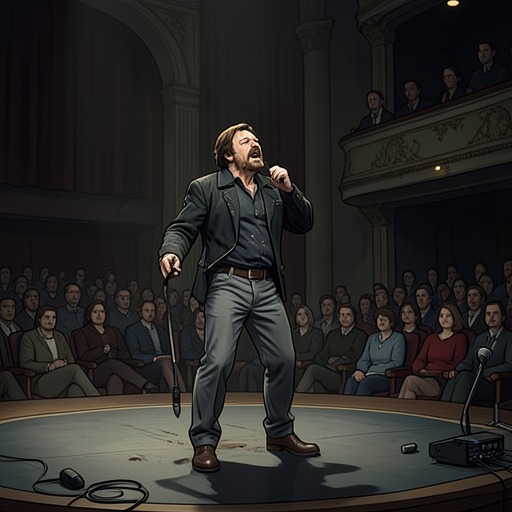
As a young actor in Toronto, Kirsten played a small, nonspeaking role in a short-lived production of King Lear. She was still a child when the production’s lead, Arthur Leander, suffered a heart attack onstage. During the crisis, Jeevan Chaudhary found her beside the motionless actor and asked her name. Kirsten was frightened and sobbing; her mother was not due to pick her up until eleven. The scene establishes her at the boundary between childhood and adult catastrophe: she is present at a death whose significance she will carry long after most of the surrounding period has faded from memory.
Arthur knew her as Kiki. When he introduced her to Miranda Carroll, Kirsten was seven or eight, very blond, and carrying a colouring book and pencil case. Her ease in asking whether she could draw in the room sits beside the adult seriousness of the performance in which she was acting. These glimpses make the child’s later transformation into an armed traveler legible without suggesting that she simply remembers a continuous passage from one life to the other.
Memory, Loss, and the Road
Kirsten’s recollection of the years around the collapse is sharply incomplete. She later tells François Diallo that she was in Toronto on the night Arthur died, but cannot remember much about that period generally. What remains is unusually precise: she was onstage behind Arthur, heard a sharp impact as he stumbled into a plywood pillar near her, and remembers someone from the audience climbing onto the stage and running toward him. The remembered sound and gesture outlast much of the context around them.
She left Toronto with her brother, though she knows this in part because he told her. The two spent thirteen unremembered months on the road before reaching an Ohio town, where her brother later died and Kirsten eventually left with the Travelling Symphony. At fifteen, during her first year with the group, she killed a man who attacked her from the underbrush. She describes the episode as a sudden alteration in perception: sound seemed to drain away and time to stretch while she drew a knife and threw it at his throat. Dieter explained the sensation as a physiological response to danger, but Kirsten could not account for her calm afterward. She stopped trying to recover the lost year because she suspected it contained things she did not want to know.
The absence is not merely a blank in a life otherwise restored to order. Kirsten’s face bears a scar from that unremembered year, and when Diallo asks how she got it, she says she has no idea. Her brother did not explain it before he died. The scar, the missing months, and her account of the knife attack place limits on what she can retrieve while showing how much of her past remains physically present.
The Travelling Symphony and Its Art
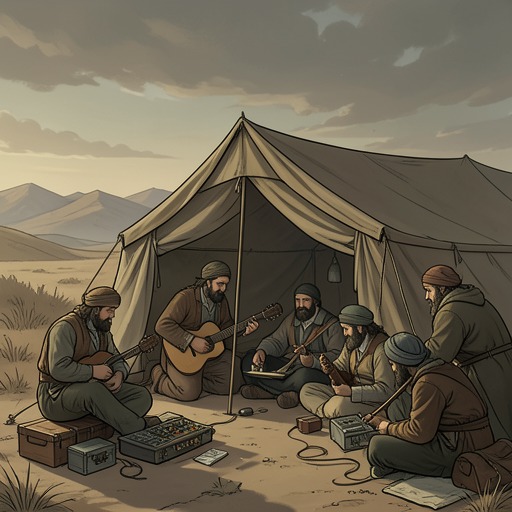
Twenty years after the end of air travel, Kirsten walks with the Travelling Symphony near Lake Michigan in severe heat. The group moves slowly under a white-hot sky, its horses needing frequent rest; its members carry weapons, watch the road, and rehearse as they travel. Kirsten wears sandals cut from an automobile tire and keeps three knives in her belt. She reads from a paperback King Lear whose stage directions are highlighted in yellow, practicing lines with August, a violinist who has recently begun acting. The scene sets Shakespeare’s lines against the practical details of travel: performance continues, but never outside the conditions of survival.
In a performance of A Midsummer Night’s Dream in St. Deborah by the Water, Kirsten plays Titania. She wears a crown of flowers over her close-cropped hair; candlelight partly softens the jagged scar on her cheekbone. Her wedding dress, scavenged near New Petoskey, is streaked with blue from a child’s watercolour kit. The improvised costume, the candlelit stage, and the silent audience make the performance a particular achievement of the changed world, not an attempt to restore the old one. Kirsten says she never feels more alive onstage and fears nothing while performing. As Titania, she speaks of contagious fogs and altered seasons before an audience gathered in a town where Lake Michigan lies only half a mile away.
The Symphony’s lead caravan bears the words Because survival is insufficient. Kirsten has carried the same phrase on her left forearm since she was fifteen. She and Dieter have argued about the tattoo for years: he objects to tattoos, while she regards the phrase as her favourite line of text. The disagreement has become a familiar exchange between dear friends rather than an active quarrel. Her two small black-knife tattoos on the back of her right wrist have a different function, marking specific events. Together, the inscriptions make her body a compact record: one phrase states what she believes life requires, while the knives register what she has endured.
Relationships and Recognition
Dieter is one of Kirsten’s dearest friends in the Symphony, and August is her close traveling companion. When she and August are separated from the group near Severn City, she dreams that he has disappeared and is dead. She wakes with tears in her eyes and finds him watching her with a hand on her arm; he tells her he is there. The dream gives form to the immediate fear of losing the person who has shared the road with her, while the brief exchange confirms that, in waking life, he is beside her.
Printed records offer another kind of companionship across time. As a teenager, Kirsten found a celebrity magazine showing Arthur picking up his seven-year-old son, Tyler, at Los Angeles International Airport. In the photograph, Arthur carries the beaming child. The Georgia Flu would arrive a year later. The magazine reconnects Kirsten to the actor she had known onstage and gives her an image of his family life beyond the fragment she retained from his death.
Years later, a New Petoskey newspaper carries a report praising a Travelling Symphony performance of King Lear, singling out Gil Harris as Lear and Kirsten as Cordelia. Its final page includes Diallo’s interview with her. The publication turns a living performance into a record that can circulate after the troupe has moved on, even as Kirsten’s own account stresses how little she remembers. When Clark Thompson reads the newspaper, her name and role place her within a chain of encounters that connects the old theatrical world to the new communities built after the collapse.
Conflict, Departure, and Narrative Significance
During the confrontation with The Prophet, Kirsten answers his language about light and the Undersea by recalling words from the first issue of her comics: a longing to go home, to dream of sunlight and walking on earth, and to return to the world into which one was born. She speaks the lines while looking past him toward a boy holding a gun. The comics are not simply possessions from an earlier life; in this moment, their language becomes an available response to the violent, competing interpretation of the world around her.
After the Travelling Symphony stays for five weeks at Severn City Airport, performing Shakespeare and music on alternate evenings and repairing its caravans, it prepares to leave for unfamiliar territory. Kirsten gives Clark one of her two Dr. Eleven comics because she wants at least one copy to remain safe if trouble comes on the road. She plans to reclaim it when the Symphony returns and leave him with the other, turning the exchange into a practical arrangement for preserving both books. Her excitement about the southern town with an electrical grid is evident to Clark, who has come to know her during the group’s stay.
Kirsten’s role is therefore not only that of a survivor or performer. She carries the opening catastrophe into the later narrative, but her story is not confined to witnessing Arthur’s death. She has made a life of movement, friendship, alertness, and repeated performance, even though important parts of her own past remain inaccessible. The highlighted stage directions, the knife tattoos, the celebrity magazine, the newspaper interview, and the comic entrusted to Clark are different kinds of records. None restores her lost memories, but each preserves a connection—between a child and the actor who was kind to her, between the road and the stage, or between a story and the people who might need it later.