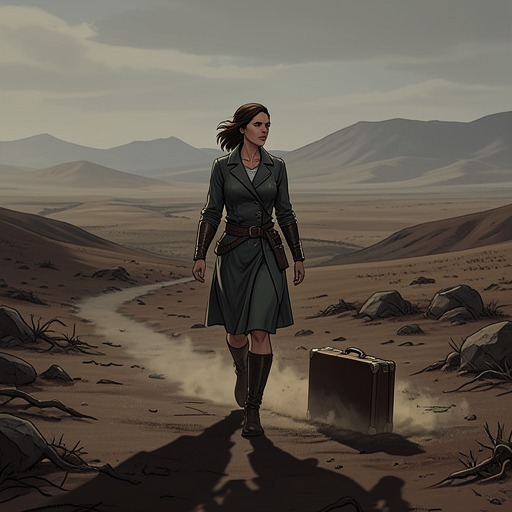
Kirsten and Peter flee Toronto
Station ElevenKirsten Raymonde and Peter Raymonde’s flight from Toronto turns a decision to leave into a journey stripped of reliable transport and any promised destination. As their neighborhood emptied, Peter chose departure over waiting; when the roads proved impassable, the siblings joined the movement of people on foot, heading east and south across an unguarded border.
The decision to leave
In an interview about her last days in Toronto, Kirsten recalls staying in the basement and watching television while the neighborhood emptied. Peter went out at night to obtain food, and one morning told her they had to go. The account gives the decision a practical urgency: remaining in the city meant waiting without any clear expectation of what might come next.
Peter hotwired a car abandoned by neighbors, and the siblings drove for a time. But the car could not carry them through the congestion. Abandoned vehicles clogged the ramps onto the expressway and the side roads as well. With the routes blocked, Kirsten and Peter had to abandon the attempt to travel by car and walk like the other people leaving.
Route and uncertain destination
The siblings travelled east and south, going around the lake and down into the United States. By the time they reached the border, its guards had left. The open crossing marks how quickly an established boundary had lost its ordinary force: the route continued not through a functioning system of inspection, but through a space no longer staffed to control movement.
Kirsten does not recall a specific destination. In her account, departure was not the first stage of a planned relocation; it was a choice between leaving and waiting in Toronto without knowing what waiting could achieve. Their direction was clear even when their endpoint was not.
Movement after infrastructure fails
The escape proceeds through successive failures of mobility. A car initially offers a way out, but abandoned traffic turns the roads into barriers, and walking becomes the remaining option. The episode is set against a wider world in which there are no ordinary commercial flights: aircraft remain dormant on runways and in hangars, repurposed in some places for storing food or drying fruit. The contrast makes the siblings’ journey part of a broader change from networked travel to movement governed by whatever routes and resources remain locally usable.
Later, the Travelling Symphony’s caravans demonstrate another adaptation to that changed world: former pickup trucks, stripped of engines and pulled by teams of horses. That mode is distinct from Kirsten and Peter’s escape, but it extends the same transformation of transport. In their departure, the car is abandoned because the road is blocked; in later travel, vehicles themselves are remade to move without gasoline.
Consequences and significance
The account ends the escape sequence without naming a safe arrival or a settled home. Its decisive outcome is narrower and more immediate: Kirsten and Peter leave Toronto, continue on foot when the roads fail them, and cross into the United States while its border is unattended. Their lack of a fixed destination is not a flaw in an otherwise complete plan; it is the condition under which they act.
The episode also establishes a pattern of movement in the post-collapse world. Leaving remains possible, but no longer depends on the infrastructure that once made distance seem manageable. Roads can be blocked, borders unstaffed, and aircraft grounded; survival instead requires changing course and continuing on foot.