Miranda Carroll
Station ElevenMiranda Carroll is a shipping-company employee and comic-book creator whose private artistic world becomes one of the novel’s defining imaginative structures. Before the Georgia Flu pandemic, she moves from an underpaid administrative job and a difficult relationship with Pablo into a life with Arthur Leander; alongside that change, she develops Station Eleven, a comic set among survivors in deep space. Her work is not incidental to her story: it gives shape to ambitions she has kept alive while her ordinary circumstances leave her little room to pursue them.
Identity and Working Life
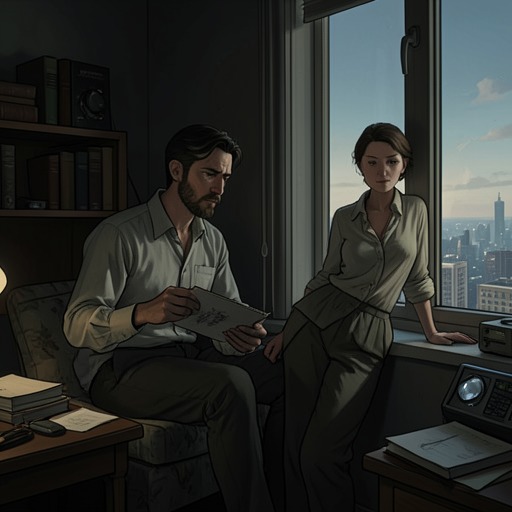
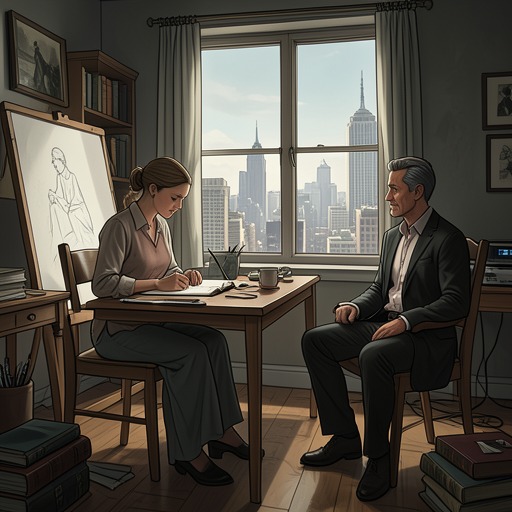
At one point, Miranda works as an administrative assistant at Neptune Logistics, seated at a horseshoe-shaped desk in a private reception area outside her boss Leon Prevant’s office. The office’s grey carpeting and glass wall looking toward Lake Ontario frame long, quiet stretches in which she can finish her tasks in an hour or two and spend the afternoon drawing. Leon is often away, and Miranda’s work includes checking travel confirmations and assembling his itineraries. When she compares herself with Thea, another assistant whose polished appearance she admires, the difference registers in small, material details: Miranda’s unruly curls, scuffed shoes and stockings with holes. Her workplace gives her both a view outward and time to work on something of her own.
Her circumstances are financially precarious. Pablo is not working or selling paintings, and Miranda can manage only the minimum interest payments on her student loans while struggling to cover rent. She has never left Canada, yet the travel itineraries she prepares become an occasion to study maps and imagine journeys to Japan, Singapore and South Korea. That combination—practical familiarity with travel arrangements and no experience of travel herself—makes the office a place where an elsewhere can be rehearsed without being reached.
In a later work assignment, Miranda is an executive at a shipping company and is sent to the south coast of Malaysia for a week to observe conditions there. Her long professional connection with Leon has included two corporate reorganizations and a relocation from Toronto to New York City. They do not socialize outside work, but she considers him her friendliest ally. Their exchange over the phrase “on the ground” draws attention to the distance between the abstraction of corporate language and her actual assignment: Leon corrects himself to say that she will observe conditions on the sea. A call reaches her while she is in Malaysia, linking this work journey to the unresolved personal history surrounding Arthur.
Station Eleven and the Work of Imagination
Miranda’s comic project has several important characters, but its hero is Dr. Eleven, a brilliant physicist who resembles Pablo physically while being unlike him in temperament. He is dashing, occasionally sarcastic, does not drink too much, and never whines; despite his courage, he has poor luck with women. He takes his name from the space station where he lives. A thousand years in the future, after a hostile civilization has conquered Earth and enslaved its population, a few hundred rebels steal a station and escape. Dr. Eleven and his colleagues send it through a wormhole and hide in uncharted deep space.
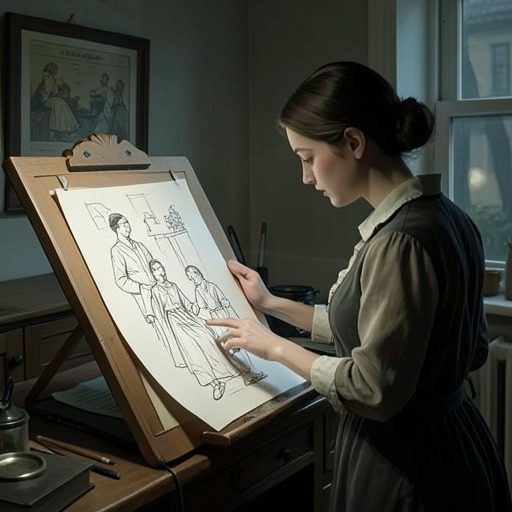
The setting gives the comic’s survival story an exact, damaged geography. Station Eleven is the size of Earth’s moon and was designed to resemble a planet, but it can travel through galaxies and needs no sun. War has damaged its artificial sky, leaving its surface in perpetual sunset, twilight or night. Damage to its ocean systems has submerged most of its land; the remaining islands were once mountaintops. The Undersea is an interconnected network of vast fallout shelters beneath those oceans. After fifteen years of perpetual twilight, three hundred people there long to return to Earth and seek amnesty under alien rule. Miranda is drawing Dr. Eleven aboard a boat with his mentor, Captain Lonagan, amid this larger division over whether the survivors should continue in exile or go home.
The project also exposes a striking contrast between Miranda’s circumstances and her hero’s. Dr. Eleven is a future-dwelling physicist, dashing and fearless; Pablo, whose appearance he shares, is an unemployed painter who is not selling his work. The resemblance is physical, not moral, and the distinction lets Miranda give the comic’s hero a different relation to life from the one she experiences at home. At her desk, with travel confirmations checked and the day’s tasks finished, she returns to the sketchbook hidden under files in her drawer. Her artistic work continues in the spaces left by paid labor.
Leaving Pablo and Beginning with Arthur
The beginning of Miranda and Arthur’s relationship is recalled through a tabloid photograph taken in Toronto, fourteen years before civilization collapses. Arthur is thirty-six and has spent the week filming a period drama, wearing a crown earlier that day and a Toronto Blue Jays cap by the time he meets Miranda at a restaurant. She has a recent bruise on her face. When Arthur asks what she will do, she says she is going to leave Pablo; they speak quietly so the restaurant staff will not overhear.
Arthur later recounts the next part of their meeting as a comic story. After their first dinner, Miranda appears at his room at Hotel Le Germain with two suitcases. She has walked through the lobby confidently enough to seem like a guest, then tells Arthur vaguely that she is moving into a hotel and asks whether she can leave her bags with him while they go to dinner. He is already in love with her. They kiss, go to bed, and do not leave the hotel that night. He invites her to stay for a few days; she never moves out, and the relationship carries them to Los Angeles.
The fuller account is less buoyant than Arthur’s version. Miranda returns to the apartment for a watercolour she has left on her drafting table and finds Pablo awake, drunk and weeping. She returns to the hotel with the bruise still on her face. The next morning Arthur takes her to the film set and introduces her as his cousin. Miranda calls in sick to work and waits in his trailer, trying not to think about Pablo while Arthur moves between her and the set in a red velvet cape and crown. The crown and the bruise belong to the same beginning: the glamour of Arthur’s performance does not erase the injury with which Miranda has arrived.
Story, Memory, and What the Photograph Hides
Arthur tells the dinner-party version of the story three and a half years later, in the Hollywood Hills. His account makes Miranda’s arrival with two suitcases the comic turn that begins their life together, but leaves out Pablo’s drunken grief, the bruise, and her anxious day at the film set. Miranda hears him tell it while she stands outside in the yard, having slipped out of the dining room. With the doors slightly open, she can still hear his voice; she knows the people inside cannot see her through their overlapping reflections on the glass.
The tabloid photograph taken after the restaurant encounter preserves another selective version of the same moment. Arthur has his arm around Miranda’s shoulders, while the flash blinds him and washes her out so that the bruise disappears from the image. What the photograph conceals, Arthur’s polished story also omits. Miranda’s perspective restores the circumstances behind the public image without turning her departure into a simple romantic anecdote: leaving Pablo is at once a decision, a physical escape, and the beginning of an uncertain dependence on Arthur.
Miranda’s comic-making and her personal history meet in the contrast between what appears finished and what remains unresolved. The restaurant photograph fixes a couple in public; the comic opens onto a damaged world whose survivors cannot simply return to what they have lost. At work, Miranda can study routes to countries she has never visited; in Station Eleven, she imagines a vast station moving through space, while its inhabitants argue over going home. Her invented setting makes isolation, damaged environments and the desire to return concrete subjects of her art, even as her own life is being redirected by travel, work and relationships.