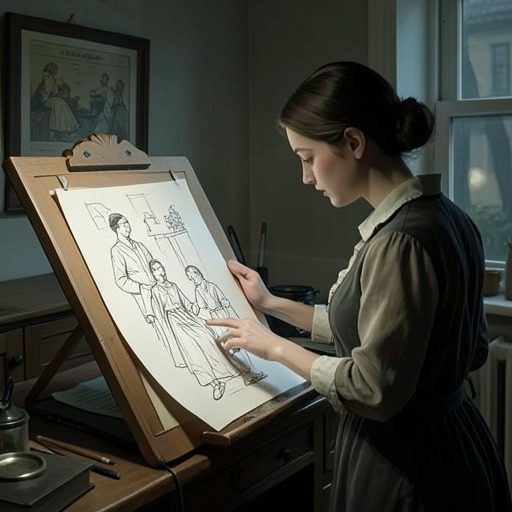
Miranda Carroll—Pablo
Station ElevenMiranda Carroll and Pablo’s relationship begins with shared art-school surroundings and a promise of artistic success, but over time becomes an unequal partnership organized around stalled ambition, financial dependence, and Pablo’s suspicion of Miranda’s work. Its ending marks a decisive turn: Miranda stops treating the relationship as something she must preserve and leaves the apartment, even as guilt and her belief in the dishonor of leaving remain with her.
Early Promise and Unequal Trajectories
Pablo graduated from art school a year before Miranda, and at first his career appeared brilliant. He sold one painting for ten thousand dollars and a larger one for twenty-one thousand, seeming poised to become the Next Big Thing. Miranda stopped waitressing at his invitation. But a show was cancelled, and he sold nothing else in the year that followed. Miranda, meanwhile, registered with a temp agency and found work in the office of Leon Prevant at Neptune Logistics. The contrast between Pablo’s anticipated artistic success and Miranda’s salaried employment gradually became a source of friction between them.
Pablo framed corporate employment as a surrender to a system he despised. When Miranda struggled with what to wear to work, he reminded her, “You’re an artist,” and asked, “Why would you want to conform to some bullshit corporate dress code?” She answered that her job required it. He called her his “poor corporate baby,” talked of the corporate machine and the Man, and assured her that the job was only temporary. The reassurance concealed a difference in how they understood her work: Pablo treated it as an interlude before his artistic prospects revived, while Miranda’s employment had already become more secure. She had moved from temporary status to a permanent position at the end of her sixth week, a change she had not told him.
Work, Money, and Suspicion
Miranda’s growing commitment to the job sharpened the conflict. Her long hours were not simply a matter of personal ambition: Leon expected her to stay until seven when he was travelling, and to be in the office when he came in, including on some weekends. Pablo objected that she worked twelve-hour days, was gone from morning until night, and sometimes went in on Saturdays. Miranda said she worked on her own project during downtime, but she found herself no longer emotionally invested in defending that choice. A conversation that might once have brought her to tears now left her thinking about moving trucks and the possibility of leaving quickly.
The phone call that exposes the deeper grievance comes to the office line. Miranda realizes Pablo has called there rather than her cell to verify that she is at work. The discovery angers her, especially because she pays the entire rent on their apartment. His focus on her hours turns her job into evidence in an accusation, while she calmly explains the expectations Leon set when he hired her. When Pablo dwells on the fact that Leon texts her, Miranda recognizes that the argument has become less about scheduling than suspicion and resentment.
Miranda tries to restore the material reality between them to the conversation: “Pablo, it’s just a job. We need the money.” She reminds him that the job pays their rent. Pablo answers by asking whether she is saying he is not pulling his weight. Miranda cannot continue listening and gently puts the receiver back on its cradle. The small, controlled gesture ends the call without resolving it. Instead, she wonders why it took her so long to notice that Pablo was mean, even though they had been dating for eight years.
The Break and Miranda’s Departure
Pablo follows the call with an email accusing Miranda of being hostile and passive-aggressive. She closes it without responding. The silence between them is no longer merely a pause in an argument: as she looks out over the lake, she imagines leaving the city and starting again. Her thoughts turn toward moving, and toward the possibility of breaking everything rather than continuing to inhabit a life that feels constraining.
That evening, after dinner with Arthur Leander, Miranda says aloud that she and Pablo are breaking up and that they are not right for each other. The decision is followed immediately by her and Arthur kissing and going to his hotel room. Pablo sends messages later that night; Miranda replies that she is staying with a friend, will be home in the morning, and that they can talk then. His response—“u know what dont bother coming home”—makes the prospect of escape feel suddenly real to her. She experiences a peculiar giddiness and imagines throwing away almost everything, with Station Eleven as the constant she would carry into a new life.
At six in the morning Miranda returns to the apartment on Jarvis Street. It is dark and silent; dishes are piled in the sink, food remains stuck to a frying pan, and the bedroom door is closed. She packs two suitcases, separating clothes from art supplies, and leaves in fifteen minutes. The speed of her exit gives physical form to the possibility she had been imagining at work: she can depart without first turning the separation into another prolonged argument.
Guilt, Conviction, and the Relationship’s End
After leaving, Miranda showers in the employee gym at Neptune Logistics and changes into clothes rumpled by the suitcases. Looking at herself in the mirror while putting on makeup, she recalls the phrase “I repent nothing,” then questions whether she is heartless. Her guilt does not cancel her awareness that the relationship has become unbearable; she knows how easily the world can make her cry and how small she feels in the city. Nor does leaving fit comfortably with her own moral rule: she believes that only the dishonorable leave when things get difficult.
That conviction makes the separation more complicated than a clean rejection of Pablo. Miranda does not leave because hardship has ceased to matter to her; she leaves after recognizing that the relationship has become a trap and that she has stopped caring enough to keep defending herself. Her escape is followed by a new relationship with Arthur, but the evidence of her departure centers on Miranda’s own decision, the two packed suitcases, and the unresolved tension between guilt and the belief that happiness may justify leaving.