Miranda and Arthur’s divorce
Station ElevenMiranda and Arthur’s divorce ends their marriage but becomes a threshold into a life Miranda increasingly shapes for herself. The narrative looks ahead from a late-night conversation with Elizabeth to the settlement, then follows the years in which Miranda turns financial independence, professional ambition, and solitary travel into a life that feels like freedom—even as loneliness persists.
From a Late-Night Conversation to the Settlement
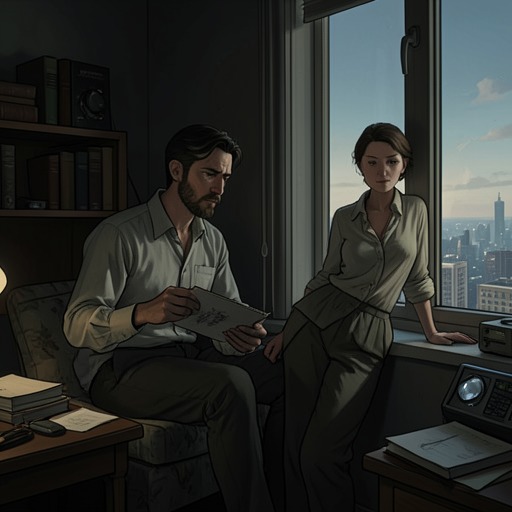
The divorce is foreshadowed in a lamp-lit room where Miranda and Elizabeth sit on the floor among sketches and paintings pinned to the walls. Elizabeth speaks softly about events unfolding as if they were meant to happen; Miranda resists the idea that she is following a script, though exhaustion has taken the force from her reply. The scene holds on their stillness before the narration moves forward to the legal separation.
Three months later, Miranda and Arthur will meet with their lawyers in a conference room to settle the final terms of the divorce. Outside, paparazzi smoke on the sidewalk. At the same time, Elizabeth is packing to move into the house with the crescent-moon light by the pool. The divorce thus appears not as an isolated legal transaction but as part of a rearrangement of the lives surrounding Arthur.
Return to Toronto and a New Career
Four months after the late-night scene, Miranda is back in Toronto, divorced at twenty-seven and studying for a commerce degree. She spends her alimony on expensive clothes and consultations with stylists, having come to understand clothing as armor. The money associated with the separation becomes a practical resource for constructing a public self, not merely a record of what the marriage has ended.
Miranda contacts Leon Prevant to ask about work. A week later she is back at Neptune Logistics, now in a more interesting position in Client Relations, working under Leon. She rises rapidly through the company. The return to her former workplace therefore leads not to a simple restoration of her past circumstances but to a career whose reach and demands will grow well beyond them.
Freedom, Work, and the Comics
After four or five years, Miranda travels almost constantly between a dozen countries and lives mostly out of a carry-on suitcase. She occasionally sleeps with her downstairs neighbour but refuses to date anyone. In hotel rooms from London to Singapore, she repeats her private declaration of having no regrets; in the morning, she puts on clothes that make her feel invincible. The routine joins the armor of dress to the independence she has made for herself, while the account makes clear that loneliness remains part of the life she values.
By her mid-thirties, Miranda feels competent and more or less at ease in the world. She studies foreign languages in first-class lounges, travels across oceans in comfortable seats, and meets clients, living her work so fully that the boundary between her identity and her job becomes uncertain. She almost always loves her life, but is often lonely. At night in hotel rooms, she draws the Station Eleven comics. The divorce’s significance therefore reaches beyond the end of the marriage: it precedes the creation of a mobile, self-directed life in which the work that accompanies Miranda around the world also makes room for her art.