Miranda leaves Pablo and begins a relationship with Arthur
Station ElevenMiranda Carroll leaves Pablo and begins a relationship with Arthur Leander through a choice that is at once an escape from a failing partnership and a breach of Miranda’s own moral code. The movement from a tense conversation at home to a late dinner, a night with Arthur, and the swift packing of two suitcases gives the departure its force: Miranda feels newly free, but cannot make freedom feel innocent.
Background and the Decision to Leave
The rupture begins before Miranda announces it. Pablo complains that she works twelve-hour days, is away from eight in the morning until nine at night, and sometimes goes in on Saturdays. When he asks what she does with her downtime, Miranda says she works on her project and objects to his hostile tone. The exchange that might once have reduced her to tears no longer has that power. Instead, she turns toward the lake and imagines calling in sick, packing her things, and leaving within hours. Her thought that sometimes everything must be broken gives the scene its decisive change: the possibility of departure has entered her mind as an action, not merely a fantasy.
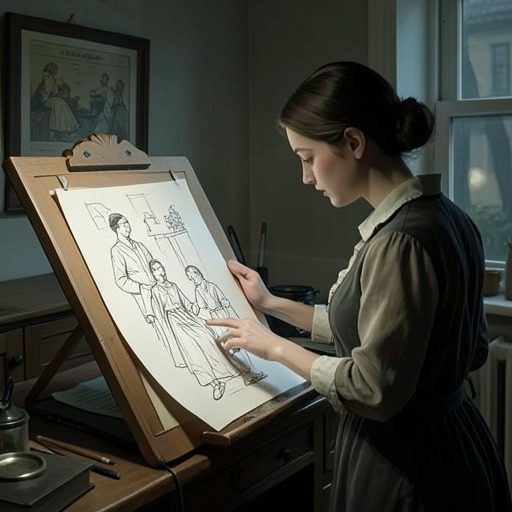
That project is the comic that becomes Station Eleven. In conversation with Arthur, Miranda recalls returning to Delano Island for Christmas during her first year of art school, after a semester of failure and frustrating attempts at photography. Looking through an old Calvin and Hobbes, she became absorbed by Spaceman Spiff’s spaceships, alien skies, and two-moon landscapes. The idea took another year to develop into the beautiful wreckage of Station Eleven. Her account connects the new relationship to a creative history that is distinctly her own: Arthur listens as she describes a form and world she had begun imagining before their affair.
After dinner, Arthur asks whether Miranda is still with Pablo. The answer is that they are breaking up and are not right for each other; saying it aloud makes the decision real. The narrative gives no account of a formal conversation in which both partners agree to end the relationship. Instead, the decision seems to have been made without either of them quite discussing it, while Arthur hails a cab. In its back seat Miranda and Arthur kiss; he guides her through the hotel lobby with a hand on her back, and she follows him into his room. The sequence makes the transition unmistakable, even as it leaves the practical end of her relationship with Pablo unresolved.
The Night with Arthur and the Departure
Pablo’s texts arrive at nine, ten, and eleven that night. Miranda replies that she is staying with a friend, will be home in the morning, and that they can talk then. Pablo answers that she should not bother coming home. His message turns the contemplated escape into an immediate separation, and Miranda feels a peculiar giddiness as she reads it. She imagines throwing almost everything away and beginning again, with Station Eleven as the one constant she would keep. The feeling is exhilaration, but the details show that it is not a simple rejection of her past: her art remains a point of continuity amid the prospect of leaving it behind.
At six in the morning, Miranda takes a taxi to the apartment on Jarvis Street. Arthur tells her he wants to see her that night, and they plan to meet in his room after work. The apartment is dark and silent, with dishes piled in the sink and food stuck to a frying pan; the bedroom door is closed. Miranda packs two suitcases, one for clothes and one for art supplies, and leaves in fifteen minutes. The division between the bags is telling without needing to be made symbolic: she takes both the practical materials of a new life and the work that has been her private project.
She showers and changes in the employee gym at Neptune Logistics, where her clothes are slightly rumpled from the suitcase. Looking at herself in the mirror as she puts on makeup, she recalls the phrase I repent nothing, then judges herself heartless. Even through her guilt, she knows that judgment is not true. She is acutely vulnerable to the suffering around her, including the small, recurring pain of being asked for change and not giving it; she feels too small for the city, or perhaps simply too soft for it. Tears gather in her eyes, complicating any easy reading of her departure as cold or carefree.
Guilt, Freedom, and the New Relationship
Miranda’s private rule is that only the dishonourable leave when things get difficult. That conviction makes the act of leaving more than a logistical break: it puts her desire for escape in conflict with the standard by which she judges herself. She is not free of guilt, and the narrative does not resolve that tension by declaring either her departure or her new relationship wholly right. Her thought that she can begin again sits beside the belief that leaving at hardship is a moral failure.
At two in the morning, Miranda and Arthur lie together in his enormous bed at Hotel Le Germain. Arthur is in Toronto for three more weeks before returning to Los Angeles. Miranda wants to believe that the light through the window is moonlight, although she suspects it is mostly electric. Their conversation turns explicitly to the ethics of their situation: Arthur asks whether pursuing happiness can be dishonourable, and Miranda answers that sleeping with a film star while living with someone else surely is not, in itself, honourable. Arthur shifts at being called a film star and kisses the top of her head. The gesture offers tenderness, not a solution to the moral question.
The episode therefore establishes the affair and Miranda’s departure from the shared home, but not a settled future. Pablo’s final text makes the return home impossible in the immediate moment; Arthur’s plans and presence draw Miranda toward a new relationship; and Station Eleven remains the constant she names as she imagines starting over. The decisive change is not that uncertainty disappears, but that Miranda acts despite it, carrying both the wish to escape and the knowledge that escape violates one of her few certainties.