New Petoskey Newspaper
Station ElevenThe newspaper published in New Petoskey reaches the Severn City Airport community in the fall of Year Fifteen, fifteen years after the collapse, and makes the distant world newly legible. Brought by a trader as three rough sheets, its irregularly issued pages report births, deaths, marriages, barter, and local dangers; they also contain an interview with Kirsten Raymonde about Arthur Leander’s death onstage. The papers matter as news, as an artifact for Clark Thompson’s Museum of Civilization, and as proof that people elsewhere are again printing and circulating information.
Arrival at the Airport
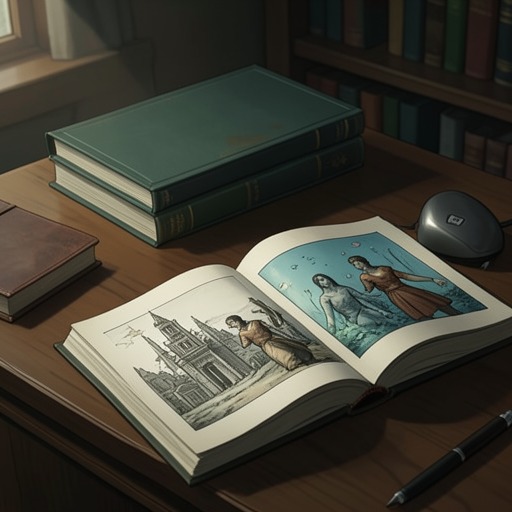
The newspaper arrives through an established exchange rather than a returning communications network. The trader has visited the airport since Year Six, dealing mainly in cookware, socks, and sewing supplies. After camping overnight in an Air France jet, he approaches Clark before leaving and offers something for the museum: three sheets of rough paper. They are three consecutive issues, already a few months out of date, from an irregular publication in New Petoskey.
The delay and the humble material are part of the object’s significance. These are not instant updates delivered by a screen, but news carried by a person whose regular trade routes have gradually connected separate communities. The issues nonetheless bring Clark information about a world beyond the airport and its immediate surroundings. Their arrival marks a change in what the museum can collect: the past is no longer represented only by surviving objects and old papers. A contemporary record from another settlement has crossed the distance to reach it.
A Local Record of Daily Life
The three issues describe practical concerns rather than a unified account of regional events. They announce births, deaths, and weddings, and provide a space for barter. One resident offers milk and eggs in exchange for new shoes; another seeks jeans in size six for a pair of reading glasses. Such notices preserve the texture of an economy in which particular goods, needs, and exchanges matter more than the vanished convenience of mass distribution.
The paper also reports the sighting of three ferals—a woman and two children—to the southwest of town. Residents are advised to avoid them and, if contact occurs by accident, to speak gently and make no sudden movements. Beside the exchange notices and family announcements, this warning shows a community attempting to convey both useful information and rules for dealing with people perceived as dangerous. A notice about a local girl giving away kittens, whose mother is described as a good mouser, adds another small piece of practical domestic life. The newspaper’s world is not merely an emblem of recovery; it is a place with its own hazards, needs, and ongoing routines.
The Symphony and the Museum
The newspaper reports that the Travelling Symphony has recently passed through town, while making clear to Clark that it is more than an orchestra. A particularly enthusiastic review describes a performance of King Lear, praising Gil Harris as Lear and Kirsten Raymonde as Cordelia. The account joins two kinds of record: the paper documents a local cultural event, and it names performers whose traveling work connects settlements through theatre as well as music.
The paper’s own treatment of empty space further broadens its role. François Diallo, the librarian and publisher, fills unused space with material from his collection: the first issue contains a poem by Emily Dickinson, the second an excerpt from a biography of Abraham Lincoln. In the third issue, a slow month for local news and announcements leaves the entire back page available for an interview with Kirsten. The newspaper is thus a local bulletin, a vehicle for literature and historical writing, and a record of performance. Its contents depend on what is happening nearby, but also on the editor’s decision to let collected texts travel alongside current notices.
Kirsten’s Account of Arthur
The interview gives the newspaper a personal connection to the past that Clark cannot find in its other reports. Kirsten explains that she left Toronto with her brother at the time of the collapse, though she knows this chiefly because he told her; her own memories of that period are limited. One night just before the end, however, remains sharply present. She recalls being onstage with two other girls, positioned behind Arthur and unable to see his face. A commotion began in front of the stage; she heard a sharp impact as Arthur struck his hand against the plywood pillar beside her, saw him stumble back and fling out an arm, and then saw a man from the audience climb onto the stage and run toward him.
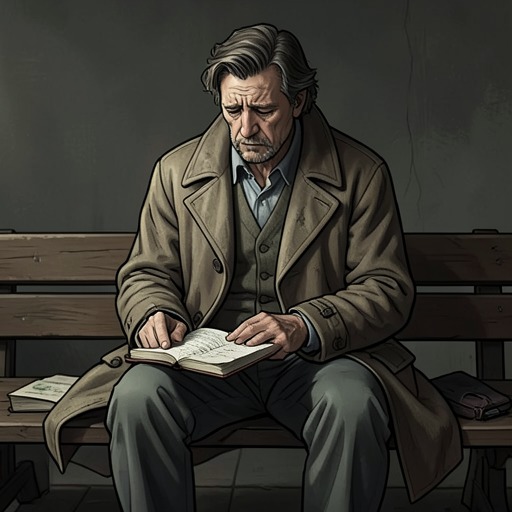
For Clark, reading the account is a shock: the interview connects him to someone who knew Arthur and witnessed his death. The information is not only biographical. It gives the earlier event a witness’s remembered details, carried across years and across the altered geography of the post-collapse world. The paper makes that testimony available to people who could not have found it through the networks that once moved information instantly.
Circulation, Memory, and Possibility
The issues pass from hand to hand around the airport for four days. They are the first new newspapers anyone there has seen since the collapse. When they return to the museum, Clark holds them for a long time and reads Kirsten’s interview again. Their circulation has temporarily made one set of pages a shared resource: readers can encounter the same local announcements, performance review, and testimony before the papers are returned to the collection.
That experience gives the object a significance beyond its contents. In the earlier world, the Internet connected people through an invisible network; after it vanished, electronic screens could remain visible but useless. In Traverse City, an inventor once pedalled a stationary bicycle to power a laptop while searching for the Internet, and the screen displayed a message that the webpage was unavailable. At the airport, televisions show silent test patterns. In the school at Concourse C, children learn about the former network as a system that connected people and transcended borders, but even teenagers struggle to grasp what those borders had meant. Against that history of failed or darkened media, the printed issues have a plain, material route: someone makes them, a trader carries them, readers share them, and a museum preserves them.
Clark’s response moves from the personal shock of seeing Arthur’s name in Kirsten’s account to a larger hope. If newspapers have begun to appear, he wonders what else may be possible. The thought recalls his old experience of watching dawn spread across the landscape from a plane, when the world seemed to be waking, though he knew it was always night somewhere and morning elsewhere. He hopes for more newspapers in the years that follow, but none arrive. The three issues therefore promise a renewed public life without confirming its steady return: a small, contingent sign of connection that remains precious partly because it is not repeated.