North American quarantine theory
Station ElevenNorth American quarantine theory is Elizabeth Colton’s explanation for the apparent end of the world: perhaps civilization has not vanished, but North America has been isolated to contain the pandemic. The idea offers a way to imagine ordinary life continuing elsewhere, beyond the reach of the catastrophe. At Severn City Airport, where Elizabeth and Clark Thompson are stranded, it becomes more than speculation. It gives Elizabeth a reason to expect rescue and a practical task to organize around, even as the available evidence makes her hope difficult to sustain.
A catastrophe with a possible boundary
Elizabeth’s argument begins with a distinction between catastrophe and finality. She has studied art history and remembers that accounts of the past are crowded with disasters that seemed to their witnesses like the end of the world but later proved temporary. To her, the present emergency may belong to that pattern: what looks like the end of everything may instead be a crisis whose limits are not yet visible.
A book she once read supplies a more specific model. It was a vampire story set after an apparent apocalypse. As its narrative unfolded, Elizabeth says, it became clear that civilization had not been lost everywhere: North America had been quarantined to prevent the spread of vampirism. The analogy gives her a ready-made way to interpret the airport’s isolation. The survivors may be trapped not because the world has ended, but because a wider world is keeping its distance.
The theory depends on a separation between the local view and the global condition. From the stranded passengers’ perspective, communication and travel have collapsed; that does not, by itself, prove that every society has collapsed too. Elizabeth uses this gap in knowledge to preserve the possibility that other people remain safe and that the present desolation may be temporary. Her conviction is not presented as confirmed information, but as an interpretation she holds onto despite uncertainty.
Evidence against the theory
Clark Thompson does not accept Elizabeth’s explanation. He suggests that civilization was fragile even before the crisis and tells her he thinks there may be nothing good left beyond the airport. His response is an opposing reading of the same absence of reliable contact: where Elizabeth imagines containment and survival elsewhere, Clark expects a broader disaster.
The narrative also supplies concrete objections to quarantine. The pandemic began in Europe, and the last news reports described chaos and disarray on every continent except Antarctica. Those reports do not fit the idea that only North America has been affected. Geography and transport create a further problem: given air travel and South America’s connection to North America, it is difficult to imagine how the continent could be isolated. Elizabeth’s proposed boundary is therefore both geographically awkward and contradicted by the fragmentary news the passengers have received.
The contrast is not simply between an optimistic person and a pessimist. Elizabeth draws on historical patterns and a fictional precedent to argue that apparent endings can be temporary; Clark weighs the evidence of a pandemic already described as global. Neither can verify the whole world’s condition from the airport. The theory remains possible to Elizabeth because knowledge is incomplete, but the information available to Clark gives him little basis for believing it.
Hope made practical
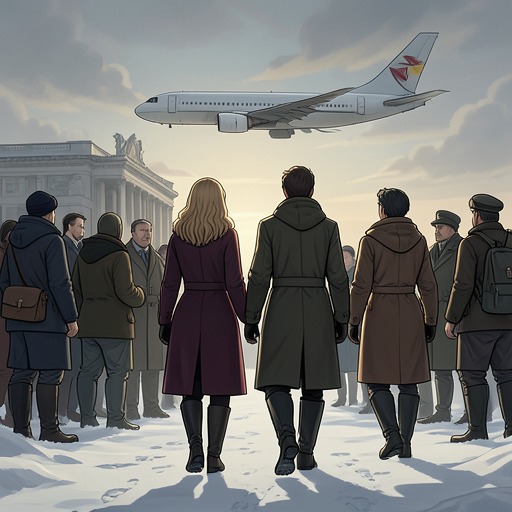
Elizabeth’s belief acquires force through what she does. After Roy leaves, she insists that one runway remain clear. At first she shovels snow on Runway Seven alone, working for hours. A few people then join her, followed by a core group of nine or ten who sometimes attract additional volunteers. Keeping the runway open turns an abstract possibility into a repeated collective task: if someone comes to retrieve them, there will be somewhere to land.
The work also changes the shape of life in the airport. Its concourses and routines have become hateful in their sameness, while inactivity leaves the stranded people with grief and the fear that they hear voices from a sealed aircraft. Clearing snow offers physical labor outdoors and a shared purpose. Some join because Elizabeth’s celebrity still has influence; others find the work preferable to remaining inside with their thoughts. The runway is therefore not proof that rescue is coming. It is a place where a disputed belief can organize effort and give people something to do together.
Elizabeth’s expectation is explicit: she says the military may come for them and will need a clear runway. Clark answers cautiously, trying to be kind, while Dolores counters that if anyone were coming, they would probably have arrived already. Their exchange shows the theory being tested socially as well as logically. Elizabeth asks others to act on the future she imagines; Clark avoids endorsing it, and Dolores names the painful implication of waiting.
Mobility after the collapse
The theory gains resonance from the book’s contrast between former mobility and post-collapse movement. Before the pandemic, airplanes connected distant cities and countries; afterward, aircraft remain dormant on runways and in hangars, repurposed for storage or left to rust. Clark and Elizabeth themselves reach Severn City Airport on one of the last flights to leave John F. Kennedy International Airport, only to be diverted and stranded. The machinery of global travel carries them into the crisis, then ceases to provide a way out.
Elsewhere, people move by much slower and more precarious means. Kirsten Raymonde and Peter escape Toronto after abandoned cars block the expressway ramps and side roads, continuing on foot. Jeevan Chaudhary chooses to follow the lakeshore rather than the roads, trying to avoid other people. The Travelling Symphony’s former pickup trucks have been stripped of engines and converted into horse-drawn caravans. These different journeys show the practical consequences of vanished infrastructure: movement persists, but its speed, reach, and safety have changed.
Against that landscape, a cleared airport runway carries a double meaning. It recalls the possibility of renewed connection, while the stranded aircraft and blocked roads testify to how thoroughly connection has failed. Elizabeth’s theory imagines a boundary imposed for protection; the wider pattern of stalled planes and difficult journeys makes isolation look less like a controlled quarantine than a consequence of systemic collapse.
Significance and limits
North American quarantine theory does not resolve what has happened beyond Severn City Airport. It reveals instead how people interpret incomplete information when the stakes include whether the world—and the people they love—still exists elsewhere. Elizabeth’s account is sustained by historical analogy, a remembered novel, and the hope of military aid; the contrary evidence remains substantial, and no rescue is confirmed in these scenes.
Its importance lies partly in the way belief becomes action without becoming certainty. Elizabeth cannot demonstrate that an intact society is waiting beyond the crisis, but she can keep a runway clear. The volunteers’ labor neither proves nor disproves her account. It shows how the possibility she defends can provide a common purpose in a community otherwise confronted by absence, grief, and a future with no reliable timetable. The theory preserves an imaginable outside world, while the airport’s daily reality keeps reminding its inhabitants how little they can know about it.