Parallel universes
Station ElevenParallel universes are an imagined field of alternate lives through which August and Kirsten consider what the world might have been, and what it might still contain beyond their knowledge. Neither character can establish that these worlds exist. Their importance lies instead in the work the possibility performs: it lets them picture lives spared the pandemic, recognize the ordinary systems they have lost, and give form to hopes they cannot secure in their own world.
August’s Theory and Its Limits
August treats the existence of multiple universes as a scientific possibility, though his explanation remains deliberately uncertain. He calls it physics, or perhaps the outer edge of quantum mechanics, while insisting that it is not simply an idea he invented. When Kirsten once asked an older member of the group for confirmation, the answer was that he had no idea. Other members likewise lacked scientific knowledge; Gil could only recall an article about subatomic particles disappearing and reappearing, and speculated that this might imply somewhere else in which a person could exist in another form.
The passage does not settle the scientific question. The older members’ uncertainty and August’s qualifications keep the theory from becoming an established fact about the story’s world. Its force comes from its open-endedness: August can speak of infinity, but neither he nor Kirsten can verify that any alternate life is real. The idea offers room to imagine without supplying proof or a way to reach those imagined places.
Kirsten pictures the universes as successive reflections between two mirrors. The images become greener and cloudier as they recede, until they disappear toward infinity. She remembers seeing this effect in a clothing store in an abandoned shopping mall. The image gives a visible shape to a possibility that otherwise has no boundary: each reflection suggests another world, while its fading edges emphasize how inaccessible those worlds remain.
Lives That Might Have Continued
August proposes that among infinite alternatives there must be a universe in which there was no pandemic and he became the physicist he had once planned to be. He also imagines a world in which the pandemic occurred but a minute difference in the virus’s genetic structure made it survivable, allowing civilization to continue. The distinction matters: the imagined escape need not erase the disaster altogether. A tiny alteration might be enough to change its outcome.
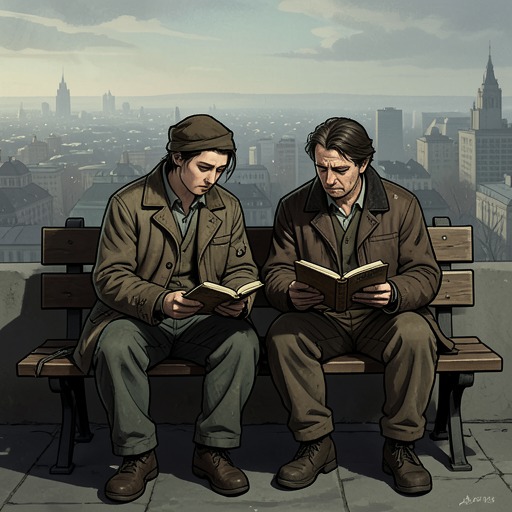
The conversation takes place in late afternoon at the top of an embankment. August and Kirsten are resting and looking through magazines taken from a house that had not been ransacked. One shows Lydia Marks shopping in New York City, carrying a dozen bags and wearing precarious shoes. The image belongs to a world on the brink: the pandemic will reach North America in less than a month. For August, the photograph becomes a prompt for an alternate version of Kirsten, someone who might have appeared in such pictures if the collapse had not happened.
Kirsten’s response reveals that the imagined life is not merely a game she accepts for August’s sake. She sometimes places herself inside the pictures she has collected and tries to picture her shadow life. In that life, ordinary services simply work: a room fills with light at the touch of a switch; garbage is taken away; police can be called in danger; hot water comes from a faucet; a telephone connects people; information is available through the Internet. Money can be exchanged for houses, boats, and dental care. These examples make the alternative concrete through routines and infrastructure rather than spectacular escape. The lost world’s conveniences appear as a network of assurances that had once required little thought.
A Game Shared Over Time
August and Kirsten have played with parallel-universe scenarios for a decade. Their examples shift from familiar details to more extravagant possibilities: a universe with space travel, one in which Kirsten’s comics are real, and one in which the pair boarded Station Eleven and escaped before the world ended. The comic-book premise does not establish an actual route out of the catastrophe; it turns the imaginative game toward the stories Kirsten carries with her. Their exchange allows speculation to become a shared form of play, even as its scenarios repeatedly return to the world they inhabit.
The game also makes their differences legible without separating them. August reaches first for physics and for the possibility that he might have become a scientist. Kirsten brings the theory back to pictures, daily comforts, and the fictional worlds she knows. She teases him for having invented the idea, but her private investment in alternate lives runs deeper than that teasing suggests. Their conversation moves between joking and loss without resolving into either one alone.
Grief, Absence, and Uncertainty
The imagined alternatives sharpen when August names the people they have lost track of. He wishes for a universe in which Sayid and Dieter did not disappear, then imagines telephones still working so they could call the group, learn where everyone was, and arrange to meet. In this version, the technology matters because it would restore contact: distance could be answered with a call rather than endured as uncertainty.
Kirsten says they will find the missing companions and see the group again, but the narration makes clear that they cannot be sure. The parallel-universe game cannot promise reunion in this world. Instead, it holds desire beside doubt: one imagined life contains working telephones and a meeting place, while their actual circumstances offer no such certainty. The idea is therefore neither a solution nor simple escapism. It gives the characters a language for what they want back—companionship, communication, and the ordinary world around them—while leaving the outcome unresolved.