Post-collapse world
Station ElevenThe Post-collapse world is the society formed after the Georgia Flu pandemic and the collapse that followed it. Its defining change is not only the loss of familiar technology but the failure of the people and networks that kept ordinary life functioning: food stops moving, cities fall quiet, and travel becomes difficult or impossible. Over time, survivors gather in small settlements, where security and mutual dependence shape daily life. The Travelling Symphony, moving between those communities with music and Shakespeare, embodies a different possibility: a life still in motion, sustained by art and fellowship as well as practical survival.
From outbreak to systemic failure
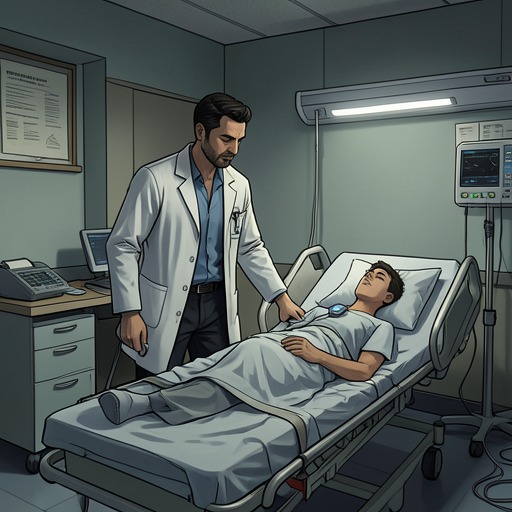
The break begins with the speed and scale of the flu. When Hua warns Jeevan Chaudhary, his hospital has admitted more than two hundred flu patients since morning, including 160 in the previous three hours; fifteen have died, the emergency room is full, and beds have been placed in the hallways. Hua tells Jeevan that the epidemic is spreading beyond the hospital and advises him to leave immediately or, if he cannot, to stock up and stay inside. The urgency marks the illness as a divide between an ordinary life and what comes after it.
The first signs of collapse arrive through failing information as well as medical care. Toronto General Hospital and two other local hospitals are put under isolation while Health Canada confirms an outbreak of the Georgia Flu. During the first days of the crisis, television coverage continues, but broadcasters and other network employees take turns reporting; news from cities and countries disappears, the remaining channels show static or repeated emergency advice, and eventually the camera in an empty newsroom goes dark. A day later, the Internet also fails. People are left with diminishing information just as the practical means of response are disappearing.
Jeevan’s experience with Frank makes the collapse tangible at the scale of an apartment. They watch the news, cover air ducts with plastic, hang towels over windows, and block the door with a dresser. When people knock, they stay silent; twice, someone tries to get through the lock. Their precautions cannot restore medical or civic systems, but they show how fear reorganizes everyday behaviour around shelter and the distinction between those inside and everyone else.
The city’s silence reflects an interdependent system breaking apart, not simply a shortage of working machines. Jeevan recognizes that fuel deliveries stop, vehicles become stranded, trucks remain where they began, food no longer reaches grocery stores, and businesses close or are looted. Power plants and substations also depend on workers, while fallen trees on electrical lines require removal. As those tasks go undone, the lights in Frank’s apartment go out. Jeevan first flips the switches on and off; Frank tells him to stop. The small futile gesture registers the new reality: electricity cannot be summoned by operating a switch when the human system behind it has ceased to function.
A changed material landscape
The losses accumulate across daily life. There are no dependable pharmaceuticals, and an ordinary scratch or cut can no longer be assumed survivable. Fire departments, police, road maintenance, garbage collection, and staffed national borders disappear. With no regular public services, safety and access to necessities increasingly depend on what nearby people can organize and maintain themselves.
The end of transport changes both distance and the meaning of movement. Air travel stops, and roads become impassable with abandoned cars. Gasoline goes stale after two or three years, making sustained road travel impossible; aviation fuel lasts longer but is difficult to obtain. Airplanes remain in hangars and on runways, collecting snow on their wings. They are put to new uses: in cold weather they can store food, while planes near orchards hold fruit that dries in the summer heat. The aircraft survive as objects, but no longer as parts of a functioning aviation network.
The loss of electricity also ends the ordinary public life once organized around it. There are no illuminated swimming pools, floodlit games, porch lights, or trains powered by electric rails; cities themselves vanish from the account of the inhabited world. Films are shown only occasionally, with generators drowning out some dialogue, and only while fuel lasts. Concert stages, electric guitars, and electronic music become unavailable. The Internet and social media disappear with the screens and networks that once carried photographs, requests for help, plans, complaints, and everyday updates. What is lost is not just entertainment or convenience but a constant medium through which people could feel connected to lives beyond the room they occupied.
Settlements and the work of staying alive
In the first years after the collapse, people travel because they have not yet understood that there is no reachable place where life continues as before. Eventually they settle in clusters: former truck stops, restaurants, motels, and other improvised homes. Many such communities are small, sometimes only four or five families. The change from continual flight to settlement is partly forced by the dwindling supply of fuel and partly by the recognition that survival now depends on making a place work rather than finding an intact world elsewhere.
By Year Twenty, settled society resembles an archipelago of small towns. These communities have endured violence, buried neighbours, and survived the dangerous years immediately following the collapse by holding together. Their caution toward outsiders follows from that experience: they do not necessarily welcome travellers, even when the wider region has become relatively tranquil. The Travelling Symphony meets few people on the road besides occasional traders carrying miscellaneous goods between towns. Its movement depends on negotiating a landscape in which a nearby community may be the only durable source of safety, but may also be wary of newcomers.
Life in the Travelling Symphony offers a concentrated picture of collective adaptation. The Conductor’s former military orchestra leaves its air base five years after the collapse and travels through an unfamiliar landscape. After six months, it meets Gil’s company of Shakespearean actors, who had escaped from Chicago, worked on a farm for several years, and then spent three months on the road. The musicians and actors combine their operations. By Year Twenty, they travel along the shores of Lake Huron and Lake Michigan, reaching west to Traverse City, north and east to Kincardine, and south along the St. Clair River toward Marine City and Algonac.
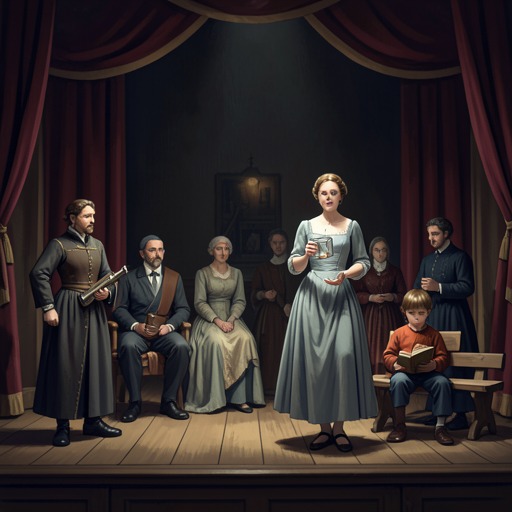
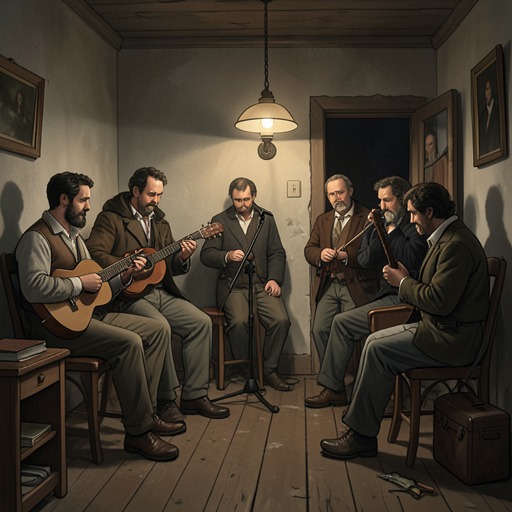
The company remains in motion while most people have settled. Its performances—classical and jazz music, orchestral arrangements of pre-collapse popular songs, and Shakespeare—make culture part of its practical life rather than a luxury reserved for a recovered civilization. The group has tried more modern plays, but audiences prefer Shakespeare. The contrast suggests that the new world does not simply reproduce former cultural habits: it selects and carries forward works that people find meaningful under changed conditions. At the same time, the Symphony is not an effortless refuge. Its members travel, rehearse, and live together year-round, with recurring jealousies and resentments. Friendship, music, performance, and shared responsibility make this demanding communal life bearable; for those who stay, the company is a home.
Memory, preservation, and an unfinished future
The scale of loss is also visible in the objects that outlast their former uses. At Severn City Airport, Clark Thompson’s Museum of Civilization preserves cell phones, tablets, laptops, impractical shoes, polished car engines, a chrome motorcycle, magazines, newspapers, stamps, coins, passports, driving licences, and credit cards. These things are not primarily tools for restoring the systems that produced them. Their preservation records the texture of a vanished society, including its habits, designs, and personal lives. Clark keeps careful records, and the passports of Elizabeth Colton and Tyler Leander remain especially unsettling to him years after they leave the airport.
The airport settlement shows that local organization can replace some functions of the old world without recreating it. By the end of Year Fifteen, three hundred people live there. Clark once spends his days gathering firewood, hauling water to keep the toilets operational, salvaging supplies, planting crops near the runways, and skinning deer. As the community grows, others can take on more of the work, leaving him time to tend the museum. When the Travelling Symphony visits, the airport has 320 residents. They stay for five weeks, repair their caravans, and perform Shakespeare and music on alternating evenings. The visitors leave behind not a restored airport or a return to air travel, but an encounter that briefly joins two distinct forms of post-collapse life: a settled community and a travelling company.
The world’s defining condition is therefore both deprivation and adaptation. Its old systems do not resume merely because their physical remains are still visible: a dormant airplane, a dead screen, or a polished engine cannot replace fuel supplies, skilled labour, power, and coordination. Yet people build new forms of continuity from what remains. Settlements provide collective survival, the museum preserves material memory, and the Travelling Symphony carries performance from place to place. The result is not a return to the pre-collapse world but a fragile, locally sustained society in which connection must be made and remade by people themselves.