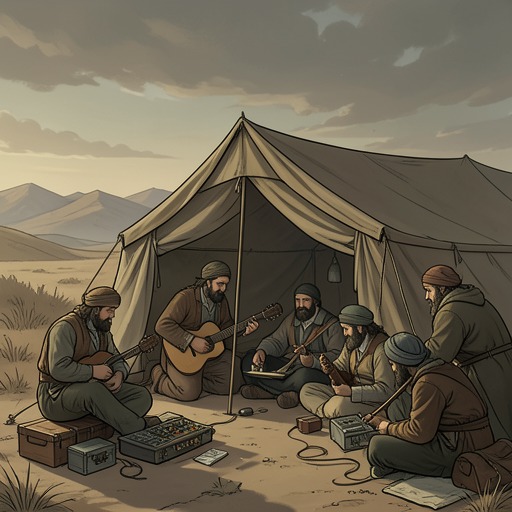
Sayid
Station ElevenSayid is an actor in the Travelling Symphony, where performance, travel, and mutual reliance shape his life. He has been on the road with The Conductor for twelve years, and his place in the troupe is personal as well as practical: he is a fellow scout, an old partner of Kirsten Raymonde, and one of the people whose absence makes the Symphony’s continued life seem uncertain. His disappearance with Dieter and the account he gives after returning reveal both the dangers the troupe faces and the difference between losing someone to the road and being able to bring someone back.
Identity and Life on the Road
Sayid’s profession is visible in the way he inhabits a role. During a performance of A Midsummer Night’s Dream in a hot parking lot, he plays Oberon with a regality that remains convincing despite the improvised setting and his ordinary clothes. The contrast is characteristic of the Symphony’s work: Shakespeare is performed amid the material conditions of a precarious journey, not in a theatre removed from them.
He is also a veteran traveler. The Conductor says that she has been on the road for fifteen years and that Sayid has been with her for twelve. That history places him among the troupe’s established members, not a recent arrival. He has shared enough of its life that his presence feels woven into its routines, including the night watches and scouting arrangements that help protect the group as it moves between towns.
The play itself makes his role in the group more complicated. When the troupe debates what to perform, Sayid proposes King Lear, though he recognizes that the tragedy might make an already bleak place feel more depressing. The actors instead choose A Midsummer Night’s Dream. His suggestion shows a performer thinking about the effect a work may have on its audience, while the eventual choice brings his personal history with Kirsten into the performance.
Kirsten and the Shared Stage
Sayid and Kirsten were a couple for two years, but their relationship ended four months before the performance. Kirsten had slept with a traveling peddler, and afterward found it difficult to meet Sayid’s eyes when they acted together. Their breakup therefore remains present not as a separate story from the Symphony’s work, but as something that enters the work itself.
Onstage, Sayid’s Oberon addresses Kirsten’s Titania. His bearing makes him credible as a king, while the lines between the characters acquire an uncomfortable personal resonance for the former couple. Kirsten speaks of having forsaken Oberon’s bed and company; the other performers snicker, and Sayid smirks. One of the troupe’s members mutters about whether the exchange is necessary. The scene exposes how performance can make private history public, even when the actors are speaking Shakespeare rather than discussing their own relationship.
After the breakup, Kirsten and Sayid speak chiefly to argue. Yet the distance between them does not extinguish her attachment: when he disappears, the possibility that he has been harmed brings her acute distress. Her response places their former intimacy alongside their present friction. Sayid is neither simply a lost lover nor merely a troublesome colleague; he is someone whose shared past with Kirsten remains consequential even after their relationship has changed.
Disappearance on Patrol
During a night watch, Sayid is assigned to scout the road behind the camp with Dieter, while Kirsten and August remain with the camp and other scouts watch the road ahead. When Kirsten and August hear a possible cry from behind them, they raise the third watch and go to investigate. The search extends miles down the road, but neither Sayid nor Dieter appears. At first light, there are no tracks, signs of a struggle, or other evidence to explain their absence.
The Travelling Symphony searches in teams, moving methodically through dense undergrowth. The lack of clues leaves the troupe with no clear account of what has happened: the two men might have been nearby without being seen, but repeated searches find nothing. For Kirsten, the loss is sharply differentiated. She has regarded Dieter as an older-brother figure and a fixture in the Symphony; she has not been close to the clarinetist, whose absence is nevertheless conspicuous; and Sayid’s possible harm is agonizing. The disappearance makes the troupe’s familiar members suddenly vulnerable to becoming unknowable absences.
The Conductor ultimately refuses to keep the group in the area. She will not leave either man willingly, but she will not risk the rest of the Symphony by remaining there another day. Her decision makes the consequences of Sayid’s disappearance collective: the troupe has to continue toward the Museum of Civilization in the Severn City Airport, carrying uncertainty with it rather than resolving it through a longer search.
Captivity and Dieter’s Death
Sayid later explains that the disappearance began with a ruse. He and Dieter were about a mile from the Symphony and nearly ready to turn back when they heard what sounded like a lost child whimpering in the bushes. They went to investigate; someone put a chemical-soaked rag over Sayid’s face, and he woke in a clearing in the woods. What had seemed like a call for help had drawn the scouts into an ambush.
The men holding them said they wanted Kirsten and had taken two hostages in hopes of arranging a trade. They had inferred the Symphony’s destination from its direction of travel and from rumors that Charlie Harrison and Jeremy Leung had gone to the Museum of Civilization. Sayid was therefore not only a captive but part of a plan directed at the troupe’s most vulnerable point: the captors believed they could use the threat to him and Dieter to obtain Kirsten.
Dieter died while the two men were being held. Sayid watched him grow unresponsive and, after waiting through the following day, saw his breathing stop. The captors tried to revive him, without success. Sayid had been restrained beside his friend and could not make him wake; the account makes the disappearance’s cost painfully specific. Dieter was not simply missing in the forest. Sayid survived the capture, but he could not prevent Dieter’s death or bring him back to the Symphony.
Return and Continuing Journey
When Sayid reappears, Kirsten and August see him on the road with two men and a boy following behind. He is gaunt, limping, exhausted, and visibly injured; she recognizes him only after he has nearly passed as a stranger. The men accompanying him are armed, and August and Kirsten intervene. In the brief confrontation, August distracts the group and attacks the man with a gun, while Kirsten strikes the archer. The boy runs. Sayid’s return is thus bound to another dangerous encounter, but he is no longer alone: his companions have found him and acted to free him.
Afterward, Sayid recounts the ambush and Dieter’s death. His account replaces the forest’s blankness with a sequence of choices and consequences: a false cry, a forced capture, the captors’ proposed exchange, and the death he witnessed while restrained. He does not return with a solution to the loss; he returns with knowledge that allows the survivors to understand it.
Following the confrontation, Sayid walks with Kirsten and August toward the airport. The Prophet’s dog follows them at a distance and then draws close to Kirsten, but the group’s direction remains the same: onward to the terminal and the Museum of Civilization. Sayid’s arc ends in continued movement, not a return to the life he had before the patrol. He has been restored to the company of the living, while Dieter’s absence remains among the costs the Symphony carries with it.