Severn City Airport
Station ElevenSevern City Airport changes from a transit hub into a permanent refuge when the Georgia Flu brings commercial aviation to a halt. Its grounded aircraft and emptied concourses first make the collapse tangible to stranded passengers; over the years, the terminal becomes a settlement, a home for successive generations, and the site of Clark Thompson’s Museum of Civilization. The airport’s transformation reverses its original purpose: a place built to move people onward becomes a place where people must learn to stay.
Arrival and closure
Clark Thompson reaches the airport by chance. He is aboard a flight from New York City to Toronto with Elizabeth Colton and her son, Tyler Leander, when the plane is diverted to Severn City Airport. The airport’s tarmac holds an international assortment of jets, parked end to end. Clark enters Concourse B expecting an ordinary stop, and pauses to buy tea before joining the crowd gathered around a television. During the flight, news of the pandemic’s arrival in North America has broken; the reports show overwhelmed hospitals, riots, and roads clogged by people trying to leave cities.
A final plane, an Air Gradia jet, lands but turns away from the terminal and parks at a distance. The airport then announces that it is closing immediately for public-health reasons and that there will be no flights for an indefinite period. Passengers are told to collect their bags and leave. The aircraft’s isolation and the announcement give the airport’s shutdown a visible form: the usual machinery of arrival and departure has stopped, even as many people initially struggle to understand what that means.
Airport workers close the restaurants and gift shop behind steel shutters and leave. Passengers begin to file out, although roads are impassable and commercial flights, trains, and buses have stopped. Clark remains with roughly a hundred others. Some people who leave return after finding no ground transport; others set out on foot toward Severn City. Above the ticket counter, the screen still says Air Gradia Flight 452 is arriving. An agent’s radio supplies the word quarantine. The remaining passengers are mostly foreign, and the stranded group looks out at the motionless aircraft that had brought them there.
From stranded terminal to settlement
At first, the people at the airport count days as if their stay must be temporary. They expect the National Guard to arrive with food and blankets, and imagine that ground crews will return and flights will resume. The expectation gradually gives way to a changed calendar. After counting Day One, Day Two, and Day Ninety, the community moves on to Year One, Year Two, and later years. By Year Four, Clark understands that the years will continue to be counted from the disaster. Ordinary dates eventually return for days and months, but the new year count remains, keeping the catastrophe as the community’s point of origin.
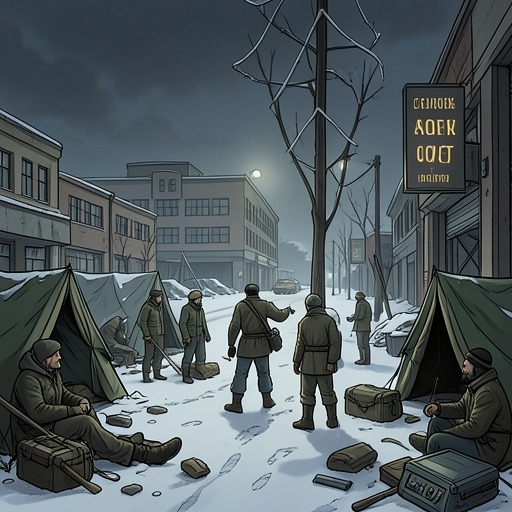
The airport’s buildings and abandoned equipment become the framework for a settled life. In the first years, Clark works on practical survival: gathering firewood, carrying water to keep the restrooms operational, joining salvage trips into the nearby town, planting crops in narrow fields along the runways, and skinning deer. By the beginning of Year Two, residents have built two rows of tents along Concourse B. Branches form the frames, and salvaged sheets cover them; each tent offers a small measure of privacy without putting its occupants far from one another. The airport is no longer simply shelter from the outside. Its concourses become streets for a community organized around the structures of the former terminal.
The number of residents grows. By Year Fifteen, about three hundred people live there, while a later account gives the population as 320. The settlement is one of the largest Kirsten Raymonde has seen. Many of its inhabitants are born there or arrive later, though around two dozen people remain from the day their flights landed. The difference between a temporary crowd of passengers and a multigenerational population marks how completely the airport has ceased to be a stop on the way somewhere else.
Clark and the Museum of Civilization
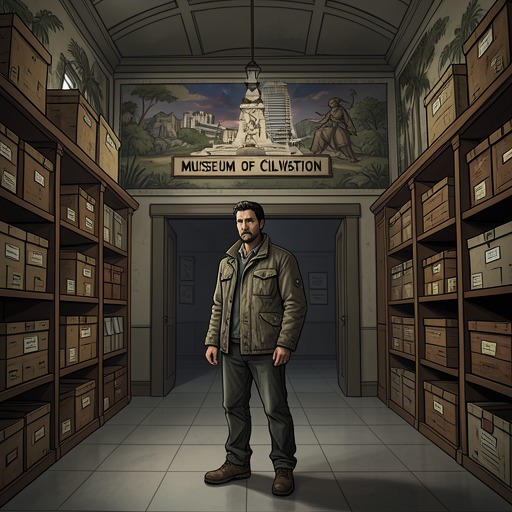
The Museum of Civilization begins in the former Skymiles Lounge, in a glass display case that once held sandwiches. During the first winter, Clark avoids the lounge because it reminds him of Elizabeth Colton, but its quiet and its view over the tarmac draw him inside. Thinking of his boyfriend, Robert, and the museum he might have made, Clark places his useless iPhone in the case. He adds an Amex card left behind by Max, who had departed on the last flight to Los Angeles, Lily Patterson’s driver’s licence, and his laptop. When he returns, someone else has contributed another phone, red high heels, and a snow globe. The collection begins not by official decision but through objects left by people who recognize their value to Clark.
As the airport population increases and Clark grows older, the museum fills the lounge. Its collection preserves things with little practical use but powerful associations: cell phones, iPads, Tyler’s Nintendo console, laptops, impractical shoes, three cleaned car engines, and a chrome motorcycle. Traders bring him magazines, newspapers, stamps, and coins. He also keeps passports, licences, and credit cards belonging to residents who have died, maintaining careful records. Elizabeth and Tyler’s passports remain open to their photographs; Elizabeth gave them to him the night before she and Tyler left in the summer of Year Two, and the sight of them continues to unsettle him.
Clark treats the museum as more than a display of obsolete things. He tries to explain the pre-pandemic world to young visitors, including a sixteen-year-old born at the airport, Emmanuelle. Its exhibits include laptops, iPhones, a radio from an administrative desk, an electric toaster from an airport-staff lounge, and a turntable with vinyl records. Explaining how airplanes once accelerated along long runways and then climbed into the sky, he makes technology legible to someone for whom flight is not remembered experience. The museum’s work is therefore also the work of translation between generations: it gives material form to a past that younger residents cannot recall for themselves.
Arrival of the Travelling Symphony
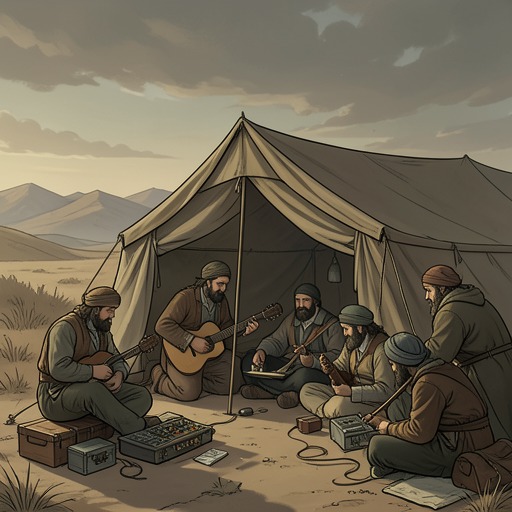
The airport’s function as a destination takes on another meaning when Kirsten Raymonde, Sayid, and August arrive on foot. Near the terminal, the road divides into lanes for Arrivals, Departures, and Parking. Sayid chooses Departures, speaking of escape from the continent as a wish rather than a practical plan. The lane rises to a second-storey entrance of glass-and-steel revolving doors. A municipal bus stands nearby, and two sentries emerge from behind it with crossbows lowered. One drops her bow and runs to welcome the newcomers, calling their names and trying to embrace them.
The reunion places personal loss beside the settlement’s capacity to receive travelers. August takes Sayid to the infirmary, while Kirsten rests in Charlie Harrison’s tent. By then the airport has a substantial population, and the terminal’s improvised domestic spaces accommodate people who have reached it after the roads and ordinary transport have failed. In the tent, Luli crowds beside Kirsten; Charlie tells her that August has explained Dieter’s death. The airport is not a return to the world the travelers left behind, but it offers shelter, familiar companions, and a community in which the consequences of their journey can be met.
Meaning of the airport
The airport concentrates the novel’s contrast between movement and immobility. Before the collapse, aircraft carried people across distances in hours; afterward, planes stand on the tarmac while survivors travel by road or on foot, and the airport itself becomes a place of prolonged residence. The broader post-collapse landscape also repurposes dormant aircraft, which collect snow or serve as storage, further separating the machines from their former promise of departure.
Within the terminal, the calendar and museum answer different aspects of loss. Counting years from the catastrophe acknowledges that the old normal will not return, while preserving passports, electronics, shoes, and everyday devices keeps evidence of that former life in view. Severn City Airport is thus both a practical settlement and an archive: its residents build a future inside the architecture of travel, while Clark’s collection insists that the world that made such travel ordinary is worth remembering.