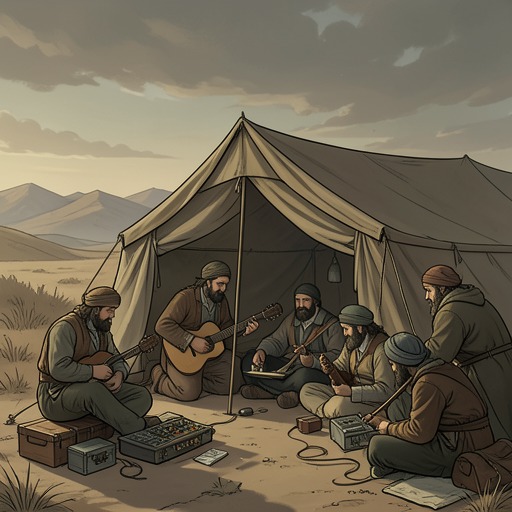
St. Deborah by the Water
Station ElevenSt. Deborah by the Water is a marginal roadside settlement whose importance lies in the sharp change between its modest beginnings and its later subjection to the Prophet. At the southwestern edge of the Travelling Symphony’s known territory, it is first a practical stopping place for travelers and performers. By the troupe’s return, however, the town has become a place where a welcoming appearance conceals a new concentration of power, and where the Symphony must choose between its customary restraint and Eleanor’s safety.
Setting and Place in the Route
Before the collapse, St. Deborah by the Water was not quite a town in its own right. It consisted of a gas station and several chain restaurants strung along a road, with a motel and a Walmart nearby. The dispersed businesses gave the place the character of a roadside interval rather than a settled center. In the post-collapse geography known to the Travelling Symphony, it marked the southwestern border of the troupe’s territory; beyond it, the performers knew little of what lay ahead.
That position made the settlement both an endpoint and a threshold. The Symphony arrived in the midafternoon, and its next passage would take it farther down the eastern shore of Lake Michigan than it had traveled before. The change in route mattered in a world where travel no longer depended on functioning cars, fuel deliveries, or ordinary air service. The troupe’s caravans had once been pickup trucks, but their engines and fuel systems had been removed and the bodies adapted to be pulled by teams of horses. St. Deborah thus stood at the edge of a familiar circuit in a landscape where movement required animals, preparation, and a willingness to enter unknown territory.
The Symphony’s Earlier Stop
Two years before the troupe returned, it had left Charlie Harrison and Jeremy Leung in St. Deborah by the Water. Charlie was pregnant with their child, and arrangements had been made for the couple to stay in the former Wendy’s beside the gas station so that she would not have to give birth while traveling. The stop therefore had a practical, communal purpose: the performers made room for a family’s needs within the limits of life on the road.
On its later arrival, the Symphony found a sentry at the northern end of town, a boy of about fifteen beneath a rainbow beach umbrella. He recognized the troupe and directed it to camp at the Walmart. That welcome initially suggested continuity with the earlier visit: the town still received the performers and offered a place to stay. But the familiar site had acquired a different history. The former Walmart had first housed a group of religious wanderers, who established a communal encampment in the Lawn and Garden Department.
The Prophet’s Rise
The newcomers numbered nineteen and said they had come in peace. Their accounts of travel in the south, through territory once known as Virginia and beyond, were vague, and rumors made that region sound dangerous. In St. Deborah, however, the group initially appeared friendly and self-sufficient. Its members shared meat obtained through hunting and helped with chores, while keeping mostly to themselves. Those ordinary acts of assistance made the encampment seem harmless to townspeople who did not yet understand the group’s capacity for force.
The Prophet, a tall blond-haired leader, gained control after winter fever struck the settlement and the mayor died. He moved with his followers from the Walmart to the gas station in the town center. The townspeople had not realized how much weaponry the group possessed; the stories about its southern travels began to take on a more threatening significance. Within a week, it was evident that the Prophet held the town. His authority combined personal charisma, violence, and selected verses from the Book of Revelation, a mixture that later descriptions of his rule make explicit.
The change in authority also altered the meaning of the town’s familiar commercial sites. The Walmart, first a communal shelter for the wanderers, became the place where the Prophet’s group had established itself. The central gas station then became the seat of a power the townspeople had not anticipated. These were not purpose-built civic institutions: they were ordinary roadside structures repurposed as a camp and then as a center of control. St. Deborah’s vulnerability came partly from the speed with which that conversion took place.
Return, Loss, and Departure
When the Travelling Symphony came back, the contrast between its earlier stop and the town it encountered was registered in a row of three grave markers. The names were Charlie Harrison, Jeremy Leung, and Annabel, their infant; each marker gave the same date, July 20, Year 19. The stones record the loss of the family the troupe had once left in the former Wendy’s, without specifying the circumstances of their deaths. Their presence turns a remembered act of care into a reminder of how little the performers could protect those who remained behind.
The troupe’s encounter with the Prophet also tested its long-standing policy of non-intervention in the politics of the towns through which it passed. The members knew that taking Eleanor with them could expose them to accusations of kidnapping, but they could not imagine returning a child bride to the Prophet. Their decision was therefore not simply a change of route: it was a refusal to treat the town’s new authority as a reason to surrender her. The Symphony chose to take Eleanor south, farther along the eastern shore of Lake Michigan than it had ever gone.
The departure required immediate action. The conductor ordered the company to harness the horses, translating its decision into movement before the group could be drawn back into the Prophet’s reach. The choice carried the troupe beyond the known edge of its route, while leaving the town under the rule that had displaced its earlier, more open welcome. St. Deborah becomes a boundary in both senses: the limit of the Symphony’s familiar geography and the point at which its principle of political non-intervention proves inadequate to the danger confronting one person.
A Town Remembered Elsewhere
St. Deborah remains present in later recollections as a measure of how the Prophet’s power was understood. Jeremy Leung describes the blond-haired leader as having held sway over the town through charisma, violence, and selected scripture. Kirsten Raymonde, too, remembers the earlier visit: she recognizes people from the town by recalling the red-haired twins who once followed her during a walk. Such memories keep the settlement from being reduced to the Prophet’s rule alone. They connect its later reputation to a community the Symphony had encountered before the takeover.
The town’s narrative force comes from that layering of ordinary use and sudden danger. A gas station, restaurants, motel, former Wendy’s, and Walmart first make it a recognizable stop on a road; later, the same kind of everyday places shelter the Prophet’s followers and enable their rule. The sentry’s welcome at the northern edge and the grave markers encountered after it place hospitality beside loss. St. Deborah by the Water consequently marks not only where the Symphony’s route changes, but where its established habits are challenged by the human consequences of leaving a place behind.