St. Deborah by the Water under the Prophet
Station ElevenSt. Deborah by the Water under the Prophet is a regime in which religious certainty becomes a system of local control. After a fever kills dozens and the town’s familiar leadership falters, the Prophet’s followers move from a seemingly peaceful encampment to the centre of power. Their grave markers make the system visible: people who depart without permission are treated as dead, even when their bodies are nowhere in the earth. The Travelling Symphony encounters the town at the point where communal grief, prophecy, and coercion have become difficult to separate.
Emergence after the epidemic
The Prophet’s group arrives after the Travelling Symphony has previously left Charlie Harrison and Jeremy Leung in St. Deborah by the Water. There are nineteen newcomers, led by a tall, blond-haired man who calls himself a messenger and is known only as the Prophet. They settle first in the Walmart’s former Lawn and Garden Department. Their accounts of travel in the south unsettle some residents, but the group is friendly and self-sufficient: its members hunt, share meat, and help with chores. Their apparent harmlessness allows them to become part of the town before most residents understand who their leader is or what he claims for himself.
The Prophet presents visions and prophetic dreams as signs of special knowledge. His followers recount an episode in which he insisted that three ravens flying low ahead meant they should stop early. The next morning they came upon a collapsed bridge and a funeral for three men who had fallen into the river. For the followers, the coincidence confirms that the Prophet’s vision saved them; the same episode also shows how ordinary events can be reorganized as evidence of his authority. The group’s stories about the dangers of the south, initially vague and unsettling, acquire a darker significance when its concealed weapons become apparent.
The decisive local crisis is the winter fever. Thirty people die, including the mayor, and the town’s leadership changes. The Prophet adds the mayor’s wife to the women described as his wives and moves with his followers into the gas station at the town’s centre. Within a week, the town is understood to be his. The account does not present this transfer as a formal election or agreement: epidemic mortality, weakened leadership, a well-organized group, and forceful capacity converge, while the residents’ earlier hospitality has already given the newcomers a foothold.
Markers, departures, and the meaning of death
When the Travelling Symphony returns two years after leaving Charlie and Jeremy, Kirsten Raymonde learns from a midwife that Charlie rejected the Prophet’s advances and that the family had to leave town. The warning to stop asking questions and leave quickly recasts the town’s changed appearance as a danger rather than a local mystery. The midwife’s public manner remains cheerful, but her private warning tells Kirsten that ordinary conversation has become risky.
In the graveyard, Dieter finds three markers bearing the names Charlie Harrison, Jeremy Leung, and Annabel, the family’s infant. Each marker gives the date July 20, Year 19. Kirsten is shaken by the sight, but Dieter points out that there is no disturbed earth beneath them. The contrast with the older graves is stark: the winter-fever burials have mounded soil, while these markers stand over flat ground. Their presence records a disappearance in the town’s official language without proving that the people named on them are physically buried there.
A resident later tells the Symphony that twenty families have left since the fever, including Charlie, the sixth guitar, and their baby, and that no one knows where they went. The town’s markers therefore do more than commemorate the dead. They impose a public interpretation on departure and make absence resemble death. The Conductor wonders aloud what the markers signify, while Sayid, whose close friend was the sixth guitar, responds with open anger at the possibility that a prophet is behind the town’s transformation.
A theology of order and selection
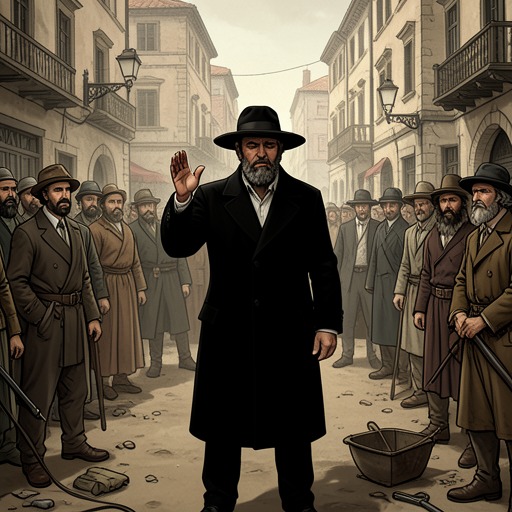
At the Symphony’s performance of A Midsummer Night’s Dream, the Prophet addresses the crowd after thanking the performers for providing a respite from daily cares. The audience applauds when prompted and falls silent when he raises his hands. His sermon supplies a total explanation for the catastrophe: the Georgia Flu was not merely an illness but a divinely purposeful cleansing. He invokes earlier influenza outbreaks and describes the final pandemic as so lethal that, by his estimate, only one person in every two hundred fifty or three hundred survived. He turns the scale of the loss into evidence of perfection and divine intent.
The Prophet casts the pandemic as a flood and the survivors’ inner light as an ark. In his account, the saved have not only been spared to carry or spread the light; they are the light, and therefore pure. The language makes survival a credential and gives the group a moral boundary between the chosen and the impure. He also warns that the catastrophe was only the beginning: in his telling, a later pestilence was another preview and more cullings would come. His visions thus make the future, as well as the past, answer to his doctrine.
That doctrine fuses spiritual authority with an explicit political claim. When The Conductor asks about the graveyard markers, the Prophet says that the group speaks of the light as order and presents the town as a place of order, incompatible with people who have chaos in their hearts. He explains the markers through a distinction between bodily death and the death of the soul: those who leave without permission are dead to the community, so the town holds funerals for them and erects markers. The account reveals the practical force of his theology. A departure is not treated as a person’s choice to go elsewhere; it is classified as spiritual death and incorporated into the town’s public record.
Permission, coercion, and the Symphony’s departure
The permission rule is not only a metaphor. As the Symphony prepares to leave, a young sentry asks whether it has permission. When The Conductor asks what happens to people who leave without it, he answers that the town holds funerals for them. Asked what happens if they return after a funeral, he cannot finish his reply. The unfinished sentence leaves the consequence unstated, but the rule’s threat is clear enough to Kirsten and the other visitors.
Earlier, the Prophet speaks privately to The Conductor after his sermon. She steps back and refuses him; the request itself is not specified in the account. The exchange is followed by his approach to an armed man who had guarded the gas station. By the time the Symphony leaves, armed guards stand on either side of the station door. The performers take a back road behind the Walmart rather than depart through the town centre. A boy roasting what may be a squirrel at a roadside post challenges them about permission, showing that the rule has reached beyond the Prophet’s own speech and into routine sentry duty.
The Symphony’s exit is therefore a small but consequential refusal to accept the town’s terms. The Conductor had initially decided that the group could not leave until it knew more, and the performance itself becomes the setting for the Prophet to state his authority. Once the markers, the midwife’s warning, and the permission rule reveal what order means in practice, the Symphony leaves rather than submit to that order. The cited account does not show the Prophet’s rule ending; it shows the group escaping its immediate reach.
The wider collapse and the town’s significance
The town’s rise to power occurs within a wider collapse in which familiar institutions and transport systems fail. At the start of the epidemic, Hua reports that more than two hundred flu patients have been admitted since morning, with fifteen deaths, and warns Jeevan Chaudhary to leave or stock up and stay inside. Toronto hospitals are placed under isolation. Later, Jeevan and Frank seal air ducts, cover windows, barricade a door, and fall silent when strangers knock; twice, someone tries to break in. These details establish the fear and practical isolation out of which competing forms of post-collapse order emerge, though the narrative does not equate every community’s response with the Prophet’s rule.
At Severn City Airport, roughly a hundred passengers remain after the flight is quarantined and ground transportation proves unavailable. A scouting party returns through a roadblock with supplies, and Dolores feels relief when the airport comes into view. By the end of Year Fifteen, the airport community numbers three hundred, and Clark Thompson spends his days preserving objects in the Museum of Civilization. This later example offers a contrast in how people organize survival: a community can develop around shared work and the preservation of memory rather than a leader’s claim that survivors are pure and dissenters are dead. In a later conversation, an unnamed woman affirms that the pandemic happened for a reason, echoing the appetite for meaning that the Prophet’s sermon exploits without proving that his particular doctrine is universally accepted.
St. Deborah by the Water under the Prophet is consequently both a local regime and a warning about the political uses of catastrophe. Its rulers offer explanation, belonging, and order in the wake of mass death, but define those goods through obedience and exclusion. The empty ground beneath Charlie Harrison, Jeremy Leung, and Annabel’s markers condenses that contradiction: the town can make a person socially dead without establishing what became of the person’s body, and can present that imposed absence as a settled fact.