St. Deborah’s permission-to-leave rule
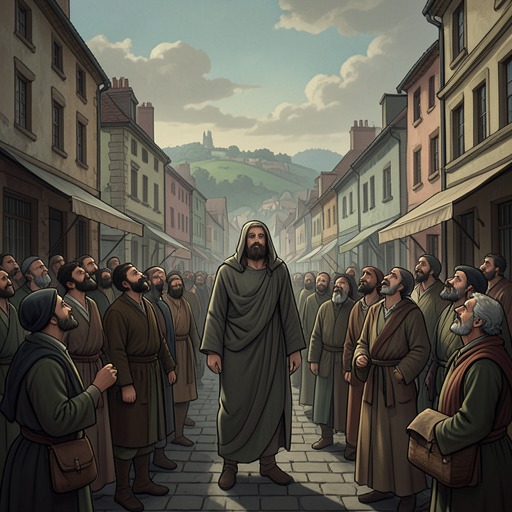
Station ElevenSt. Deborah’s permission-to-leave rule makes leaving town conditional on authorization from the community controlled by The Prophet. Its consequence is not simply a denied journey: people who depart without permission are declared dead by those who remain and commemorated with funerals and grave markers. The rule makes movement a test of obedience, and gives the town’s claims of freedom a starkly different meaning in practice.
The Rule and Its Meaning
The rule appears when The Travelling Symphony returns to St. Deborah by the Water. Asked whether residents typically travel to other nearby towns, a man says there is no town nearby, then turns to the silent crowd and publicly declares that everyone is free to go as they please. The Conductor answers that the company had not expected residents to set out alone when they knew the Symphony would return for them. The exchange establishes the central contradiction: the town’s representative asserts freedom, while the circumstances of the residents’ departure suggest that leaving has become subject to control.
The Prophet’s explanation supplies the rule behind that contradiction. He describes his community as a place of order and says that people with chaos in their hearts cannot abide there. He distinguishes physical death from the death of the soul, then explains that those who leave without permission are considered dead by the community. Funerals and grave markers make this judgment public and durable. The absent person may still be alive elsewhere, but within the town’s social and religious order, unauthorized departure is treated as a final severance.
That distinction also explains why the graveyard becomes a point of tension. The Conductor asks about its markers; The Prophet frames the question through his doctrine of death rather than treating the markers as ordinary evidence of physical deaths. He connects the practice to his own account of having seen his mother die twice, though he does not elaborate that claim in the exchange. The graveyard therefore signifies more than loss: it records the regime’s power to define who belongs among the living community and who has been cast out of it.
Enforcement at the Town’s Edge
The rule is enforced not only through The Prophet’s authority but through ordinary encounters at the boundary. After the discussion, armed guards are posted beside the gas station door. The Travelling Symphony departs by a back road behind the Walmart, where a young sentry is stationed beside a small fire. His post does not look like a major defensive position, but his question to the travelers is direct: have they obtained permission to leave?
The Conductor tells him that no permission was required the last time the company visited. The boy replies that things are different now. When she asks what would happen if they had no permission, he repeats the town’s rule: people who leave without it are given funerals. Asked what happens if they return after a funeral has already been held, he cannot finish his answer. His hesitation gives the policy an unsettling practical edge. The rule is stated clearly, but what the community would do with a living person it had formally declared dead remains unresolved.
The Symphony does not stop to settle the question. The Conductor signals the lead driver to keep moving and speaks with the sentry while the caravans continue. A member of the company urges Kirsten Raymonde to keep going; Sayid takes her by the shoulder and propels her after the others. The scene thus shows how the rule reaches beyond official declarations: it shapes the company’s choices at the roadside, turning a conversation into a moment of hurried departure. The evidence does not establish that the Symphony received permission, only that its wagons move on while the rule is being challenged.
Mobility After the Collapse
The town’s restriction belongs to a world in which movement has already been transformed by the collapse of familiar infrastructure. Commercial flight is gone, although abandoned airplanes remain on runways and in hangars, repurposed for storage as weather and circumstance allow. Borders are unmanned, and services such as road maintenance have ceased. Travel is possible, but no longer supported by the systems that once made long-distance movement routine.
The Travelling Symphony’s caravans embody that change. Once pickup trucks, they have been stripped of engines and fuel systems and rebuilt to be pulled by horses. Their drivers sit on benches above the cabs; the enclosed cab interiors offer children a comparatively safe place when the company crosses dangerous territory. These practical adaptations make the company mobile, but not independent of risk. At St. Deborah by the Water, the permission rule adds a different limit: even a group capable of travelling onward must reckon with a community that claims authority over departure.
Other journeys in the novel clarify the contrast without making the rule universal. During the flight from Toronto, Kirsten Raymonde and her brother Peter initially use an abandoned car, but clogged expressway ramps and side roads eventually force them to continue on foot; the border is open because its guards have left. Jeevan Chaudhary, meanwhile, resolves to follow the lake and avoid roads and other people. These journeys show movement shaped by blocked routes, danger, and personal choice. At St. Deborah by the Water, the decisive obstacle is instead political: the town’s authority attaches a communal penalty to leaving without consent.
Significance
The rule turns a basic act of self-direction into a conflict over who has the right to define a person’s status. The Prophet’s language presents the town as orderly and departure as evidence of inner chaos, while the funeral ritual converts that judgment into a communal fact. The boy at the roadside can repeat the rule but cannot explain what follows if the supposedly dead return. That unanswered question exposes the gap between doctrine and the lived consequences of enforcing it.
For The Travelling Symphony, the encounter tests the boundary between its movement through communities and their control over residents. The Conductor asks questions rather than accepting the town’s public reassurance at face value; the company nevertheless keeps moving when the sentry invokes the new requirement. The rule’s force lies both in its official premise and in the uncertainty it creates: leaving may remain physically possible, but unauthorized departure carries the threat of being erased from the community that one leaves behind.