Station Eleven comics
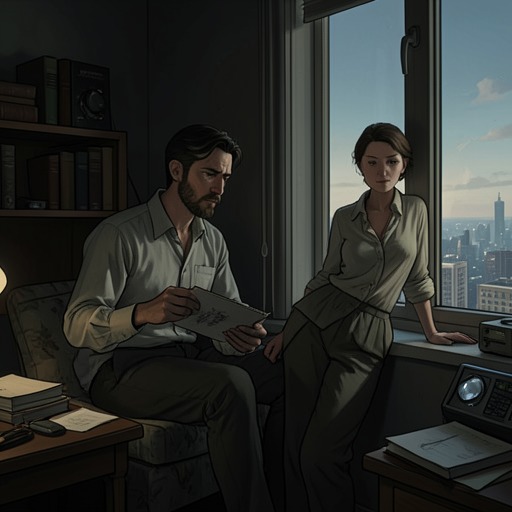
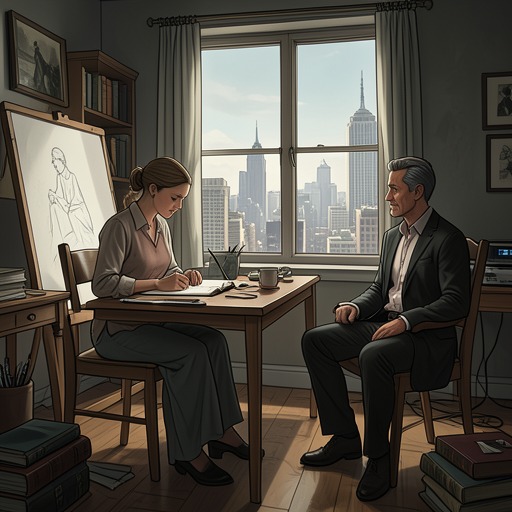
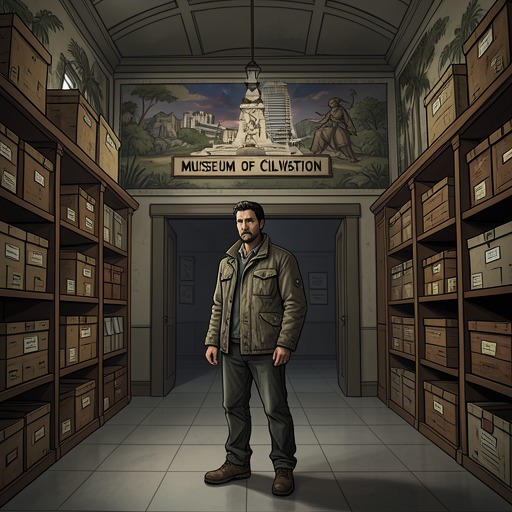
Station ElevenThe Station Eleven comics are two scarce issues of a little-known series, given by Arthur Leander to Kirsten Raymonde before the Georgia Flu and carried by her into the post-collapse world. They matter both as the surviving trace of a childhood encounter Kirsten can barely remember and as a work whose vivid, technologically advanced setting persists after the infrastructure that once connected people has failed.
The two issues and their world
The comics are identified as Dr. Eleven, Vol. 1, No. 1: Station Eleven and Dr. Eleven, Vol. 1, No. 2: The Pursuit. Their central figure, Dr. Eleven, is a physicist who lives on a space station designed to resemble a small planet. That inhabited landscape includes deep blue seas, rocky islands joined by bridges, orange and crimson skies, and two moons on the horizon. The premise gives the series a world that is at once artificial and expansive: a constructed habitat rendered with the geographic breadth and visual richness of a planet.
One surviving spread in the first issue shows Dr. Eleven on dark rocks above an indigo sea at twilight. Small boats pass between islands, wind turbines turn on the horizon, and Dr. Eleven holds his fedora while a small white animal stands beside him. Older members of the Travelling Symphony identify the animal as a dog, although it is unlike any dog Kirsten Raymonde has seen; its name is Luli, and it looks like a cross between a fox and a cloud. The scene’s exact line is, “I stood looking over my damaged home and tried to forget the sweetness of life on Earth.” The damaged home and remembered Earth introduce loss into the comic’s otherworldly landscape, linking its imagined refuge to the damaged world in which Kirsten carries it.
Rarity, authorship, and physical survival
The comics are conspicuously unlike ordinary mass-market issues. A Travelling Symphony member who had worked in printing before the collapse explains that their bright images and archival paper would have made them expensive to produce. He suggests that they may have been someone’s vanity project, but the books offer no biography of their maker: the author’s name is replaced by the initials “M. C.” The inside cover of the first issue is marked “Copy 2 of 10,” while the second is marked “Copy 3 of 10.” The numbering raises the possibility that only ten copies of each issue were made, without confirming whether that is the full extent of the print run.
Their survival is material as well as imaginative. Kirsten Raymonde has cared for them as best she can, but by Year Twenty they are dog-eared and worn soft at the edges. They are not pristine relics sealed away from use: Kirsten knows them by heart, and their condition records years of handling. Their rarity makes the surviving pair seem almost impossibly small beside the world they depict, but their worn pages also show that they have remained objects to be read and carried rather than artifacts removed from daily life.
Arthur Leander’s gift and Kirsten’s memory
Arthur Leander gave the comics to Kirsten Raymonde when she was a child. Her recollection of the encounter is uncertain and fragmentary: she remembers Arthur as kind and grey-haired, and is almost certain he pressed the two books into her hands while saying, “I have a present for you.” The comics consequently hold a specific place in a past she otherwise struggles to recover. Kirsten cannot remember her old street address or her mother’s face, but she remembers Arthur and the gift.
That connection becomes especially tangible when Kirsten searches abandoned houses for celebrity-gossip magazines. At sixteen, she found a photograph of Arthur with his young son, and she began collecting images of him, including photographs with his first wife, Miranda, his second wife, Elizabeth Colton, and his third wife, Lydia. She stores the clippings and comics together in a ziplock bag in her red, child-sized backpack. The comics are therefore kept alongside evidence of the life that Kirsten can reconstruct only in pieces: the printed record of Arthur’s public existence and the private gift she associates with him. The collection cannot restore her memories, but it gives their gaps a durable, physical form.
The gift also survives in Kirsten’s account to François Diallo, a librarian since Year Four. When asked whether he has seen the space-station comics or another work in the series, Diallo says he has not. Kirsten identifies their source plainly: Arthur Leander gave them to her, and he was the actor she had described. That exchange confirms both the books’ unusualness and the importance Kirsten attaches to their provenance; within her remembered life, they are not merely anonymous survivors of the old world.
Paper, screens, and a vanished network
The comics persist in a world where electronic connection has become difficult even to imagine. The global Internet and social media have disappeared, and in a later search for electricity in Traverse City an inventor pedals a stationary bicycle to power a laptop while trying to find the Internet. The attempt produces the message “This webpage is not available.” Kirsten is less interested in a practical return to the network than in electricity itself, imagining lamps, a nightlight, a chandelier, and a brilliantly lit stage. The episode makes the comics’ printed survival distinct from the electronic world that younger Symphony members have heard about but never experienced.
That contrast is sharpened by the comics’ material form. A screen in the attic depends on pedaling and remains at risk of flickering out; the Internet it is meant to reach cannot be found. The paper pages, by contrast, are damaged by age and handling but remain readable, and Kirsten can carry them with her. Their durability is not absolute—their softened edges attest to wear—but their physical presence allows a work from before the collapse to remain available when the network has vanished.
The loss of electronic media is made visible elsewhere in the book through silent television test patterns and lessons at the airport school about the former worldwide network, its satellites, and the devices that once opened portals into it. Against that history, the comics are a small but unusually vivid surviving medium: they preserve not only a story but also images, paper, and a traceable act of transmission from Arthur Leander to Kirsten Raymonde. Their imagined space station does not replace the lost world. Instead, its damaged home and remembered Earth give the surviving pages a language for carrying the past without making it whole again.