Tanya
Station ElevenTanya is a young theatre worker who looks after the three child actresses playing Lear’s daughters and is in a relationship with Arthur Leander. Seen mainly through Arthur’s attention to her, she brings everyday warmth into his final hours at the theatre: she notices when he looks unwell, accepts his lapses without reproach, and meets his impulsive offers with affection. Her last appearance comes on the night of his final performance, in a backstage moment framed by the approaching Georgia Flu and the narration’s note that she is already in the final week of her life.
Work and first appearance
Tanya enters Arthur’s dressing room before the end of the first act, brushing past him after he has returned to the theatre and risen from the sofa. He is not steady on his feet. She is there in connection with her work caring for the three little actresses who play Lear’s daughters, and she soon checks on him rather than treating his unsteadiness as incidental. Arthur dismisses his condition as tiredness and insomnia; Tanya asks whether he is sick. The contrast is small but consequential: while he tries to make his weakness ordinary, she sees enough to question that explanation.
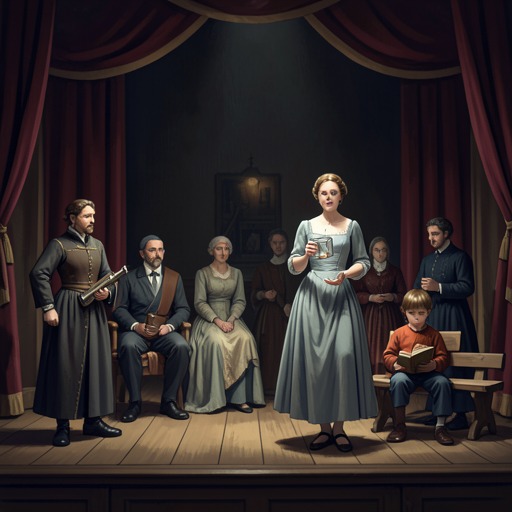
The theatre gives her a practical place in the performance’s backstage life. When Arthur sees her later on the night of his last performance, she is herding the three girls toward the dressing rooms. She is not presented as a performer herself; her work is to look after the children whose roles belong to the play. Her movements between the stage and the dressing rooms place her among the people who sustain a production outside the leading actor’s view.
Relationship with Arthur
Arthur is captivated by Tanya, who is slightly more than half his age. His attraction is described alongside his delight at seeing her and his appreciation of the way she lets small grievances go. When she explains that her phone battery died, she does not turn the missed contact into an argument; she proposes that he make it up to her with a glass of wine. Arthur takes this ease as a welcome change in his life, valuing her lack of resentment as much as the immediate pleasure of her company.
Their differences emerge in details rather than a stated conflict. Tanya likes her wine cold and concentrates on its taste; Arthur knows this and finds pleasure in watching her drink. He associates her appreciation of good things with having grown up with little money. The detail gives her enjoyment a history in Arthur’s understanding, even as the account remains filtered through his affection for her.
That affection also makes Arthur attentive to what he might do for her. During a call at the half-hour, he says he has been thinking for a week about doing something for her and asks how much she still owes in student loans. The exchange establishes a concrete concern—her debt—and his wish to help, but does not state what he ultimately offers or whether the loans are repaid. His attention to the question sits beside his own growing physical distress: in the dressing room he has noticed his hands trembling, yet he turns toward a plan for Tanya’s future.
Gifts and the meaning of possessions
A glass paperweight sent to Arthur by Miranda becomes a gift to Tanya. Miranda had explained that Clark brought it to the house in Los Angeles and that she regretted taking it, believing it had been meant for Arthur. Arthur, however, has no memory of Clark giving it to them and does not want a paperweight—or possessions generally. When he gives it to Tanya, she peers into its cloudy depths and admires it. The object therefore changes meaning in passing between people: what carries a history of uncertain ownership and unwanted attachment for Arthur becomes, for Tanya, a beautiful present.
The gift also clarifies the imbalance between Arthur’s growing detachment from things and his desire to give Tanya something. He has little use for objects as keepsakes, but he does want to respond to her with generosity. His proposal to help with her student loans points toward practical aid; the paperweight offers a smaller, immediate pleasure. Neither gesture is shown resolving a larger problem, and the text leaves the scale of his intended help open.
The final performance
On the night of Arthur’s last performance, Tanya appears across the stage while guiding the three girls toward the dressing rooms. She smiles and blows him a kiss; he returns it before attending to the murmurs backstage. Later, in his costume of rags for the mad scene, Arthur sees her across the stage again. A stagehand then brings Kirsten Raymonde to him, so Tanya’s brief exchange belongs to the surrounding movement of the production rather than to a private farewell between the couple.
The narration places this ordinary affectionate gesture against a stark boundary: Tanya is already in the final week of her life, with the Georgia Flu close. It does not show her illness or explain her eventual fate in detail. Instead, the impending loss alters the weight of what has just seemed casual—a kiss across a stage, the work of escorting children to their dressing rooms, and Arthur’s assumption that there will be another chance to help her. Tanya’s limited appearances thus connect intimate, practical care to a world on the verge of being irreversibly changed.