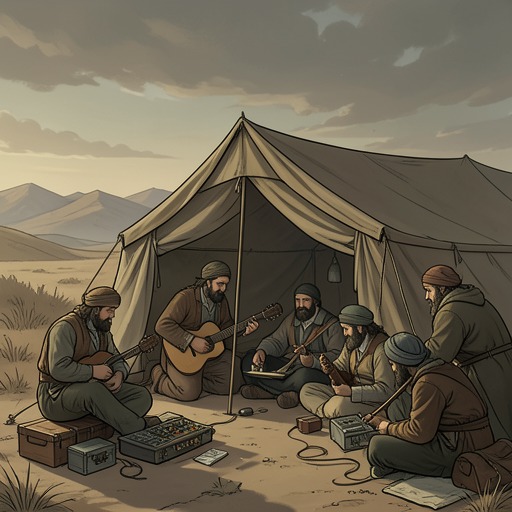
The Conductor
Station ElevenThe Conductor is the leader of the Travelling Symphony, a mobile company of musicians and actors that formed in the years after the Georgia Flu and the Collapse. She gathered friends from her military orchestra, left the air base where they had been living, and took them into an unsettled landscape. Her leadership is practical as well as artistic: she directs the company’s movements, weighs risks to the group, and must decide when its rules can no longer determine what is right.
Formation and the Road
The Travelling Symphony began moving five years after the Collapse, during the years when people were still searching for places where life could continue. After six months of travel, the orchestra met a company of Shakespearean actors who had escaped from Chicago and spent several years on a farm. The actors had been travelling for three months. The groups joined forces, creating a company that could offer both music and theatre to scattered settlements.
By twenty years after the Collapse, the Symphony was still travelling the shores of Lakes Huron and Michigan. Its regular circuit reached west to Traverse City, north and east to Kincardine, and south along the St. Clair River to fishing towns before turning back. The Conductor’s company therefore remained an exception to the broader pattern of settlement: many people had stopped travelling as gasoline became unusable, but the Symphony continued to connect communities by road.
The form of that movement had changed with the old infrastructure. The company’s caravans had once been pickup trucks; after fuel became useless, they were stripped of their engines and fuel systems and adapted to be drawn by teams of horses. Their covered structures were built in the truck beds, with doors and sturdy windows that offered children a relatively protected place when the company crossed dangerous territory. The vehicles carried the travelling company while also serving as a visible, recognizable home on the road.
The Symphony’s Work and Leadership
Under the Conductor’s direction, the company performed classical and jazz music, orchestral arrangements of pre-Collapse popular songs, and Shakespeare. Its audiences came from small settlements separated by long stretches of sparsely travelled territory. Shakespeare became especially important: although the company had sometimes performed more modern plays in its early years, audiences appeared to prefer Shakespeare. The Conductor’s work thus joined the practical task of keeping a group moving with the preservation of performance in a world where the former conditions of cultural life had disappeared.
Her authority is expressed through decisions, not through a detailed account of a formal hierarchy. At St. Deborah by the Water, Kirsten reported grave markers and warned that a Prophet controlled the town. The Conductor refused to leave before the company knew more, and decided they would make inquiries after the performance. During the show, she stood very still with her hands clasped behind her back as The Prophet addressed the crowd and presented the pandemic as divine punishment and cleansing. His welcome had turned the performance into an occasion for his own public address; the audience applauded on cue, and his authority over the gathering was apparent.
Afterward, when the audience dispersed without its customary conversations with the performers, the Conductor acted quickly. She ordered the company to harness the horses and depart. Her command came despite an expectation that they might stay in town for several days. The change in plan followed the encounter with The Prophet and the absence of the ordinary welcome that the Symphony’s performances had often received. The company’s mobility, normally a way of carrying art between settlements, also gave it a means of leaving a dangerous situation.
Risk, Route, and Missing Members
The Conductor’s decisions are not simply a policy of avoiding danger. When the Symphony was missing two members, she believed they had gone south and considered whether the company should expand beyond its familiar territory. She acknowledged that the route was risky, but chose to continue south along the lakeshore. A population in Severn City might know the best route back to the company’s usual region, and the search for the missing members gave the journey an immediate purpose. Her choice placed the group farther down the eastern shore of Lake Michigan than it had travelled before.
The missing members also test her responsibilities to individuals and to the whole company. After fifteen years on the road, she said that four times Symphony members had become separated from the group. On each occasion, they had followed the separation protocol and reunited with the others at the destination. Rather than abandon that procedure when the group was divided, she asked Alexandra to recite it, emphasizing that the rules had been taught to everyone. At the same time, the familiar record of reunions did not remove the present danger or guarantee an outcome.
She made the conflict explicit when the company considered whether to stay and search. She had been on the road for fifteen years; Sayid had been with her for twelve, and Dieter even longer. Gil had been with her from the beginning, when they walked out of Chicago together. The length of those associations gives weight to her refusal to leave either of the missing members willingly. Yet she concluded that remaining another day would put the rest of the company at risk. The following morning, after a night of double watches with teams of four, the Symphony set out. Her decision neither dismisses the missing members nor treats loyalty as permission to expose everyone else to danger.
Eleanor and the Limits of Non-Intervention
The Conductor’s usual policy was strict non-intervention in the politics of settlements. That principle was challenged when the Symphony discovered Eleanor, a girl hiding beneath the costumes. She begged not to be sent back. The Conductor initially stated that the company could not take children, explaining that the situation was not like running away to join a circus, and noted that the discovery was why the caravans were checked before departure.
Once the company understood that returning Eleanor would mean delivering a child bride to The Prophet, the Conductor faced a different choice. The group recognized that taking Eleanor could expose them to accusations of kidnapping, and that she might even be leading them into a trap. Still, no one could imagine sending her back. The Conductor set aside the non-intervention rule and took the girl with them into the unknown south. Eleanor rode in the first caravan, positioned so she would be at least temporarily out of sight to anyone approaching from behind. The decision makes the boundary of the Symphony’s neutrality clear: it ordinarily avoids local political conflicts, but the rule does not compel it to return a child to a situation the company considers dangerous.
Change and Significance
The Conductor’s leadership is defined by the tension between continuity and revision. The Symphony depends on routines: performances, planned routes, caravan checks, watches, and a separation protocol learned by its members. Those practices make a travelling life possible, but they do not settle every crisis. At St. Deborah by the Water, she changes the schedule and leaves after The Prophet’s address. During the search for separated members, she honours their established protocol but refuses to let the search endanger the rest of the company. In Eleanor’s case, she breaks with a longstanding non-intervention policy.
The motto painted on the lead caravan, “Because survival is insufficient,” gives the Symphony’s work its stated purpose. The Conductor’s choices show that the motto does not mean disregarding survival: she orders watches, moves the company away from a threatening settlement, and weighs the safety of those travelling together. Rather, her leadership holds artistic life and physical safety in the same field of responsibility. She keeps the company moving so it can perform, but also revises its rules when following them would abandon someone whom the group can protect.