The First Winter at Severn City Airport
Station ElevenThe First Winter at Severn City Airport traces how a group of stranded passengers turns an abandoned transport hub into a fragile refuge as the Georgia Flu dismantles the systems on which ordinary life depends. Its defining movement is from waiting for rescue to making a life in place: broadcasts fall silent, supplies run out, and the airport’s remaining people improvise food, water, security, and eventually a shared account of the vanished world.
The epidemic reaches the airport
The winter’s crisis begins beyond the terminal. In Toronto, Hua tells Jeevan Chaudhary that more than two hundred flu patients have been admitted since morning, including 160 in three hours, and that fifteen have died. With the emergency room full and beds in the hallways, Hua urges Jeevan to leave or, if he cannot, to stock food and stay inside. The warning turns illness from a distant report into a dividing line between life before and life after. News reports confirm that Toronto General Hospital and two other local hospitals are under isolation, while officials acknowledge the Georgia Flu and request calm.
Jeevan reaches his brother Frank’s apartment with shopping carts of supplies. They watch the news in a state of exhaustion, cover the air ducts with plastic, hang towels across the windows, and move a dresser in front of the door. When people knock, they keep silent; twice, someone tries to get through the lock, but the deadbolt holds. This private barricade anticipates the airport’s larger problem: survival depends not only on provisions, but on deciding whom to trust and how to remain sheltered when public systems no longer protect anyone.
The news itself deteriorates as the pandemic spreads. By the fifth day, Frank turns from the broadcasts to his ghostwriting project. Networks and cities disappear from the air, one by one; the last visible newsroom is eventually empty, and then the internet goes dark. In the apartment, a phone displays no service. Across the city, abandoned cars block roads, while the absence of workers halts fuel delivery, transport, food distribution, and electrical maintenance. When the lights go out, Jeevan sees the failure not as a single broken machine but as the interruption of a vast human network whose labor had been easy to overlook.
Waiting, scarcity, and departure
At the airport, Clark Thompson decides to stay after hearing that ground transportation is unavailable. Some passengers leave on foot toward Severn City, and a few return with the same report; an Air Gradia agent is in tears as the flight display continues to announce an arrival and her radio gives the word quarantine. About a hundred passengers remain. Many cover their mouths and noses, but the group has no clear way to know whether the danger is already among them or what the instruction to leave would mean in a world without buses, trains, or passable roads.
Scarcity becomes immediate by the third day. The vending machines are empty, and Tyler Leander, whose Nintendo console has run out of battery, breaks down in tears. A passenger who needs Effexor becomes ill from withdrawal. The others search airport offices, the TSA holding cell, desks, and abandoned cars, finding warm clothing and shoes but none of the needed medication. A call to 911 from the baggage-claim pay phone brings no answer. By the fifth day, people have broken into the gift shop for clean clothes; bright souvenir shirts and laundry drying on benches lend the terminal an improvised, almost festive appearance, but the snacks are gone by the sixth day and the National Guard has not arrived.
On the seventh day, television networks suspend broadcasts or fall away. After a brief power interruption, the airport appears to switch to generator power, though the workers who know how to operate the generators have left. People have been trickling out since the third day, driven by the strain of waiting and the urge to do something. On the eighth day, Tyrone, the remaining TSA agent, goes into the trees with a former park ranger and returns with a deer. The group roasts it over a fire and shares the last of the champagne; the passenger suffering from withdrawal leaves the airport and does not return.
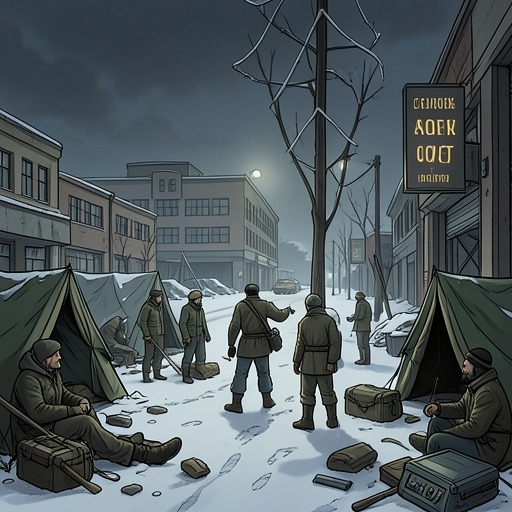
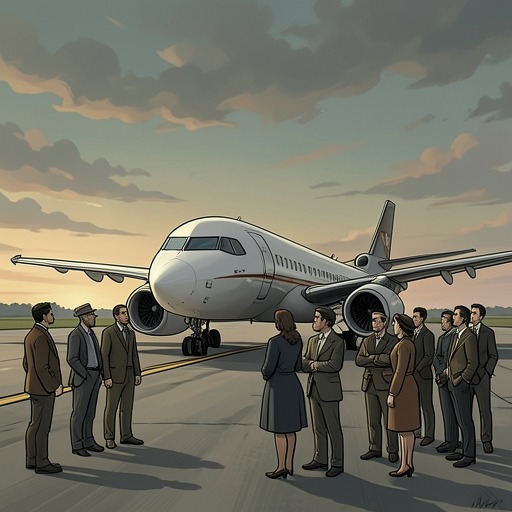
On the twelfth day, the lights go out for good. The toilets can still be used if the bowls are supplied with water, so passengers collect snow in plastic security trays and melt it in the restrooms. The glass architecture lets daylight support the routine: they live by the light and go to bed at sundown. This practical adaptation stands beside a much riskier choice. On the fifteenth day, a pilot offers to fly to Los Angeles in search of his family. With news unavailable and no assurance that the destination is safe, the passengers weigh the chance of moving closer to home against the possibility of losing their refuge. At noon the following day, they board by a wheeled staircase found in a hangar. The aircraft works its way between parked jets and takes off. Its successful ascent gives flight a newly precarious meaning: a familiar form of travel has become an act of faith.
The departure leaves fifty-four people behind. Their subdued gathering around the fire that night marks the cost of the decision without resolving its uncertainty. On Day One Hundred, with enough deer to survive but supplies such as soap and batteries exhausted, Clark proposes a scouting expedition. Tyrone, Dolores, and a schoolteacher set out with road maps and a TSA handgun. They return with carts of food and necessities from an unlooted Chili’s, but also report a quarantine warning, abandoned vehicles, signs of death, and no other people. Dolores is surprised by her relief when the airport comes back into view: for the first time, it has become home rather than merely a place to wait.
A community takes shape
The first stranger arrives after the scouts return, carrying a gun but dropping it when Tyrone orders him to do so. His difficulty speaking conveys how long he has been alone; he says he had thought he was the only one. The encounter unsettles the airport’s expectation that outsiders will necessarily be attackers. Guards and whistles remain part of the community’s precautions, but the arrival also establishes the possibility of connection beyond the original group.
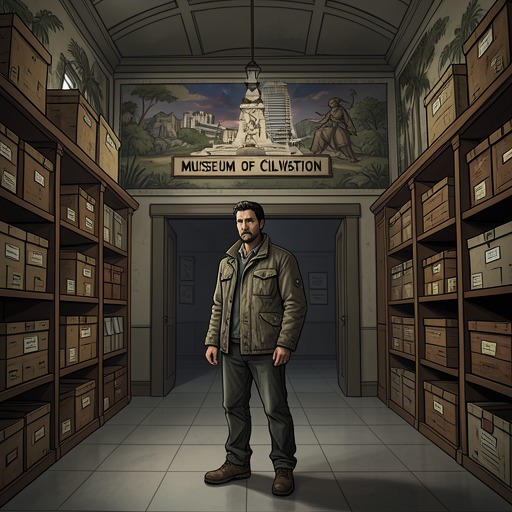
The airport’s transformation continues over years rather than ending with the winter. By the end of Year Fifteen, three hundred people live there, and Clark has devoted himself to the Museum of Civilization in the Skymiles Lounge. In the first, difficult period he had gathered firewood, hauled water to keep the toilets working, joined salvage trips, planted crops beside the runways, and helped skin deer. As the population grows, he can spend his days preserving objects that have no practical use but retain human meaning: phones, computers, impractical shoes, vehicle parts, newspapers, coins, and the identification or credit cards of people who lived and died at the airport. He keeps careful records, turning the scattered residue of private lives into a communal archive.
The museum’s first objects make that purpose visible. Clark places his useless iPhone in an empty display case, then adds a departed passenger’s credit card and another person’s driver’s licence, followed by his laptop. Other people contribute an additional phone, red heels, and a snow globe. Clark looks at the globe not simply as a possession but as the end point of many kinds of labor: design, manufacture, packing, ocean shipping, port work, and delivery. Held up against the runway, its miniature snow distorts the grounded planes. The object condenses the invisible human infrastructure whose disappearance had stranded the passengers, while its preservation keeps that network imaginable.
By Year Fifteen, the museum also gives the settlement a place to encounter the scale of what has been lost. People visit after work; James returns to see the motorcycle he once used in Severn City, and Emmanuelle, the first child born at the airport, looks at the phones. In Concourse C, children learn that planes once carried people around the world, that electronic devices once connected to a worldwide network, and that goods crossed oceans by ship and air. The facts are difficult to grasp, particularly the borders and distances that no longer organize their daily experience. The winter’s emergency thus becomes the origin of a durable social world: the terminal shelters bodies first, then sustains work, education, memory, and a shared history.