The Prophet's death
Station ElevenThe Prophet’s death occurs on the road near the airport, where a boy among his armed followers turns against him while Kirsten Raymonde faces the group. The killing abruptly ends The Prophet’s control of the confrontation, but it does not bring a clean rescue: the boy dies moments later, and Kirsten is left to reckon with both deaths before the Travelling Symphony’s scouts arrive.
The confrontation and its competing visions
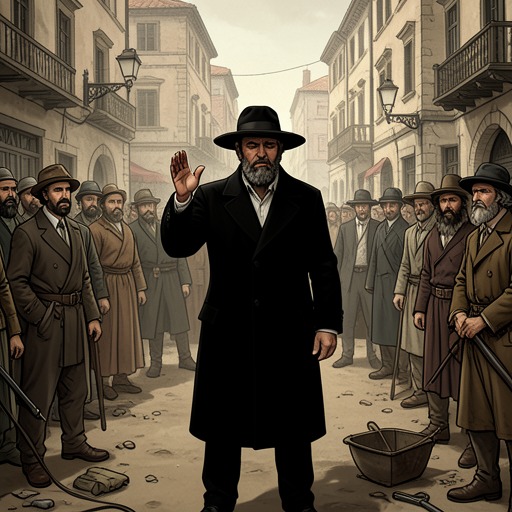
The scene turns on a dispute over what the future can mean. The Prophet presents himself as part of a light moving over darkness and the waters of the Undersea, insisting that the approaching people will arrive too late. His language makes his authority seem larger than any individual man: he asks his listeners to understand their allegiance as belonging to a destiny, not simply to himself. Kirsten’s response comes instead from Station Eleven, the comic whose language has accompanied her through the post-collapse world. She recalls its longing for sunlight, earth, and a world to which the lost might return. The exchange sets two versions of hope against each other: The Prophet’s claim that the old world is irretrievable, and the comic’s articulation of longing for home.
The boy’s attention shifts to the gun in his hands. As The Prophet declares that return is too late and adjusts his rifle, the boy shoots him. The reversal is immediate: the person who has been speaking with apparent certainty is killed by someone within his own group, and Kirsten survives the confrontation. The evidence does not explain the boy’s private motive, so the act remains a decisive choice without an accompanying account of what prompted it. Its consequence, however, is plain: The Prophet’s authority ends in the moment his follower turns the weapon against him.
The gunfire and the scouts’ arrival
The shot does not end the danger at once. Two other armed men remain, and August intervenes as the brief shock of The Prophet’s death gives way to further violence. One of August’s arrows brings down the man carrying a crossbow. The man with a shotgun fires into the trees, then finds his weapon empty; another arrow kills him. The sequence leaves Kirsten and the boy alone on the road. August’s intervention protects Kirsten from the remaining attackers, but it cannot undo what has happened between The Prophet and the boy.
The boy then turns the handgun on himself and dies by suicide. Kirsten tries to stop him, but cannot. The event therefore offers no uncomplicated release from The Prophet’s rule: his death is followed almost immediately by another death, this time the death of the person who made it possible. The distinction between action and aftermath is central to the scene. The boy’s shot breaks the immediate threat, yet the narrative gives no suggestion that his survival follows from that act.
Only afterward do the Travelling Symphony’s forward scouts round the road’s curve on horseback. Viola and Jackson arrive, and August calls to Kirsten. Their arrival confirms that help was approaching, but it comes after the decisive events rather than in time to prevent them. The delay gives the encounter its stark shape: Kirsten has been left among the dead, and the people who might have changed the outcome reach her only once the shooting is over.
What Kirsten leaves behind
After the encounter, Kirsten remains beside The Prophet. She closes his eyes and places a folded page from Station Eleven in his hand. The gesture links the confrontation back to the comic she had used to answer him: the page carries a different language of longing into the aftermath of the argument over light, darkness, and the possibility of going home. Kirsten does not explain the gesture, and the scene does not establish whether The Prophet recognized the text. Its meaning rests instead on the contrast between the beliefs he had imposed on others and the words Kirsten chose to leave with him.
The Prophet’s age sharpens that contrast. Kirsten understands that he was about her age and had once been a boy adrift on the road. She considers the possibility that he had been unfortunate enough to remember everything. This thought does not excuse what he became, but it places his death within a longer history of childhood exposed to the ruined world. The boy who kills him and the former boy he kills are joined by the road, even though the scene supplies no account of their earlier relationship.
A copy of the New Testament, held together with tape and crowded with annotations, is found among The Prophet’s belongings. The object suggests the material presence of the religious life he led, while Kirsten’s page from Station Eleven offers a different text at his death. As Kirsten, August, and Sayid resume their journey to the airport, The Prophet’s dog follows them at a distance. The killing thus closes his immediate hold over the road without making the world around it disappear: his possessions remain, the dog persists, and the survivors continue toward their destination.
Significance within the story
The scene resolves the immediate conflict between Kirsten and The Prophet through an unexpected act by a boy inside his own following, rather than through a direct victory by the Travelling Symphony. Kirsten’s words from the comic do not persuade The Prophet to abandon his beliefs; he rejects the possibility of return. Yet the exchange gives the killing a wider frame, because the conflict is about more than who holds a gun. It is also about which account of the ruined world can be believed: irreversible loss made into doctrine, or longing preserved in a story.
The Prophet’s death and the boy’s suicide leave that conflict unresolved as a political or spiritual question. What changes is that The Prophet can no longer dictate its terms. Kirsten’s final placement of the comic page makes art an act of remembrance rather than a means of saving either man. The approaching scouts carry the survivors onward, but the ending refuses to make rescue erase what has happened on the road.