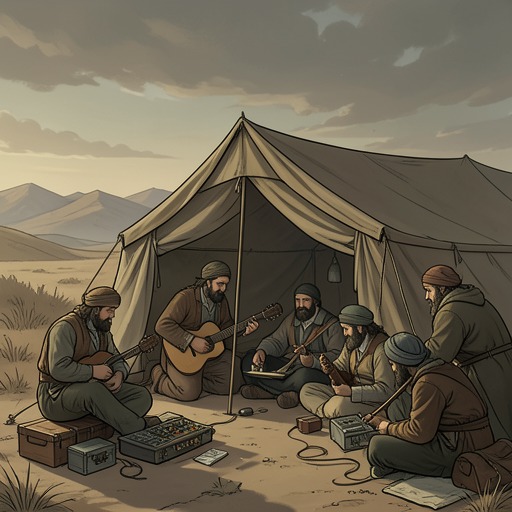
The Travelling Symphony chooses a southern route
Station ElevenThe Travelling Symphony’s choice to continue south turns a forced detour into a deliberate search. With two members missing and the direct routes back to familiar territory carrying serious dangers, The Conductor accepts the risks of an unfamiliar direction in hopes of finding both the missing travelers and useful guidance at a rumored settlement near Severn City.
Background and Constraints
The decision follows the Symphony’s flight from St. Deborah by the Water. By moonlight, The Conductor studies a map with several of the older members. The group is already moving awkwardly south along the eastern shore of Lake Michigan, and none of the straightforward ways back to its usual territory looks safe or simple.
One route would take the company back through St. Deborah by the Water, where it has just escaped danger. Another would bring it close to a town known for shooting outsiders on sight. The remaining option cuts inland through a wilderness that, before the Collapse, had been designated a national forest. A trader’s report, relayed by the tuba player, describes the area as burned out, without towns, and inhabited by violent ferals. The map offers possible lines of travel, but no reassuring route.
The Decision to Continue South
The discussion turns on what the Symphony knows about the country beyond its usual range. Gil recalls a rumored population south of the group, near Severn City, said to be living in the former airport. The Conductor has heard the same rumor. Her hesitation is unusual enough to be noted, and she studies the map before answering; the possibility of a settlement is still only hearsay, not a confirmed destination.
The rumor gives the southward journey a practical purpose. If people are living at Severn City Airport, they may know the best way for the Symphony to return to its familiar territory. The Conductor also has a more immediate reason to press on: two Symphony members are missing, and she believes they went south. Dieter calls the proposed course risky. The Conductor accepts that risk and folds the map, deciding that the group will continue south along the lakeshore.
Stakes and Consequences
The decision links the search for the missing members with the need to find a route home. Rather than retracing the path through St. Deborah by the Water or committing to the dangerous inland wilderness, the Symphony chooses an uncertain course that may bring it to people who can offer information. The settlement could help, but its existence and usefulness remain unverified at the moment of choice.
The journey also takes place in a world where movement has lost its former speed and reliability. Airplanes remain on runways and in hangars, but they are dormant; some serve as storage for food, gathering snow in winter or holding fruit near orchards in summer. The Symphony’s own caravans, once pickup trucks, have been stripped of their engines and fuel systems and adapted to be pulled by teams of horses. Its southward progress depends on maps, animal power, and judgments about danger rather than on the dependable network of powered transport that once connected distant places.
Significance
The choice makes uncertainty an explicit condition of survival. The Conductor cannot verify either the report about the wilderness or the rumor about Severn City, and the group cannot simply return to a safe, known route. Its decision is therefore neither a confident expedition nor a straightforward retreat: it is a calculated gamble shaped by the missing members and by the possibility that strangers may know the way home. The southward turn sets the Symphony on a course toward a settlement that could alter its understanding of what communities have survived beyond its customary territory.