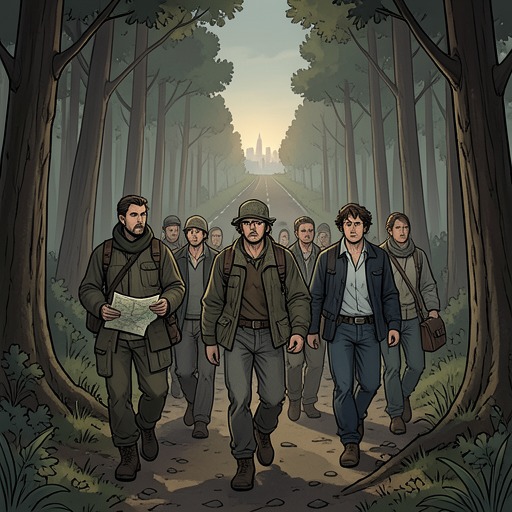
The Travelling Symphony is separated from Kirsten and August after a storm
Station ElevenThe route and the separation
The separation unfolds after the Travelling Symphony’s progress is slowed by fallen trees. The land has grown wilder and houses have become less frequent; the group has to stop three times to clear trees from the road with two-handed saws. While people keep watch in the surrounding forest, Kirsten and August walk ahead despite The Conductor’s objection. Half a mile beyond the halted caravans, they find a rolling plain and a golf course. The troupe’s movement depends on a road that can be blocked by fallen timber, and the search for a nearby source of food will take Kirsten and August out of sight of it.
The golf course recalls an earlier lucky find: August has been trying to repeat the discovery of scotch and edible olives in another clubhouse. This clubhouse offers no such refuge. It has burned, its roof partly collapsed, and the golf carts lie overturned. Rather than risk entering the damaged building, Kirsten and August find a small artificial pond behind it and return to the caravans for fishing equipment. The first and third cellos are still sawing through the last fallen tree. That ordinary work of clearing the road is the last direct indication of the Symphony’s presence before the pair leave to fish.
Fishing through the storm
The pond is crowded with small, brownish fish, so Kirsten can catch them with a net. Thunder and then rain arrive while she and August work. August protects the violin he carries by wrapping its case in plastic; Kirsten drags the net through the water while August cleans the catch. He takes on the task Kirsten finds difficult because something she witnessed during her first year on the road left her unable to stomach gutting fish. The narration does not make that memory clear to her or to the reader. In the storm, their work and their customary care for each other briefly occupy the foreground, although three people are already missing from the Symphony.
The storm also conceals the troupe’s movement. Kirsten and August are hidden from the road behind the clubhouse, and the rain prevents them from hearing the wagons pass. When the weather subsides, they have filled the net with fish. Carrying their catch back along the driveway, they reach the place where the fallen trees have been cut and pulled aside—and find that the Travelling Symphony has departed. Their separation is therefore discovered only after it has happened; neither sees the wagons leave nor receives an explanation for the timing.
An uncertain departure
August offers the most reasonable account available: the Symphony must have passed on the road while they were fishing. He and Kirsten had confirmed their route with The Conductor before returning to the pond, and the clubhouse blocked their view. The storm, meanwhile, would have swallowed the sound of the wagons. Their explanation fits what they know, but it does not resolve Kirsten’s unease. The troupe seems to have moved quickly, and she cannot understand why it would travel in a downpour unless an unexpected emergency had arisen.
The storm leaves no reliable trail. Rain has washed the road clear of tracks, while leaves and twigs lie in swirled patterns across the pavement. Kirsten and August have no hoofprints, footprints, or wheel marks to follow. A practical inference about the route becomes an unanswered question about the reason: the pair can imagine how the Symphony passed them, but they cannot tell what prompted its departure or whether the group knows they have been left behind. The event is defined as much by that absence of evidence as by the physical distance between the two travelers and the troupe.
The decision to pursue
The fish cannot be kept long in the heat, and Kirsten’s instinct is to follow the Symphony immediately. But it is safer to make a fire in daylight, and the pair have eaten only a little rabbit jerky that morning. They gather wood, though it is wet, and struggle to get a flame. They cook and eat as much fish as they can, then carry the rest in the net. The need to eat briefly competes with the urgency of finding the others; neither can simply abandon the food without considering the danger of traveling hungry.
They set off along the road, passing the golf course and houses ransacked years earlier, with ruined furniture scattered across their lawns. When the fish begin to spoil in the heat, they discard them and walk faster. Still, the road yields no sign of the Symphony. Near twilight, they reach an overpass and Kirsten climbs it for a better view. The road curves toward the distant lake and disappears behind trees; the highway above is blocked by a permanent traffic jam, with small trees growing between abandoned cars and a skeleton in the nearest vehicle. The vantage point offers no way to catch up or determine where the troupe has gone.
Kirsten and August sleep beneath a tree, sharing August’s plastic sheet. Kirsten wakes repeatedly to the emptiness around them. The separation has changed their immediate circumstances from traveling within a group to continuing as two people without the troupe’s company or a confirmed meeting plan. Their bond is evident in their shared work, their concern for each other, and their decision to keep moving together. The storm has not shown that the Symphony deliberately abandoned them; it has made the departure impossible to witness and the route forward impossible to verify. The pair are left to pursue the group through a landscape in which weather can erase the traces on which pursuit depends.